Heat leak estimation for a cryogenic dewar requires identifying all environmental heat loads. Previous posts discussed sizing of the inner vessel and selection of the insulation around it. This post focuses on additional heat transfer from solid conduction paths into the inner vessel.

Heat Leak Sources
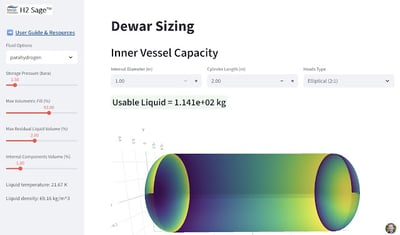
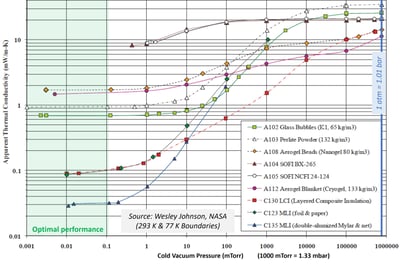
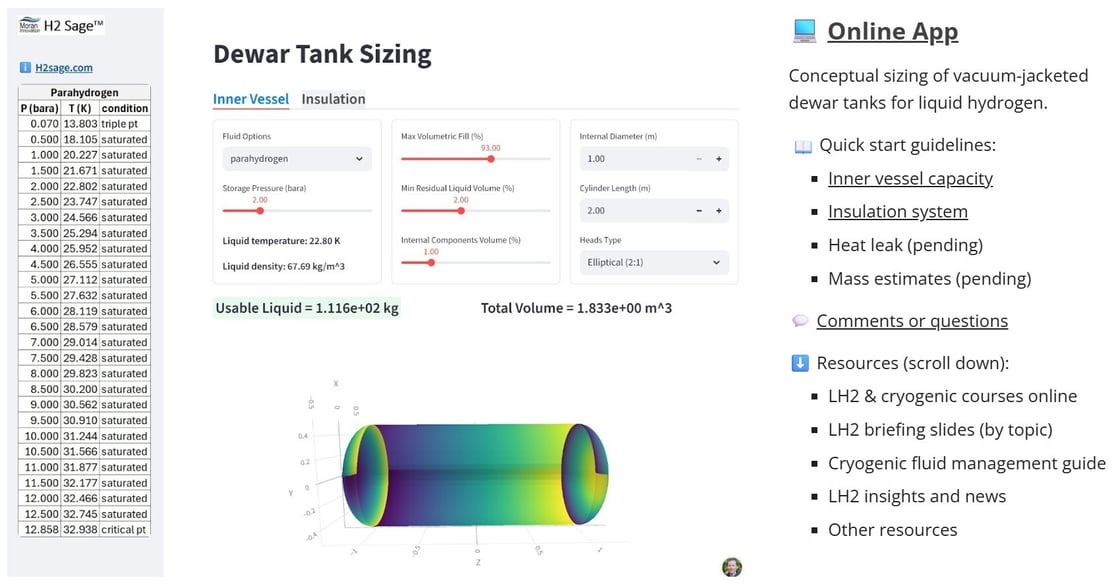
As shown above, the H2 Sage™ dewar sizing app automatically calculates heat leak through the insulation based on the conceptual design inputs entered in the insulation tab. This calculation uses the appropriate thermal shape factors for the inner vessel cylindrical section and heads as defined in the inner vessel tab.
However, there are other heat leak sources to consider which are design dependent. Any solid connection to, or penetration through, the inner vessel introduces conduction heat loads to the cryogen. These additional heat leak sources are often greater than the insulation heat leak for small to moderate size dewars, and must be considered even for the largest dewar tanks.
Common additional heat leak sources are provided in the dropdown menu and include:
- Access port (at least one generally located at the top of the dewar, often with a flanged interface and various feedthroughs, and also providing some or all of the structural support for the inner vessel)
- Support strut (usually several providing structural support to the inner vessel from the outer vessel wall)
- Support ring (often used in vacuum-jacketed piping but also in some smaller or lightweight dewars)
- End support (provides structural support at either end of the dewar along the axial midline)
- Fill/drain pipe (for adding or removing cryogen)
- Vent/press pipe (for tank venting and pressurization)
- Wire lead (wires for sensors, powered internals, etc.)
- Tube shape (any other solid conduction source with an inner and outer diameter)
Once the source is selected, the quantity of that source is entered along with several other inputs:
- Diameters: Internal and external diameters, where the internal diameter can be set to zero for solid rods or wires. Thin-walled schedule 10 pipe is common for cryogenic piping if the pressure range is within specifications. In the case of a support ring, the inner diameter is generally in contact with the inner vessel and the outer diameter is against the outer vessel wall.
- Axial length: For most of the sources, the axial length is between the cold and warm boundary temperatures (e.g., pipe length). For a support ring, the axial length is the ring thickness.
- Temperature boundaries: The warm and cold boundary temperatures define the conduction temperature differential. Depending on the heat source, the cold boundary may be at the cryogen temperature or higher (e.g., on the warmer upper vessel wall); and the warm boundary may be ambient temperature or lower (e.g., if a cold box is used).
- Material: Although optional, the solid material type of the source should be entered for documentation.
- Conductivity integral: This is the value of the material's thermal conductivity integrated over the warm and cold temperature range. It can be found using the link to NIST's online calculator, or estimated from the table provided further down the page by subtracting the K value at the cold temperature from the K value at the warm temperature for the appropriate material.
- Series resistance: A value can be added to account for contact resistance or other thermal resistances in series. This would be most common for representing various mounting assemblies for support struts, or the contact resistances at the edges of a support ring.
- Comments: Another optional input for adding additional information about the heat source.
When the add heat leak source button is clicked, the above inputs are used to calculate the heat leak contribution for the specified source.
Heat Leak Summary
The heat leak summary table includes the insulation and all other added heat leak sources by row. Their associated inputs and key calculated values are organized by column. Note that the only editable entry in the table is the comments column.
A heat leak source can be deleted from the table by checking the box in the first column of any row and choosing the delete icon in the small menu at the upper right of the table. This menu has other options including download of the table in csv format which can be opened in a spreadsheet.
Below the table is a summation of the total heat leak along with a bar chart showing the contribution of each heat leak source. A pie chart is also displayed indicating the percentage breakdown of each heat source. These visuals are helpful for identifying potential design improvements for lowering the overall heat leak.
Environmental heat loads from thermal radiation or convection heat transfer to the inner dewar are generally represented in the insulation heat leak value. Cases or conditions where additional non-conduction heat transfer is significant are not included in the dewar sizing app and would require a separate analysis. A potential example might be a dewar with a low fill level and very warm upper walls.
Dewar Thermal Performance
Normal evaporation rate of the dewar based on the conceptual design and identified heat leak sources is shown below the charts on a mass basis. This value represents the rate of vaporization for the selected cryogen in a saturated state at one atmosphere (1.013 bar) constant pressure (i.e., vented).
The normal vaporization rate as a percentage per day based on total inner vessel volume is also provided. It varies based on on a variety of design parameters, and is indirectly proportional to the dewar size.
For example, the 5000 cbm LH2 tank at NASA KSC has a reported NER of less than 0.05% per day, while much smaller mobile dewars can have an NER two orders of magnitude higher.
This figure of merit is often used (and misused) to characterize a dewar's thermal performance. It is not the boil-off loss per day of a non-venting tank under storage conditions. However, it does provide a metric for comparing the thermal performance of two or more dewar designs.
Other Bells & Whistles
Toward the bottom of heat leak page is selected reference material on conduction heat transfer, conductivity integrals, and shape factors. A timestamp is also displayed along with an optional text input field for any user notes. These notes are available across all tabs in the dewar sizing app until the session is ended or a new instance is created.
At the top left of the page is a sidebar that can be expanded or hidden and provides a saturation table of pressure versus temperature for the selected cryogen. At the top right of the page is a 3-dot menu with a variety of options and settings. The "About" selection contains links for more details on the app and updates, other H2 Sage™ resources, unit converters, and NIST cryogenic links.
Visit H2sage.com to access the online app and for more detailed information.
Author Bio
 Matt Moran is the Managing Member at Moran Innovation LLC, and previous Managing Partner at Isotherm Energy. He's been developing power and propulsion systems for more than 40 years; and first-of-a-kind gas, slush, and liquid hydrogen systems since the mid-1980s. Matt was also the Sector Manager for Energy & Materials in his final position at NASA where he worked for 31 years. He's been a cofounder in seven technology-based startups; and provided R&D, engineering, and innovation consulting to several hundred organizations. Matt has three patents and more than 50 publications including his online Cryogenic Fluid Management guide and Decarbonizing Mobility with Liquid Hydrogen SAE report. He has created and taught liquid hydrogen courses, webinars, and workshops to global audiences.