Translate

Showing posts with label software. Show all posts

Monday, January 16, 2023

Calculations for Introduction to Cryogenic Fluid Management


My previous post provided introductory video clips from the short course on cryogenic fluid management (CFM) I taught at NASA's Thermal and Fluid Analysis Workshop in September, 2022. The reference report used to present the course topics can be accessed on the Training page at www.moraninnovation.com.

The final section in the Introduction chapter contains example calculations to demonstrate how to use the tools and equations presented in the previous sections. As an additional resource, I've created a Jupyter notebook containing Python code with the key calculations and example exercises. It is available under a permissive open source license in my public GitHub repository at: https://github.com/moranmatthewe/CryoFM

I've attempted to include sufficient descriptive information and graphics to make the notebook useful as a standalone tool. The Python coding is intentionally straightforward to facilitate interpretation and make it easy to translate to other coding languages of interest to the user (e.g., VBA, C/C++, Matlab, Fortran, etc.).

If you have Python and JupyterLab on your computer, the Introduction notebook and CryoFM™ functions library can be downloaded and used locally (subject to the Apache 2.0 license). If you don't have these applications loaded but would like to try them out, I suggest using the Anaconda distribution to set up your computer with these and other useful programming tools.

Alternatively, if you prefer not to load these programs onto your local machine (or are prohibited by your IT department from doing so), an interactive web browser instance can be invoked using Binder that requires no downloads nor software installation. To try this method, simply look at the readme file on my GitHub repository and click on the "launch binder" icon (see screenshot below).


Matt Moran is the Managing Member at Moran Innovation LLC, and previous Managing Partner at Isotherm Energy. He's been developing power and propulsion systems for more than 40 years; and first-of-a-kind liquid, slush and gaseous hydrogen systems since the mid-1980s. Matt was also the Sector Manager for Energy & Materials in his last position at NASA where he worked for 31 years. He's been a cofounder in seven technology based start-ups; and provided R&D and engineering support to hundreds of organizations. Matt has three patents and more than 50 publications including the Cryogenic Fluid Management report series. More about him can be found here.

Sunday, October 2, 2022

Cryogenic Systems Modeling and Analysis


Cryogenic Fluid Management (CryoFM™) Interactive Calculations Notebook


Last month I participated in NASA's annual Thermal and Fluids Analysis Workshop (TFAWS) as a short course instructor, panelist, and presenter on the topic of cryogenic fluid management. This is a critical topic for launch vehicles and spacecraft. It is also becoming a very important consideration for the rapid growth in production, energy storage, ground transportation, shipping, and aviation applications of liquid hydrogen systems.


What is Cryogenic Fluid Management?

Cryogenic fluid management deals with the systems, technologies, and operations associated with the liquefaction, storage, and transfer of cryogenic liquid propellants. Hydrogen, oxygen, and methane are the most commonly used fluids for this purpose.

Appropriate modeling and analysis is vital for development of high performing cryogenic systems. There are three broad categories of software tools typically used for this purpose:
  1. Computational fluid dynamics (CFD): The highest fidelity option that also generally requires the highest level of resource commitment (i.e., computational, personnel, and licensing). CFD typically uses a very fine mesh of finite volumes to model the system. Setting up the model and the appropriate parameter adjustments requires experience with the particular CFD software being used and an understanding of how to best represent the actual system of interest.
  2. Multi-nodal models: A moderate fidelity and resource option that divides a cryogenic system into discrete lumped nodes. The number of nodes can be few or many, and is a key determinant of the model resolution. Similar to CFD, the modeler's experience with the software and ability to accurately represent the actual system is critical.
  3. System-level and first-order analysis: The lowest fidelity option with generally the lowest resource commitment. Reduced order system models and first order analyses can be used early in the development to narrow the trade space of feasible designs. Also useful as a check on the results obtained from higher fidelity tools.

System-Level and First-Order Analyses

Generally, the development of a new cryogenic system and assessment of key operations begins with system-level and first-order analyses. These activities can be performed faster and for lower resource expenditures compared to higher fidelity modeling. They enable assessment and modification of the early design and operational options.

Commercially available general purpose system simulation software options have limited cryogenic modeling capabilities. Conversely, while many cryogenic system specific software tools have been developed over the years, most are either proprietary or inconsistently maintained and documented. And validation of model results for all of the modeling options is an ongoing challenge for applying them to new cryogenic systems.

The short course I taught at the NASA TFAWS event was an attempt to address the documentation issue by presenting a publicly available report on passive cryogenic fluid management that can be accessed online by anyone at no cost. My subsequent technical presentation outlined the status and plans for a set of calculation software tools based on that report for quickly performing first-order analyses and building system-level models.

While both the training course and technical presentation were well received, several excellent questions from workshop participants have been on my mind:
  • How can all of the planned cryogenic fluid management tools best be developed and maintained?
  • What about users who don't have access to the tool platforms or aren't permitted by their organization to download them (e.g., Python)?
  • If other platforms are of interest to specific users (e.g. Matlab), who will modify the tools for those users?

The Open Source Option

One potential approach to addressing these questions is to make the new cryogenic fluid management software tools open source. This approach would ensure that they are accessible; and would encourage  community development, maintenance, and expansion to other platforms and new capabilities.

The screenshot shown at the top of this post represents a small first step in that direction. It uses the Jupyter platform to integrate markdown outline, text, images, and equations with interactive calculations in the Python programming language. A fully functional instance of the notebook can be invoked in a web browser without downloading anything.

By hosting these tools in a public GitHub repository, full access is granted to anyone interested in using or modifying the tools subject to the open source license. Improvements and extension to other platforms can be likewise shared among the user community. If you have any feedback on this approach, or are interested in being part of a future beta test group for the software tools, send me a message at info@moraninnovation.com.


Matt Moran is the Managing Member at Moran Innovation LLC, and previous Managing Partner at Isotherm Energy. He's been developing power and propulsion systems for more than 40 years; and first-of-a-kind liquid, slush and gaseous hydrogen systems since the mid-1980s. Matt was also the Sector Manager for Energy & Materials in his last position at NASA where he worked for 31 years. He's been a cofounder in seven technology based start-ups; and provided R&D and engineering support to hundreds of organizations. Matt has three patents and more than 50 publications including the Cryogenic Fluid Management report series. More about him can be found here.


Saturday, October 9, 2021

Hydrogen Systems Development: Past, Present and Future


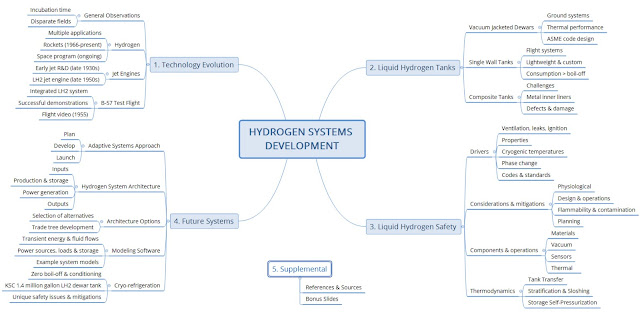
Technological evolution often requires decades of incubation and advancement in a variety of fields before large scale commercial adoption is achieved. Hydrogen has followed these trends since its discovery in the late 1700’s and subsequent application for wide ranging industrial uses. Liquid hydrogen (LH2) has been in routine and continuous use in the space program since the early 1960’s. However, many are not aware that its roots in aerospace trace much further back in aviation to the initial jet engine research and development in the late 1930’s; and later with successful flight demonstrations of a liquid hydrogen fueled jet engine in the mid-1950’s.

Modern LH2 systems make use of vacuum jacketed dewars for long term storage on the ground. Flight vehicles have used single wall tanks with foam insulation which significantly reduces mass but is only viable if the consumption rate in flight is greater than the boil-off venting required to meet tank pressure constraints. Composite LH2 tanks of various types (with or without metal inner liners) have been attempted over the years with mixed success and are still under development.

Safety with LH2 is a paramount priority. Key drivers are related to hydrogen’s properties, LH2 cryogenic temperatures, and liquid-vapor phase change within the system. Many legacy standards, codes and guidelines exist for LH2, and many more are in active formulation or revision. The three primary mantras to remember when designing and operating hydrogen systems is: 1) provide ventilation, 2) prevent leaks, and 3) eliminate ignition sources. Understanding the thermodynamic behavior of LH2 systems during various operations is also critical.

The development of future hydrogen systems can be optimized using an adaptive systems approach that treats hydrogen as a critical enabler in an overall system architecture rather than simply a commodity fuel. Selecting architecture options permit trade studies of candidate system concepts that can be assessed on the basis of technical, economic, environmental impact, and other key performance metrics. The end result is the ability to optimize systems for a multitude of hydrogen applications that can then be modeled, simulated, developed, assembled, and put into operation. Further, the proven ability to eliminate boil-off losses in LH2 systems - and provide better performing and sustainable propulsion and power relative to legacy fossil fuel systems - will play a key role in the global transition to hydrogen


Matt Moran is the Managing Member at Moran Innovation LLC, and previous Managing Partner at Isotherm Energy. He's been developing power and propulsion systems for more than 40 years; and first-of-a-kind liquid, slush and gaseous hydrogen systems since the mid-1980s. Matt was also the Sector Manager for Energy & Materials in his last position at NASA where he worked for 31 years. He's been a cofounder in seven technology based start-ups; and provided R&D and engineering support to many industrial, government and research organizations. Matt has three patents and more than 50 publications including the Cryogenic Fluid Management report series. More about him can be found here.

Tuesday, August 30, 2016

Hydrogen System Architecture and Software Demo

The variability of wind and solar energy sources presents a challenge for meeting electrical load requirements. Isotherm Energy has developed a system architecture for addressing this challenge that provides energy storage, potable water, and hydrogen fuel production. The architecture enables tailoring of system parameters to meet specific application requirements using current and emerging technologies.


Click here to view a demonstration of the software

Isotherm Energy is developing a suite of software tools to simulate, analyze and design systems based on our hydrogen storage system architecture. The software allows selection of various input energy sources, water sources, biomass and other inputs. Subsequent screens allow the selection of options for hydrogen production, storage, byproducts, power generation, heat recovery, power output, excess hydrogen, and water management.

Once the architecture options are selected, the software generates a system model that incorporates all the chosen parameters. The system model calculates all energy and mass flows between subsystems along with heat available for recovery and improved overall system performance. Note that all system flows are driven by the load following function of the power management and distribution (PMAD) subsystem and calculated accordingly.


The system model has an optional time stamp capability for the conditions being simulated. When the “Save Conditions” button is clicked, all of the parameters associated with the time stamped simulation are stored for subsequent transient analysis. In this manner, a sequence of simulated hours, days, weeks or a full year can be automatically generated and investigated. Every parameter of the system can then be adjusted using built-in optimization tools to meet the performance goals over any timeframe of interest.

The software also provides complete flexibility in the selection of system variables such as electrical load and energy inputs. These can be a constant number at a given timestamp, a historical profile, a statistical distribution over a time averaged period, a stochastic probabilistic algorithm (e.g. Monte Carlo), or some other user defined method.

New capabilities under development include:
  • Detailed subsystem and component models
  • Drop-in capability for existing and emerging technologies
  • Comparison to other storage options (e.g. batteries, compressed air, pumped hydro, etc.)
  • Capital/operating expenditures, payback period, levelized cost of energy and other financial


Matt Moran is the Managing Member at Moran Innovation, and previous Managing Partner at Isotherm Energy. He's been developing power and propulsion systems since 1982. Matt was also the Sector Manager for Energy & Materials in his last position at NASA where he worked for 31 years. He's been involved in seven technology based start-ups; and provided R&D and engineering support to many industrial, government and research organizations.  More about Matt here…

Friday, April 22, 2016

System Modeling Software for Isotherm's Hydrogen Energy Storage Architecture

Isotherm Energy is developing a suite of software tools to simulate, analyze and design systems based on its hydrogen energy storage architecture.  The software allows selection of various input energy sources, water sources, biomass and other inputs as shown in the screen shot below.


Subsequent screens allow the selection of options for hydrogen production, storage, byproducts, power generation, heat recovery, power output, excess hydrogen, and water management.  Once the architecture options are selected, the software generates a system model that incorporates all the chosen parameters.

Below is an example of one of these system models that incorporates wind, photovoltaics, saltwater, electrolytic hydrogen production, compressed gas storage, fuel cells, and potable water production.  Oxygen is also stored as a cryogenic liquid in this model permitting passive cooling of the compressed hydrogen for greater density storage and higher fuel cell efficiency.

The system model calculates all energy and mass flows between subsystems along with heat available for recovery and improved overall system performance.  Note that all system flows are driven by the load following function of the power management and distribution (PMAD) subsystem and calculated accordingly.


The above screenshot represents a daylight scenario where the combined wind and solar energy input is sufficient to meet the electrical load, so the excess energy is directed by the PMAD subsystem to the saltwater electrolyzer.  Hydrogen and oxygen are thereby produced to be stored for later use in the fuel cell when needed.  Commercially saleable chlorine and sodium hydroxide byproducts are also produced during the saltwater electrolysis process.

When solar energy is unavailable, the system must augment the wind power by consuming stored hydrogen along with ambient air (or oxygen in this case) in the fuel cell to meet the electrical load demand.  The screenshot below shows the system model in this night time scenario.  With appropriate material selection and design, potable water is produced when the fuel cell is operating (for drinking water, irrigation, humidity control, etc.).

The system model has an optional time stamp capability for the conditions being simulated.  When the “Save Conditions” button is clicked, all of the parameters associated with the time stamped simulation are stored for subsequent transient analysis.  In this manner, a sequence of simulated hours, days, weeks or a full year can be automatically generated and investigated.  Every parameter of the system can then be adjusted using built-in optimization tools to meet the performance goals over any timeframe of interest.

The software also provides complete flexibility in the selection of system variables such as electrical load and energy inputs.  These can be a constant number at a given timestamp, a statistical distribution over a time averaged period, a stochastic probabilistic algorithm (e.g. Monte Carlo), or some other user defined method.


New capabilities under development include: 

  • Detailed subsystem and component model
  • Drop-in capability for existing and emerging technologies
  • Comparison to other storage options (e.g. batteries, compressed air, pumped hydro, etc.)
  • Capital/operating expenditures, payback period, levelized cost of energy and other financials
  • Detailed design data, product selections, bill of materials, and more...

Isotherm Energy is developing this software to customize its hydrogen energy storage architecture for a wide range of applications in collaboration with its partners and clients.  Planned case studies will begin to explore grid connected and off-grid scenarios, particularly in markets where the benefits of the architecture uniquely address inherent key requirements and constraints (e.g. controlled environment agriculture).  Please contact us if your organization has interest in participating in these early stage studies.


Matt Moran is the Managing Member at Moran Innovation, and previous Managing Partner at Isotherm Energy. He's been developing power and propulsion systems since 1982. Matt was also the Sector Manager for Energy & Materials in his last position at NASA where he worked for 31 years. He's been involved in seven technology based start-ups; and provided R&D and engineering support to many industrial, government and research organizations.  More about Matt here…