Translate

Showing posts with label aviation. Show all posts

Wednesday, November 19, 2025

Hydrogen Workforce Needs

Photo credit: David Blekhman

Yesterday I gave an invited presentation on liquid hydrogen in aviation spotlighting some of the organizations and individuals at the forefront of hydrogen aircraft flight testing, engine development, and airport operations. This will also be the topic of a longer discussion and Q&A for the December 3rd Mission Hydrogen webinar.

The presentation slides along with supplemental content and hyperlinks to more details are available in the "Aviation" briefing at https://h2sage.com. Free registration for the Mission Hydrogen webinar is available here: https://mission-hydrogen.com.

Hydrogen Workforce Needs


The event held on November 18th at the Ohio Aerospace Institute (OAI) was a second in-person gathering supporting the DOE project on hydrogen workforce needs led by the University of Toledo (UToledo). Andrew Gyekenyesi of OAI and Mark Mason of UToledo kicked off the event setting the stage for the project context, progress, and key insights. Regional survey results were then presented by Kevin Cranick of Workforce Intelligence Network.


Some themes that continued to be built upon as the day progressed included:

  • Creating the right balance of workforce training and upskilling building on foundational community college and university curricula and supplementing with hydrogen specific knowledge depending on the needs of specific job roles.
  • Credentialing programs, short courses, trades upskilling, and other shorter training opportunities to provide key skills quickly and tailored to various industry sectors and applications.
  • The need to create a pipeline of education and awareness programs in secondary (high schools) and perhaps earlier, as well as activities that provide broader public awareness directly or indirectly to parents and other local community members.

Industry Perspectives


My aviation presentation was part of the industry portion of the event to provide examples of how hydrogen systems are being developed, deployed, and operated. Mark Haberbusch of NEOEx Systems described some of their new systems that liquefy hydrogen (electrolytically produced from microgrid renewables or from other sources), and refuel long range drones with liquid hydrogen.

David Perzynski followed with a portfolio of initiatives under development at Honda for hydrogen vehicles, engines, and other applications. Nick Vargo of Babcock & Wilcox finished up the industry portion with a description of their chemical looping technology for producing low-carbon hydrogen from various hydrocarbon feedstocks using engineered FeO particles.

Education and Training Perspectives


The afternoon session started with a presentation by Pat Hufnagel-Smith of Creative Links summarizing some findings from her work on building a resilient energy workforce amid uncertainty. Later presenters confirmed that her publication on this topic is the best available and a gold standard.

Anil Bika of the University of Delaware presented information on some of the hydrogen initiatives, electrochemical engineering program, high school programs, and key industry collaborations at the Center for Clean Hydrogen. The importance of building an ecosystem of diverse stakeholders was evident.

David Blekhman of California State University, LA followed with highlights of the impressive array of projects, sustainable energy curricula, fueling stations, hands-on internships, and industry collaborations he has developed over many years as Technical Director of the Hydrogen Research and Fueling Facility.

Tiffany Howard of South Louisiana Community College provided a thought provoking final presentation on community college strategies and tactics during times of economic stagnation drawing on her experiences in a variety of roles and insights from previous technology trends in driverless trucking and broadband communications.

Panel Discussions and Networking

Sujata Shetty of UToledo led a panel discussion amongst the afternoon presenters that included audience thoughts and insights. Although it covered a great deal of themes, a few takeaways from memory:
  • Supplemental and complementary training and curricula related to hydrogen that can build upon foundational certifications and degrees may be the best approach (i.e., rather than specific "hydrogen" degrees)
  • Uncertainty in public policy, economic, and other factors requires developing adaptable and robust training and upskilling options
  • Attracting, training, and retaining an emerging and skilled hydrogen workforce requires addressing multiple worker needs including aspirations for meaningful work, career stability, personal growth, and quality of life.

In addition to the scheduled talks and presenters, I enjoyed catching up with existing colleagues along with some new and inspiring contacts across the economic development, industry associations, and other key actors in the hydrogen and sustainable energy ecosystem. 

Bill Whittenberger and Linda Buckosh of the Ohio Fuel Cell and Hydrogen Consortium continue to advocate for hydrogen-related businesses to various stakeholders within the state and well beyond. Keri Zipay of TeamNEO and Jing Lyon (past interim CEO at Brite Energy) are economic development champions who help make critical connections and assist new businesses in the region.

An unexpected bonus was meeting Veronica Vaca of Cobra Industrial Activities who is focused on geologic hydrogen (both naturally occurring and stimulated by selected fluid injection). This is a topic that is rapidly gaining interest from investors and industry, and has the potential to significantly lower hydrogen supply costs for various use cases.

Author Bio

Matt Moran is the Managing Member at Moran Innovation LLC, and previous Managing Partner at Isotherm Energy. He's been developing power and propulsion systems for more than 40 years; and first-of-a-kind gas, slush, and liquid hydrogen systems since the mid-1980s. Matt was also the Sector Manager for Energy & Materials in his final position at NASA where he worked for 31 years. He's been a cofounder in seven technology-based startups; and provided R&D, engineering, and innovation consulting to several hundred organizations. Matt has three patents and more than 50 publications including his online Cryogenic Fluid Management guide and Decarbonizing Mobility with Liquid Hydrogen SAE report. He has created and taught liquid hydrogen courses, webinars, and workshops to global audiences.

Tuesday, July 1, 2025

Hydrogen in Aviation (Myth Busting, Episode 5)

Hydrogen aircraft concept (Airbus); engine testing (Rolls-Royce); and flight tests (multiple)


There is a small cadre of very vocal hydrogen critics with an outsized presence on social media, and media coverage in general. I've written about some of the most common archetypes in a previous hydrogen myth busting post [1]. Yet in a Google Scholar search on "hydrogen aviation", these self-proclaimed experts are nowhere to be found in the ranking of published sources on the topic [2].

Unfortunately, peer-reviewed articles are also not a guarantee of unbiased accurate information as addressed in my recent LinkedIn post on the topic [3]. A contemporary example is an article co-authored by techno-economic and energy analysis experts, but without any apparent input from experts with relevant hydrogen systems experience [4]. As a result, it contains some errors, omissions, and assumptions untethered to real world data.*

In the real world, the increased use of hydrogen in new aircraft development and demonstrations requires a paradigm shift in conventional aviation systems engineering and integration. Unlike sustainable aviation fuel (SAF) options, hydrogen is not a drop-in replacement for legacy aircraft. However, hydrogen is an important long-term solution in terms of performance, environmental impact, many safety aspects, and full lifecycle cost.

This leads to a few key questions. Why is hydrogen being used for aviation? What are the fundamental design drivers for successful implementation? How can lessons already learned from the aerospace sector be incorporated? This blog post is a short introduction to these topics in the hopes of dispelling some of the persistent misinformation that continues to be posted and published on the subject.


Options for Decarbonizing Aviation


The table below summarizes key characteristics of the primary atmospheric greenhouse gases (GHGs), with carbon dioxide (CO2) being the most prevalent in terms of concentration and with an atmospheric lifetime of thousands of years. The global warming potential of these GHGs in the last column has been normalized to CO2. Each of these characteristics are important to keep in mind when assessing the impact of any systems or processes that use or emit one of these GHGs.**


Aviation accounts for roughly 2.5% of all global CO2 emissions and 4% of the global warming to date [5], with CO2 emissions expected to double in 25 to 30 years based on current legacy technologies and predicted growth in air travel according to the FAA.^ These may seem like small percentages in the big picture, but aviation is a difficult industry to decarbonize directly with renewables-based electrification along with other large transportation and maritime applications. There are a few methods for potentially reducing GHGs that are applicable to aviation: SAF, batteries, hydrogen, methane, and nuclear.

SAFs provide a near-term solution for reducing CO2 emissions in existing aircraft as a drop-in fuel. However, the impact on overall CO2 emissions depends on the degree of uptake and these emissions continue to grow over time for most scenarios.^ So, SAFs can help blunt the environmental effects of legacy fuels, but they can't fully decarbonize aviation. In addition, SAFs have some challenges at scale related to sustainable feedstocks, supply chains, and infrastructure build out. Incidentally, some of the most promising formulations use hydrogen as a feedstock.

Batteries are feasible for some electric aviation applications where the impacts to range, payload, and operations due to their low specific energy relative to chemical fuels and their charging requirements are acceptable. Most of these applications are short haul small aircraft flying at low to moderate altitudes using electric motor driven propellers or fans. A fundamental drawback is that batteries weigh the same whether fully charged or fully discharged, so there is no reduction in aircraft mass in flight (or propulsion requirements) common with chemical fuels. And landing is one of the highest energy consumption flight phases, resulting in a hot discharged battery that must be conditioned and recharged before the next flight. This impacts operational turn around time and infrastructure requirements. 

Hybrid electric aircraft concepts can potentially extend the suitable aviation applications using various fuels (including hydrogen) integrated with batteries. Depending on the fuel choice, there are tradeoffs related to technology development required, degree of decarbonization, and other parameters. Advanced hybrid electric propulsion systems are under development by NASA and other organizations that may be promising to commercialize as they reach sufficiently mature technology readiness levels.

Methane, which is the primary constituent of natural gas, and liquefied natural gas (LNG) have been considered and tested for aircraft. But neither are drop-in fuels. In the case of LNG, cryogenic systems similar to liquid hydrogen (LH2) must be developed, albeit at a somewhat higher operating temperature as shown below. Similar to SAF, combustion of methane still produces CO2 emissions, although at a lower rate than legacy fuels. More concerning is un-combusted methane that has 25 times the 100-year global warming potential of CO2. So any leaks, venting, dumping, or other releases of methane anywhere in its journey from extraction or production to consumption represents a powerful GHG gas being added to the atmosphere.


Nuclear aircraft were investigated by NACA and during the early days of NASA. And demonstrations of nuclear powered drones have been reported in recent years by multiple sources. In theory, the performance of these aircraft greatly exceeds any chemically fueled or battery powered vehicle. In practice, use in a non-military application would run afoul of national security, regulatory, and public safety concerns. This is also the reason why nuclear powered naval ships and submarines have been successfully operating since the 1950s, but there is only one currently operating nuclear powered merchant ship.

That leaves hydrogen as the final practical option, which can be used for an unlimited range of aircraft types and flight requirements. A multitude of hydrogen propulsion systems testing and flight tests have been successfully performed by combusting it in jet engines or feeding it to fuels cells for electric motor driven propulsion. Hydrogen is suitable for fixed wing or vertical-take-off-and-landing (VTOL) aircraft of any size currently used, at any currently feasible altitude and range, and with no carbon emissions during operation.


Hydrogen Use in Aerospace


There are two primary reasons to use hydrogen for any aerospace application: superior performance and decarbonization.

Performance is the reason liquid hydrogen has been used for various launch vehicles and rocket stages continuously at large scale and full lifecycle for six decades. Historic examples include: Apollo's Saturn rocket upper stages, Centaur upper stage, and the Space Shuttle. Currently operational examples include: NASA's SLS (see design below); upper stages of the Atlas V, Delta IV, ULA Vulcan, and New Glenn; EU's Ariane 5 and 6; Japan's H-IIA; variants of China's Long March rockets; and India's LVM-3 upper stage.


The specific energy (energy per unit mass) of hydrogen is three times greater than legacy fuels, and along with other energetic properties and characteristics enables its superior performance. This is offset by the low volumetric energy density which requires larger storage volumes compared to legacy fuels. However, fuel cell applications significantly reduce this requirement with more than double the efficiency of conventional combustion engines. Below is a plot illustrating some of these hydrogen properties.


For aircraft, decarbonization is the primary reason for using hydrogen, although performance gains are possible as designs evolve to optimize its usage. The first LH2 aircraft flight testing was done in the 1950s by NACA/NASA, and a dozen more hydrogen powered aircraft have flown as of 2024.

Fuel cell power and propulsion systems only emit water vapor during operation and are currently limited to altitudes where propellers can be used. However, internal combustion engines (ICE) can cover the entire aircraft size range (small piston to jet engines) and can operate at any altitude currently feasible with legacy aircraft. In fact, hydrogen ramjets and scramjets can operate well above legacy aircraft altitudes.

It's important to note that all combustion engines produce nitrous oxides (NOx) due to the disassociation of air at high temperatures. However, the wide oxygen-fuel (O/F) ratio possible with hydrogen permits very lean mixtures that can decrease NOx much more than legacy fuels or SAF.

There is much too be learned in implementing hydrogen aviation from the aerospace-adjacent space industry. Systems, integration, infrastructure, safety, components, supporting technologies, supply chains, and a host of other challenges have long ago been solved in the space industry. Adapting all of it to new industry sectors requires good systems engineering, sound business models, capital investments, infrastructure build out, scaling for cost reductions, and supportive policy and regulatory environments. All the enabling technology is already available.

When all lifecycle costs are included, hydrogen is an economically competitive investment in our future. As it scales, further cost reductions will occur as they do with any new technology shift. This has occurred with solar and wind renewables, just as it did with the shift to natural gas, and the shift from coal to oil before that, and the shift from wood to coal before that. It is the natural economic evolution of new energy paradigms [6].

Valid comparisons to legacy fuels must include their costs associated with: exploration of underground sources (including "dry well" and other abandoned costs); extraction; storage; delivery to refinery; refining; distribution; fueling depots and stations; legacy subsidies; and casualty losses and public health impacts from exposure to toxic fuels, fumes, smoke/soot, polluted air and water, accidents, and all the aggregated effects of GHG emissions. Along with the outlays over the past 100+ years (private and public) associated with putting all the existing infrastructure in place for fossil fuels.


Hydrogen Systems Considerations


For aviation and most other industry sectors transitioning to hydrogen, there are a few key initial design drivers to consider, particularly for LH2: volumetric density, systems integration, cryogenic engineering, operations, and safety.

The comparatively low volumetric density of hydrogen is resolved in the systems engineering and integration of the aircraft. For legacy aircraft, innovative designs and packaging of hydrogen tanks is required. This can result in less volume available for payloads or passengers, longer and/or wider fuselages, storage outside of the fuselage, or other methods to accommodate the volume required.

Larger tanks that can result in increased drag for legacy aircraft designs are a relevant consideration, although many aircraft have successfully flown with enormous outer mold line volumes in order to achieve overall vehicle and mission performance criteria [7]. New VTOL and fixed wing aircraft designs optimized around hydrogen can actually improve aerodynamic performance. Lifting bodies and flying wing configurations are examples where the volume requirements become much more easily integrated within the fuselage [8].

Therefore, the combination of higher specific energy but lower volumetric density of hydrogen relative to legacy fuels are primary parameters to optimize in aircraft design. Lower fuel mass requires less lift which can be traded against greater payload and/or longer range. Larger fuel storage volumes require holistic integration within the aircraft to minimize the impact on drag and maximize aircraft performance and capabilities.

Systems engineering and integration combined with cryogenic engineering best practices also plays an important role. A portion of the energy expended to liquefy hydrogen can be recovered for better overall system efficiency [9]. Examples include: pressure building systems for zero-power pressurization; heat rejection from other subsystems; thermal protection of structures exposed to high temperatures; cooling of superconducting components; Joule-Thomson cooling; vapor-cooled shields for reducing heat loads; para-to-ortho conversion cooling; and other methods.


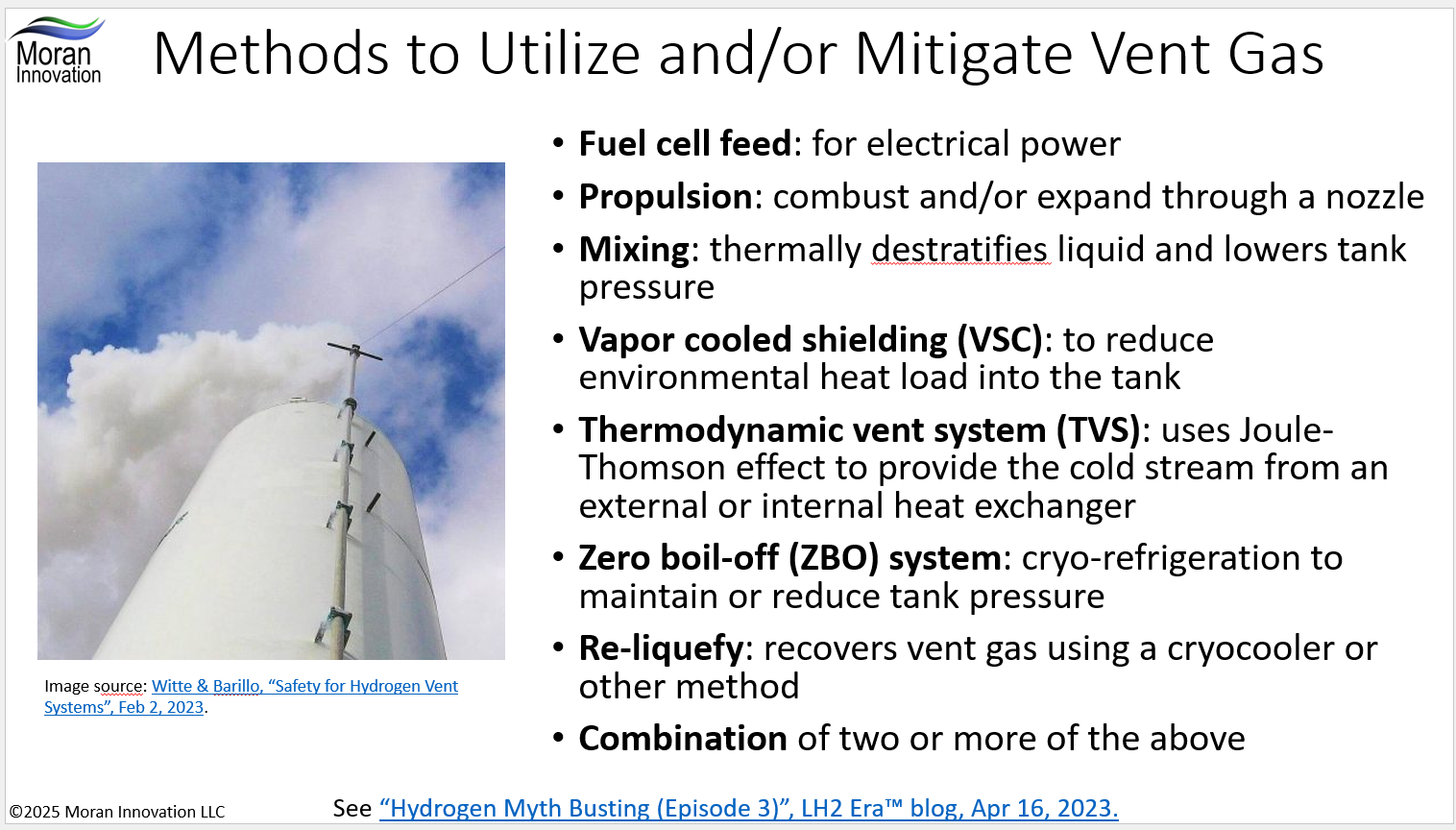
Existing mature cryogenic engineering technologies also enable any LH2 storage and deliver system to have zero boil-off losses. Every LH2 storage system has a characteristic natural boil-off rate profile depending on the size, environment, operations, fill level, and other variables.^^ In all cases, boil-off gas losses can be driven to zero with a combination passive, hybrid, active, and operational techniques. Claims of unavoidable boil-off losses with LH2 systems are false. All boil-off losses are avoidable with proper system design [10].


Changes to aircraft operations, and required airport infrastructure, are also valid considerations [11]. Below is a notional example of how onboard LH2 storage is affected by the acceleration and thermal environments during key aircraft operations. In addition to onboard systems that properly manage LH2, ground support systems must also be in place to support fueling and other associated activities [12]. Various organizations and standards working groups are actively addressing these aspects in preparation for the decades of development required to fully build out the infrastructure [13].


Safety is a paramount consideration with any fuel or energetic system, and hydrogen is no exception. Many codes, standards, training, and certifications are already in place; and many more are under development to address specific use cases and industries. Below is a comparison of key safety relevant properties for hydrogen and natural gas (methane). A few implications that may not be obvious on initial inspection:
  • A given volume of methane has more stored energy for detonation than hydrogen under identical conditions; and its lower bound detonation limit in air is less than one-third that of hydrogen
  • While both gases are lighter than air at ambient temperatures, hydrogen rises much faster (20 m/s or 45 mph) and diffuses much more rapidly in air
  • The lower flammability limit in air (which any safe system is designed to stay well below) and the autoignition temperatures for the gases are not much different
  • However, hydrogen has a much lower ignition energy, much higher upper flammability limit in air, and much higher flame speed

So which fuel is safer? It depends on the situation.# The same can be said for comparing legacy aviation fuels with hydrogen, because each fuel behaves very differently. In a mid-air collision or an emergency landing where the fuel storage is breached, hydrogen (in liquid or gas phase) would be vaporized, gone/diffused, ignited upward, or some combination thereof. And with none of the toxic fumes, smoke/soot, persistent burning pools of spreading liquid, or extended exposure to high temperatures that jet fuel produces.

On the other hand, an undetected fuel leak and potential ignition event is a generally lower risk for jet fuel than it is for hydrogen. However, hydrogen is nontoxic and can be safely breathed as long as its concentration is below asphyxiation levels. Definitely not the case for any legacy aviation fuels. Bottom line: every potential hazard and operational situation requires careful consideration while keeping in mind the unique properties and behaviors of the specific fuel in question.


The Path Forward


Every new energy paradigm shift in history (and every other major technological disruption) has occurred due to market adoption within a supportive policy environment by innovating individuals and teams developing systems and products in the real world. Not on social media. Not in general media opinion pieces or news coverage. And not in peer reviewed articles that ignore information that doesn't fit the predetermined narrative of the authors.

If we had relied on the talkers during previous energy paradigm shifts, we would still be huddled around wood and brush fires. Afterall, a technoeconomic analysis before the industrial revolution could have easily showed that the complexities and costs of extracting fossil fuels and transitioning to their use made no sense compared to burning cheap available wood. And if we rely on today's talkers and delay addressing the existential threats of rising GHGs, public health impacts, and pollution, we will end up dealing with much larger fires and many more calamities at a scale unprecedented in human history.


Footnotes


* For example: ignoring flight demonstrations and testing, alternative aircraft concepts, hydrogen systems state-of-the-art, cryogenic systems integration, propulsion dynamics, regulatory and certification pathways, infrastructure assessments, energy density trades, thermal management, cost projections, etc.

** Note: the so-called 'indirect greenhouse gas' effect of hydrogen is an unproven hypothesis based on unverified assumptions and no atmospheric data at scale. And initial studies into the contrails produced by hydrogen aircraft indicate they dissipate quicker than legacy aviation fuel contrails.

^ The website that documented this information appears to have been taken down by the current administration (https://www.faa.gov/sustainability).

^^ There is no standard value or accurate rule of thumb for estimating natural LH2 boil-off rates despite many sources that attempt to claim otherwise (which is a clear sign of someone lacking experience in this domain).

# Paradoxically, the most infamous historical hydrogen incident would have been much worse with any other fuel under similar conditions: store the fuel in an enormous fabric container with a highly flammable coating; suspend 97 people from it 200 feet (60 m) above the ground; have more people underneath it; allow a lightning strike to ignite the flammable coating; record it with a 1930s era black & white motion camera (that won't record hydrogen flames in daylight, and all the hydrogen is out of the frame within 2 seconds anyway). In the case of hydrogen, it did not detonate nor apparently even ignite any significant amount since there were no water droplets. And 62 of the 97 people onboard survived, with one casualty on the ground. What would be the outcome of repeating that scenario with any other fuel? Or with batteries?

References


[1] "Myth Busting (Episode 4): Hydrogen Haters", LH2era.com, Oct 26, 2023.
[2] "Hydrogen Aviation" Google Scholar search.
[3] Misinformation Hydrogen Zombies, LinkedIn post, Jun 27, 2025.
[4] "Realistic roles for hydrogen in the future energy transition", Johnson, et al., Nat. Rev. Clean Technol. 1, 351–371 (2025).
[6]  "Why All Hydrogen Cost Projections Are Wrong", LH2era.com, Aug 5, 2023.
[7] "List of large aircraft", Wikipedia
[8] "Lifting body", Wikipedia
[9] "Why Liquefy Hydrogen?", LH2era.com, Jun 4, 2025.
[10] "Hydrogen Myth Busting (Episode 3)", LH2era.com, Apr 16, 2023.
[11] "Decarbonizing Mobility with Liquid Hydrogen", SAE Research Report, 2024.
[12] "H2-powered aviation – Optimized aircraft and green LH2 supply in air transport networks", Hoelzen, et al., Applied Energy, Vol. 380, 2025.
[13] "Hydrogen Fueling Stations for Airports, in Both Gaseous and Liquid Form", SAE International, issued Nov 11, 2024.

All graphics are from: Liquid Hydrogen Systems Course, Moran Innovation LLC, 2025.

Author Bio

Matt Moran is the Managing Member at Moran Innovation LLC, and previous Managing Partner at Isotherm Energy. He's been developing power and propulsion systems for more than 40 years; and first-of-a-kind gas, slush, and liquid hydrogen systems since the mid-1980s. Matt was also the Sector Manager for Energy & Materials in his final position at NASA where he worked for 31 years. He's been a cofounder in seven technology-based startups; and provided R&D, engineering, and innovation consulting to several hundred organizations. Matt has three patents and more than 50 publications including his online Cryogenic Fluid Management guide and Decarbonizing Mobility with Liquid Hydrogen SAE report. He has created and taught liquid hydrogen courses, webinars, and workshops to global audiences.


Thursday, March 30, 2023

OSU Sustainable Aviation Forum Highlights

OSU Sustainable Aviation Forum participants. I'm in the back row, far right, light plaid shirt. (image credit: The Ohio State University)

I was invited again this year to participate in the Sustainable Aviation Forum hosted by The Ohio State University (OSU) at their airport location on March 28, 2023. Although it's a six hour roundtrip drive from my home office, it was well worth the investment in time (and electricity to recharge my car :) Great venue, speakers, topics, and colleagues!

Hydrogen in the Mix


Let me start by expressing my appreciation to Josh Knights at OSU for inviting me again this year. Also, gratitude to my fellow NASA alumni Joe Shaw who initially got me tied into this activity. Last year I was the outlier participant bringing up hydrogen during the panel sessions and breakout working groups, so I'm glad they didn't scratch me off the list for this year...

On the topic of hydrogen, what a difference just one year makes! Many of the presentations explicitly addressed hydrogen this time around, whereas none did last year. And the General Manager of Advanced Technology at GE Aerospace, Arjan Hegeman, gave a fantastic keynote presentation that included their development program in collaboration with Airbus for a hydrogen jet engine.

A student group from OSU also presented an impressively comprehensive project they tackled on sustainable aviation that included a look at hydrogen. And one of the event hosts who I met at last year's event, PhD candidate David Mapunda, did an excellent job keeping us on track topically and temporally throughout the forum.

SAFs and Batteries


The other two options for decarbonizing aviation were also well represented this year: sustainable aviation fuels (SAF) and batteries. The Technical Director of the Flight Sciences Dept at Honda Aircraft, Kui Ou, and GE Aerospace's Arjan Hegeman both described active development programs around SAFs.

And the Chief Engineer at Textron eAviation, JD Terry, talked about their new design incorporating batteries integrated into the wings of an aircraft. This panel session was expertly facilitated by my OSU colleague, Professor Matilde D'Arpino, who is doing cutting edge research in several electric aviation and power systems areas with her team.

Strategy and Workforce


The joint venture between GE and Honda was also featured with the President of newly formed GE Honda Aero Engines, Mel Solomon, giving an overview of their goals and efforts. Discussions on regional aviation strategy were provided by state of Ohio representative Adam Holmes; Ohio economic development speakers Elaine Bryant (JobsOhio) and Rich Granger (FlyOhio); and OSU Professor Amber Woodburn McNair. And the wrap up talk was from Joe Zeis of the Ohio Governor's office.

A great panel discussion on aviation workforce challenges was well represented by OSU at Lima Dean Tim Rehner, Boeing Director of R&T Mark Cleary, Deborah Scherer of One Columbus, and Eboni Wimbush of the Airport Minority Advisory Council. Attracting and retaining the needed skillsets continues to be a critically important issue as the global aviation community transitions away from legacy fuels. This topic also dovetailed nicely into earlier opening remarks by OSU's Dorota Grejner-Brzezinska.

Infrastructure 


Another interesting theme throughout the forum was infrastructure. Rex Alexander of Five-Alpha provided very insightful perspectives on what it takes to create or convert a vertical takeoff and landing (VTOL) site to accommodate electric aircraft. 
Just a couple of interesting takeaways from his remarks were the long runs of heavy gauge copper wire often required, and the fact that it isn't very green if recharging is done with electricity from a coal power plant.

This infrastructure topic resonated with me since one of my current projects is supporting a customer developing in-situ liquid hydrogen infrastructure capability for the Air Force and Army. Hydrogen generated onsite by electrolyzers splitting water using a renewable energy microgrid. Then liquefied and loaded onto queued aircraft autonomously.

Refuel and fly in minutes rather than the hours it takes to recharge batteries. Twenty times the range and flight time of an equivalent battery powered aircraft. And no long copper runs or coal (or any other fossil fuels) required.


Carbon as a Proxy for "Green"


An additional topic that I brought up during the forum is related to greenhouse gas (GHG) emissions. We commonly use "net-zero" carbon as a proxy for addressing the existential threat of increasing GHG effects. However, the lifecycle environmental impacts of any fuel or battery is vitally important to keep in mind.

For example, I've been helping to develop a liquid methane propulsion system for one of my customers over the past few years. It's the only project remaining in my company's portfolio that isn't focused on liquid hydrogen. And my willingness to continue supporting it is waning. Here's why...

Methane (and by extension, natural gas) is a 25 times more potent GHG emission than carbon dioxide. So any leaks or other releases of methane are huge contributors to the problem. And recent satellite data has revealed how shockingly widespread and grossly underreported methane and natural gas leaks are globally.

So even if we use so called "green" methane by combining hydrogen with carbon dioxide pulled from the air (e.g., Sabatier process), it does nothing to address the impacts of methane releases throughout the delivery and distribution pathway before it's combusted. This is a case where "zero net carbon" is a totally inadequate proxy for GHG emissions and related environmental impacts.

By the way, batteries have their own significant lifecycle environmental impacts that we are already witnessing with the current supply chain scaling. Lithium mining, strategic materials sourcing, recycling,... and we are still very early in the technology adoption curve.

But my question to one of the forum panels was about SAFs, and if they suffer from drawbacks regarding GHG impacts similar to methane and natural gas. The answer I got was very candid: yes and no, depending on the feedstocks used. Biofuels apparently aren't so bad; other SAFs are another issue.

The follow up question from an OSU alumni from Brazil was even more eye opening. He described the alarming regional impact in South America already with the scaling of bio-based feedstocks to support SAF processing. The answer to his question was also very candid: we are just scratching the surface on that issue.

The Solution


I'll end this post where those of you who follow my blog know it always leads to: hydrogen. I am unabashedly biased in this regard because hydrogen completely and fully solves all the environmental impact issues when it is generated from renewable energy sources: GHGs, supply chains, scarce resources, recycling, etc. It also produces copious amounts of potable water as a "byproduct" that could be a game changer in many global regions.

While I'm an open minded advocate of any solutions that potentially get us heading in the right direction, the ultimate answer to many applications and industry sectors is clear. The sooner we make the transition away from fossil fuels and toward hydrogen, the greater our chances of pulling up on the environmental damage control stick before we hit the ground in the flight vehicle we call earth.


Matt Moran is the Managing Member at Moran Innovation LLC, and previous Managing Partner at Isotherm Energy. He's been developing power and propulsion systems for more than 40 years; and break-through liquid, slush, and gaseous hydrogen systems since the mid-1980s. Matt was also the Sector Manager for Energy & Materials in his last position at NASA where he worked for 31 years. He's been a co-founder in seven technology startups; and provided R&D and engineering support to many organizations. Matt has three patents and more than 50 publications including the Cryogenic Fluid Management series. He also leads the monthly LH2 Era™ Webinar.

Sunday, June 5, 2022

The Evolution of Hydrogen Systems: 1930 - 1960


Technological evolution often requires decades of incubation and advancement before large scale commercial adoption is achieved. First discovered as a discrete substance by Henry Cavendish in the late 1700s, hydrogen has followed a circuitous path of discovery and application in a variety of fields.

Its primary large scale commercial use was in the petroleum and chemical industry where it's still a critical element of fossil fuel upgrading processes. Various other industrial processes - including applications as wide ranging as food preparation and semiconductors - use hydrogen.

Although it's been demonstrated in nearly every type of internal combustion engine as a replacement for fossil fuels, it's primary use for power and propulsion (until recently) has been in the aerospace industry.

Liquid Hydrogen


Liquid hydrogen (LH2) has been in routine and continuous use in the space program since the early 1960’s. However, many are not aware that its roots in aerospace trace much further back in aviation to the initial jet engine research and development in the late 1930’s; and later with successful flight demonstrations of a liquid hydrogen fueled jet engine in the mid-1950’s [1].

Initial jet engine testing done by the German's in 1937 used hydrogen in part due to its ease of ignition and high flame speed. First used on a 250 pound thrust (lbf) jet engine operating at 10,000 rpm (and later on a 989 lbf jet engine), hydrogen proved to be an ideal fuel for this new propulsion technology.

About twenty years later, Pratt & Whitney Aircraft developed a jet engine with an afterburner that operated on liquid hydrogen. The project was started in 1956 and resulted in a 4700 lbf jet engine intended for a supersonic reconnaissance aircraft under development by Lockheed. The engine was a success, but the aircraft concept was cancelled in favor of the Blackbird SR-7 development.

Aircraft Flight Testing with LH2


Liquid hydrogen was eventually tested successfully in a series of B-57 flights at the NASA Lewis Research Center from 1956 through 1959. The aircraft was modified with an LH2 tank under one wing; a helium pressurant tank under the other wing; and a heat exchanger to vaporize and warm the hydrogen prior to engine injection.

No modifications were made to the Curtiss Wright J-65 turbojet engines that typically operated on JP-4 (kerosene) fuel. Multiple in-flight tests involved taking off with JP-4 and then switching to hydrogen in one of the two engines during flight to demonstrate various operational conditions.

Three successful flight test campaigns were completed with 38 transitions from JP-4 to hydrogen that thoroughly demonstrated the feasiblity of using LH2 for jet aircraft. In parallel with the flight tests, wind tunnel and fixed engine tests were also performed. The hydrogen jet engines were found to significantly outperform their JP-4 counterparts in terms of engine mass, thrust, stable operation, and fuel consumption.

Beyond Aircraft


Paradoxically, aviation did not become the primary use case for LH2 despite these early successes. However, it did set the stage for LH2 use in rockets and future space vehicles. More on that in the next post.

As a final thought, it is interesting to note that electric cars have followed a similar path. First introduced by Thomas Edison circa 1913, they were initially unable to compete with internal combustion engines. Now both technologies are aggressively competing to overtake fossil-fueled aircraft and vehicles in the marketplace.

References


Matt Moran is the Managing Member at Moran Innovation LLC, and previous Managing Partner at Isotherm Energy. He's been developing power and propulsion systems for more than 40 years; and first-of-a-kind liquid, slush and gaseous hydrogen systems since the mid-1980s. Matt was also the Sector Manager for Energy & Materials in his last position at NASA where he worked for 31 years. He's been a cofounder in seven technology based start-ups; and provided R&D and engineering support to hundreds of organizations. Matt has three patents and more than 50 publications including the Cryogenic Fluid Management report series. More about him can be found here.