Translate

Showing posts with label storage. Show all posts

Thursday, May 8, 2025

Storage of Liquid Hydrogen


LH2 Self Pressurization Test Data, Modeling, and Thermodynamic Behavior [1]

Mobility applications, as well as the infrastructure systems used for fueling operations, require hydrogen storage. Choosing the appropriate hydrogen storage option is driven by system requirements. This process uses a holistic approach that also addresses the local regulatory framework and policy priorities. 

Volumetric storage density and mass fraction are key parameters for mass- and volume-limited mobile applications. Conversely, mass fraction is generally not a driver for stationary fueling, ground support equipment, and long-term storage.

Stationary LH2 storage dewars of various sizes along with the applicable codes and standards are well established. Mobile LH2 storage is less mature and will likely be subject to different certification processes depending on the type of vessel, materials, design details, and application.

Distribution options for LH2 range from long-distance transport to onsite production and liquefaction. Capital and operational costs of the delivery infrastructure drive profitability and subsequent investments. Standardization and interoperability must evolve to bring down costs and accelerate growth.

Thermal management of LH2 and mitigation of boil-off throughout the delivery pathways is critical to minimizing hydrogen loss and associated costs. Identifying the appropriate options to mitigate boil-off losses requires systems engineering to identify the best trades for a particular use case [2].

References

[1] Image source: Liquid Hydrogen Systems Course, 2025.
[2] Text source: Decarbonizing Mobility with Liquid Hydrogen, SAE Research Report, 2024.

Author Bio

Matt Moran is the Managing Member at Moran Innovation LLC, and previous Managing Partner at Isotherm Energy. He's been developing power and propulsion systems for more than 40 years; and first-of-a-kind gas, slush, and liquid hydrogen systems since the mid-1980s. Matt was also the Sector Manager for Energy & Materials in his final position at NASA where he worked for 31 years. He's been a cofounder in seven technology-based startups; and provided R&D, engineering, and innovation consulting to several hundred organizations. Matt has three patents and more than 50 publications including his online Cryogenic Fluid Management guide and Decarbonizing Mobility with Liquid Hydrogen SAE report. He has created and taught liquid hydrogen courses, webinars, and workshops to global audiences.

Sunday, January 5, 2025

Hydrogen Storage Options


The most common commercially available storage options along with some of their key characteristics are shown above [1]. Each of these methods has advantages and disadvantages that are critical considerations for selecting the best storage method for a given system and use case.

Low-to-moderate pressure storage in salt caverns or other compatible underground locations enables large quantities of gaseous hydrogen to be stored for long periods of time. Electrical energy input is required for a blower or compressor to inject the hydrogen and buffer gas underground at the desired storage pressure. This approach relies on the necessary local geology as well as connection to a gaseous distribution system similar to natural gas infrastructures. A hydrogen liquefaction plant can also be sited nearby using the underground hydrogen storage as feedstock after removal of the buffer gas.

Material-based or solid-state storage is a broad category that encompasses methods to store hydrogen in a matrix material via microscale adsorption or chemical absorption. Many materials and methods have been developed, with metal hydrides currently the most common type in commercial use. Thermal energy is generally required for the solid-state storage reaction to occur as adding hydrogen is exothermic requiring cooling, and removal is endothermic with heat addition. Metal hydride systems are generally better suited to stationary applications due to their low mass fraction and should be installed where low-cost process heat and cooling are available or low pressure is especially important. However, newer technologies using lightweight matrix materials such as aerogels may hold promise for some mobility applications.

Compressed gaseous hydrogen storage requires electrical energy to create the high pressures required. Cooling is also needed to bring the gas stream back down to ambient temperature due to the heat of compression. Composite overwrap pressure vessels (COPV) designed to withstand the high pressures are commercially available at 350 or 700 bar. Initial mobility demonstrations with hydrogen often use COPV storage, and for some applications this option is sufficient to meet the system goals. For many mobile applications, however, the volumetric energy density and mass fraction of compressed hydrogen storage is too low to meet performance requirements.

Cryogenic LH2 has nearly double the volumetric storage density of 700 bar compressed hydrogen at ambient temperature, and along with low-pressure storage conditions enables a much higher mass fraction. For this reason, many transportation applications transitioning to hydrogen are storing or planning to store in cryogenic liquid form. The primary electrical energy input required for LH2 storage is the liquefaction process. As previously mentioned, LH2 has been the primary storage and distribution method in the space industry for many decades.

In aviation, H2Fly demonstrated LH2 onboard storage during successful flight testing of their small demonstrator aircraft. ZeroAvia and Airbus have publicly shared their LH2 design plans for new aircraft. Nikola and Hyzon have demonstrated long-range truck routes with LH2, and First Mode has demonstrated hydrogen in a large mining truck. Operational mobility systems using LH2 include Hyundai Rotem trams and marine vessels from multiple companies.

Cryo-compressed hydrogen is another option that has intriguing advantages for some mobile applications. In this supercritical storage state, the hydrogen is compressed at cryogenic temperature resulting in higher potential volumetric density compared to LH2 storage. However, the mass fraction is generally less than LH2 storage systems due to the need for thicker walled vessels to withstand the higher pressures. The U.S. Department of Energy (DOE) has funded development of this technology over many years, and it is now being commercialized by Daimler Truck, Verne, and others. Daimler has also developed a ‘subcooled’ transfer process that can fuel a truck with 80 kilogram of hydrogen in 15 minutes or less without a return vent line resulting in onboard cryo-compressed storage. [2]

Sunday, July 10, 2022

Storing Liquid Hydrogen

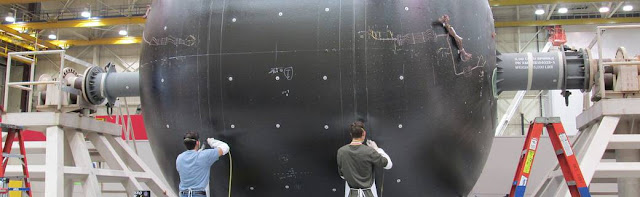
Composite cryogenic demonstration tank (courtesy NASA)


Storage vessels for liquid hydrogen (LH2) can be broadly classified as single-wall tanks or double-wall dewars. In both cases, operating pressures are generally kept relatively low. As mentioned in my previous post, stainless steel and aluminum alloys are the most commonly used material for these vessels. Metal liners with a composite overwrap have also been used in some LH2 applications.

A very active area of ongoing development are vessels comprised only of composite material for applications where weight reduction is critical (see photo of an example above). Composite vessels can also potentially withstand higher pressures with reasonable wall thicknesses providing increased storage density and greater operational flexibility.

Single-Wall Tanks

Single-wall tanks are used in applications where storage times are relatively short and consumption rate is very high. The most common example are rocket stages that are loaded on the launch pad and consume most of the LH2 during the several minutes required to reach orbit.

Spray-on foam insulation (SOFI) is the most common option historically used for thermal protection of a single-wall LH2 tank. Key design considerations include: foam thickness; micro-cracking due to large temperature differentials; water uptake from the environment; repair and maintenance; and other factors.

Aerogel blankets are another potential option for single-wall LH2 tanks. While this option mitigates some of the issues with foam mentioned above, other design considerations come into play (e.g. cost, installation, total insulation mass, etc.).

Double-Wall Dewars

Dewars are comprised of an inner wall that contains the LH2 and an outer wall exposed to the environment. The space between the walls is evacuated and generally contains insulating materials. These vessels are sometimes referred to as vacuum jacketed and are based on the same principle as "vacuum flasks" used to store hot or cold beverages.

Dewars are heavier than a single-wall design with comparable storage capacity because of the additional containment wall. However, their thermal performance is far superior due to the minimization of conduction and elimination of convection heat transfer within the vacuum jacket. For this reason, virtually all current stationary and transportation LH2 vessels are dewars.

Insulation options inside the vacuum jacket to further improve thermal performance include: reflective surfaces, perlite, glass bubbles, aerogel beads, multi-layer insulation (MLI), and others. MLI is the highest performing practical insulation option within a vacuum jacket. Double aluminized mylar with dacron netting spacers is a common MLI configuration.

Design parameters that effect MLI performance include: materials used, number of layers, layer density, boundary temperatures, compression load, and degradation factors. Degradation due to seams and penetrations must be minimized with proper design and installation techniques to ensure acceptable storage performance.

Penetrations

Penetrations refer to any solid conduction path that is in thermal connection with the inner tank wall and its contents. In well-insulated tanks, penetrations and their associated thermal conduction often impose the largest heat load into the LH2. Some key penetrations for LH2 vessels of any type include:
  • Supports, flanges, ports and similar structural components
  • Fill line for loading LH2 into the vessel
  • Drain line for removing LH2 (a single fill/drain line is sometimes used)
  • Feed line for high LH2 consumption rate applications
  • Pressurization or other pressure building subsystem
  • Vent line for pressure relief and fluid conditioning (sometimes tied into the pressurization line with appropriate isolation valving)
  • Sensors for temperature, pressure, and mass gauging or fill level monitoring

In the next post I'll talk about at how LH2 is transferred in and out of a storage vessel.


Matt Moran is the Managing Member at Moran Innovation LLC, and previous Managing Partner at Isotherm Energy. He's been developing power and propulsion systems for more than 40 years; and first-of-a-kind liquid, slush and gaseous hydrogen systems since the mid-1980s. Matt was also the Sector Manager for Energy & Materials in his last position at NASA where he worked for 31 years. He's been a cofounder in seven technology based start-ups; and provided R&D and engineering support to hundreds of organizations. Matt has three patents and more than 50 publications including the Cryogenic Fluid Management report series. More about him can be found here.