Translate

Showing posts with label safety. Show all posts

Thursday, February 13, 2025

Safety with Liquid Hydrogen


Relative to conventional fuels, hydrogen has a wider flammability range in air (4–75%), higher permeability through some materials, and a lower ignition energy (0.02 mJ). These characteristics make it vital to provide adequate ventilation, prevent leaks, and eliminate ignition sources in any hydrogen system design and operation. System monitoring and detection is important to ensure that all safety precautions are active and operating as intended. 

The very rapid 20 m/s rise rate of gaseous hydrogen in air under ambient conditions greatly aids with ventilation and dilution. Hydrogen also has an auto-ignition temperature of 585°C, which is higher than most fuels. Hydrogen is colorless, odorless, and not toxic to breathe. However, low oxygen detection is needed anywhere hydrogen may accumulate near personnel since asphyxiation is possible if insufficient oxygen is available.

When combusted, hydrogen produces no smoke or soot, which eliminates associated inhalation risks common with fossil and other hydrocarbon fuels. The resulting flame also produces much less radiant energy compared to hydrocarbon fires, thereby reducing the zone of potential heat damage or burns. A hydrogen flame is nearly invisible under daylight conditions, requiring infrared sensors or cameras for detection. At night, the flame is pale blue in appearance. For all hydrogen systems, emergency and fire response planning and coordination is a critical consideration.

The use of LH2 introduces additional safety concerns beyond gaseous hydrogen due to the temperature extremes and phase change characteristics inherent in cryogenic fluid systems. Personnel training, appropriate protective clothing, human interface designs, and safe operations are key to mitigating frostbite and other physiological risks. Appropriate equipment design that eliminates the possibility of human contact with cryogenic surfaces is preferable whenever possible. Exclusion zones, caution and warning systems, safety sensors, and approved operational procedures further mitigate risks to personnel.

The large temperature ranges in cryogenic systems require careful materials selection and design to accommodate differences in thermal expansion and contraction. Phase change from liquid to vapor (and sometime the reverse) occurs throughout a LH2 system, resulting in potential rapid pressure changes in isolated volumes. This must be addressed with appropriate design, operations, and pressure relief devices. If maximum vent relief flow rates are high enough, flaring may be required.

Mitigation of ice buildup is necessary where it may cause key components to not operate properly or create other hazards. Likewise, prevention of oxygen condensing out of the air is addressed with proper insulation on any surfaces that may reach low enough cryogenic temperatures. Any LH2 spills will begin to immediately vaporize and rise as the vapor warms. However, the initially cold hydrogen vapor will be denser than air and can result in temporary regions of high concentration near the ground.

Material selection for hydrogen service must address the design and operational requirements for strength, ductility, fatigue, permeability, and other material properties. Approved cleaning processes must be followed to ensure that unacceptable contaminants are not introduced to the system from materials. Purity levels of the hydrogen are generally dictated by the fuel cell specifications or other feed requirements. Purging and inerting of the assembled system is required for various operations to prevent the introduction of air or other contaminant fluids.
Saturday, October 9, 2021

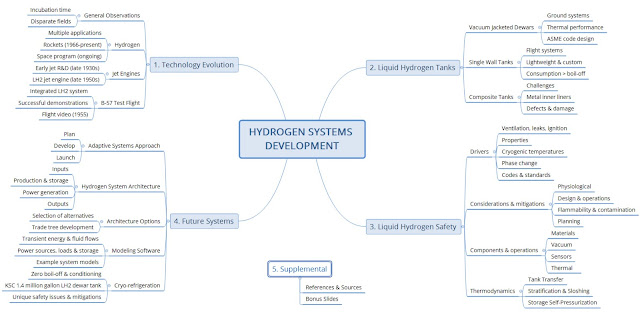
Hydrogen Systems Development: Past, Present and Future


Technological evolution often requires decades of incubation and advancement in a variety of fields before large scale commercial adoption is achieved. Hydrogen has followed these trends since its discovery in the late 1700’s and subsequent application for wide ranging industrial uses. Liquid hydrogen (LH2) has been in routine and continuous use in the space program since the early 1960’s. However, many are not aware that its roots in aerospace trace much further back in aviation to the initial jet engine research and development in the late 1930’s; and later with successful flight demonstrations of a liquid hydrogen fueled jet engine in the mid-1950’s.

Modern LH2 systems make use of vacuum jacketed dewars for long term storage on the ground. Flight vehicles have used single wall tanks with foam insulation which significantly reduces mass but is only viable if the consumption rate in flight is greater than the boil-off venting required to meet tank pressure constraints. Composite LH2 tanks of various types (with or without metal inner liners) have been attempted over the years with mixed success and are still under development.

Safety with LH2 is a paramount priority. Key drivers are related to hydrogen’s properties, LH2 cryogenic temperatures, and liquid-vapor phase change within the system. Many legacy standards, codes and guidelines exist for LH2, and many more are in active formulation or revision. The three primary mantras to remember when designing and operating hydrogen systems is: 1) provide ventilation, 2) prevent leaks, and 3) eliminate ignition sources. Understanding the thermodynamic behavior of LH2 systems during various operations is also critical.

The development of future hydrogen systems can be optimized using an adaptive systems approach that treats hydrogen as a critical enabler in an overall system architecture rather than simply a commodity fuel. Selecting architecture options permit trade studies of candidate system concepts that can be assessed on the basis of technical, economic, environmental impact, and other key performance metrics. The end result is the ability to optimize systems for a multitude of hydrogen applications that can then be modeled, simulated, developed, assembled, and put into operation. Further, the proven ability to eliminate boil-off losses in LH2 systems - and provide better performing and sustainable propulsion and power relative to legacy fossil fuel systems - will play a key role in the global transition to hydrogen


Matt Moran is the Managing Member at Moran Innovation LLC, and previous Managing Partner at Isotherm Energy. He's been developing power and propulsion systems for more than 40 years; and first-of-a-kind liquid, slush and gaseous hydrogen systems since the mid-1980s. Matt was also the Sector Manager for Energy & Materials in his last position at NASA where he worked for 31 years. He's been a cofounder in seven technology based start-ups; and provided R&D and engineering support to many industrial, government and research organizations. Matt has three patents and more than 50 publications including the Cryogenic Fluid Management report series. More about him can be found here.

Thursday, September 10, 2020

Liquid Hydrogen Presentation (Center for Hydrogen Safety U.S. Conference 2020)


Above are the slides (click on image), and below is the video (part 1) of my presentation at the Center for Hydrogen Safety U.S. Conference 2020. The second video (part 2) is additional content that couldn't fit into the conference time slot.


Matt Moran is the Managing Member at Moran Innovation, and previous Managing Partner at Isotherm Energy. He's been developing power and propulsion systems since 1982. Matt was also the Sector Manager for Energy & Materials in his last position at NASA where he worked for 31 years. He's been involved in seven technology based start-ups; and provided R&D and engineering support to many industrial, government and research organizations.  More about Matt here…