Translate

Showing posts with label energy storage. Show all posts

Saturday, October 9, 2021

Hydrogen Systems Development: Past, Present and Future


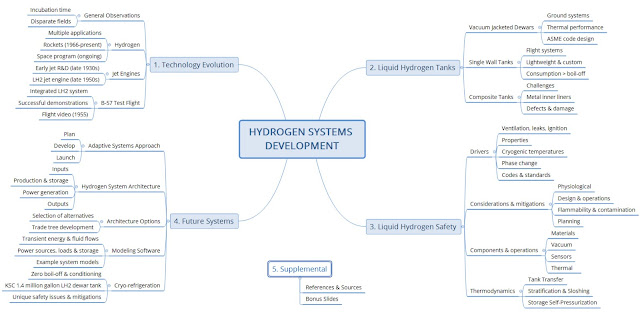
Technological evolution often requires decades of incubation and advancement in a variety of fields before large scale commercial adoption is achieved. Hydrogen has followed these trends since its discovery in the late 1700’s and subsequent application for wide ranging industrial uses. Liquid hydrogen (LH2) has been in routine and continuous use in the space program since the early 1960’s. However, many are not aware that its roots in aerospace trace much further back in aviation to the initial jet engine research and development in the late 1930’s; and later with successful flight demonstrations of a liquid hydrogen fueled jet engine in the mid-1950’s.

Modern LH2 systems make use of vacuum jacketed dewars for long term storage on the ground. Flight vehicles have used single wall tanks with foam insulation which significantly reduces mass but is only viable if the consumption rate in flight is greater than the boil-off venting required to meet tank pressure constraints. Composite LH2 tanks of various types (with or without metal inner liners) have been attempted over the years with mixed success and are still under development.

Safety with LH2 is a paramount priority. Key drivers are related to hydrogen’s properties, LH2 cryogenic temperatures, and liquid-vapor phase change within the system. Many legacy standards, codes and guidelines exist for LH2, and many more are in active formulation or revision. The three primary mantras to remember when designing and operating hydrogen systems is: 1) provide ventilation, 2) prevent leaks, and 3) eliminate ignition sources. Understanding the thermodynamic behavior of LH2 systems during various operations is also critical.

The development of future hydrogen systems can be optimized using an adaptive systems approach that treats hydrogen as a critical enabler in an overall system architecture rather than simply a commodity fuel. Selecting architecture options permit trade studies of candidate system concepts that can be assessed on the basis of technical, economic, environmental impact, and other key performance metrics. The end result is the ability to optimize systems for a multitude of hydrogen applications that can then be modeled, simulated, developed, assembled, and put into operation. Further, the proven ability to eliminate boil-off losses in LH2 systems - and provide better performing and sustainable propulsion and power relative to legacy fossil fuel systems - will play a key role in the global transition to hydrogen


Matt Moran is the Managing Member at Moran Innovation LLC, and previous Managing Partner at Isotherm Energy. He's been developing power and propulsion systems for more than 40 years; and first-of-a-kind liquid, slush and gaseous hydrogen systems since the mid-1980s. Matt was also the Sector Manager for Energy & Materials in his last position at NASA where he worked for 31 years. He's been a cofounder in seven technology based start-ups; and provided R&D and engineering support to many industrial, government and research organizations. Matt has three patents and more than 50 publications including the Cryogenic Fluid Management report series. More about him can be found here.

Sunday, August 30, 2020

AIAA Propulsion and Energy Forum


On August 24th I was on a Forum 360 panel about "Sustaining Mission Possibilities Through Enabling Technologies" at the virtual AIAA Propulsion and Energy conference. Above is a video clip of my opening remarks.


Matt Moran is the Managing Member at Moran Innovation, and previous Managing Partner at Isotherm Energy. He's been developing power and propulsion systems since 1982. Matt was also the Sector Manager for Energy & Materials in his last position at NASA where he worked for 31 years. He's been involved in seven technology based start-ups; and provided R&D and engineering support to many industrial, government and research organizations.  More about Matt here…

Thursday, June 6, 2019

ThinkTech Hawaii interviews Matt Moran

Hydrogen Endgame: The Infinity Fuel for a Sustainable Future


Matt Moran is the Managing Member at Moran Innovation, and previous Managing Partner at Isotherm Energy. He's been developing power and propulsion systems since 1982. Matt was also the Sector Manager for Energy & Materials in his last position at NASA where he worked for 31 years. He's been involved in seven technology based start-ups; and provided R&D and engineering support to many industrial, government and research organizations.  More about Matt here…

Tuesday, August 30, 2016

Hydrogen System Architecture and Software Demo

The variability of wind and solar energy sources presents a challenge for meeting electrical load requirements. Isotherm Energy has developed a system architecture for addressing this challenge that provides energy storage, potable water, and hydrogen fuel production. The architecture enables tailoring of system parameters to meet specific application requirements using current and emerging technologies.


Click here to view a demonstration of the software

Isotherm Energy is developing a suite of software tools to simulate, analyze and design systems based on our hydrogen storage system architecture. The software allows selection of various input energy sources, water sources, biomass and other inputs. Subsequent screens allow the selection of options for hydrogen production, storage, byproducts, power generation, heat recovery, power output, excess hydrogen, and water management.

Once the architecture options are selected, the software generates a system model that incorporates all the chosen parameters. The system model calculates all energy and mass flows between subsystems along with heat available for recovery and improved overall system performance. Note that all system flows are driven by the load following function of the power management and distribution (PMAD) subsystem and calculated accordingly.


The system model has an optional time stamp capability for the conditions being simulated. When the “Save Conditions” button is clicked, all of the parameters associated with the time stamped simulation are stored for subsequent transient analysis. In this manner, a sequence of simulated hours, days, weeks or a full year can be automatically generated and investigated. Every parameter of the system can then be adjusted using built-in optimization tools to meet the performance goals over any timeframe of interest.

The software also provides complete flexibility in the selection of system variables such as electrical load and energy inputs. These can be a constant number at a given timestamp, a historical profile, a statistical distribution over a time averaged period, a stochastic probabilistic algorithm (e.g. Monte Carlo), or some other user defined method.

New capabilities under development include:
  • Detailed subsystem and component models
  • Drop-in capability for existing and emerging technologies
  • Comparison to other storage options (e.g. batteries, compressed air, pumped hydro, etc.)
  • Capital/operating expenditures, payback period, levelized cost of energy and other financial


Matt Moran is the Managing Member at Moran Innovation, and previous Managing Partner at Isotherm Energy. He's been developing power and propulsion systems since 1982. Matt was also the Sector Manager for Energy & Materials in his last position at NASA where he worked for 31 years. He's been involved in seven technology based start-ups; and provided R&D and engineering support to many industrial, government and research organizations.  More about Matt here…

Friday, April 22, 2016

System Modeling Software for Isotherm's Hydrogen Energy Storage Architecture

Isotherm Energy is developing a suite of software tools to simulate, analyze and design systems based on its hydrogen energy storage architecture.  The software allows selection of various input energy sources, water sources, biomass and other inputs as shown in the screen shot below.


Subsequent screens allow the selection of options for hydrogen production, storage, byproducts, power generation, heat recovery, power output, excess hydrogen, and water management.  Once the architecture options are selected, the software generates a system model that incorporates all the chosen parameters.

Below is an example of one of these system models that incorporates wind, photovoltaics, saltwater, electrolytic hydrogen production, compressed gas storage, fuel cells, and potable water production.  Oxygen is also stored as a cryogenic liquid in this model permitting passive cooling of the compressed hydrogen for greater density storage and higher fuel cell efficiency.

The system model calculates all energy and mass flows between subsystems along with heat available for recovery and improved overall system performance.  Note that all system flows are driven by the load following function of the power management and distribution (PMAD) subsystem and calculated accordingly.


The above screenshot represents a daylight scenario where the combined wind and solar energy input is sufficient to meet the electrical load, so the excess energy is directed by the PMAD subsystem to the saltwater electrolyzer.  Hydrogen and oxygen are thereby produced to be stored for later use in the fuel cell when needed.  Commercially saleable chlorine and sodium hydroxide byproducts are also produced during the saltwater electrolysis process.

When solar energy is unavailable, the system must augment the wind power by consuming stored hydrogen along with ambient air (or oxygen in this case) in the fuel cell to meet the electrical load demand.  The screenshot below shows the system model in this night time scenario.  With appropriate material selection and design, potable water is produced when the fuel cell is operating (for drinking water, irrigation, humidity control, etc.).

The system model has an optional time stamp capability for the conditions being simulated.  When the “Save Conditions” button is clicked, all of the parameters associated with the time stamped simulation are stored for subsequent transient analysis.  In this manner, a sequence of simulated hours, days, weeks or a full year can be automatically generated and investigated.  Every parameter of the system can then be adjusted using built-in optimization tools to meet the performance goals over any timeframe of interest.

The software also provides complete flexibility in the selection of system variables such as electrical load and energy inputs.  These can be a constant number at a given timestamp, a statistical distribution over a time averaged period, a stochastic probabilistic algorithm (e.g. Monte Carlo), or some other user defined method.


New capabilities under development include: 

  • Detailed subsystem and component model
  • Drop-in capability for existing and emerging technologies
  • Comparison to other storage options (e.g. batteries, compressed air, pumped hydro, etc.)
  • Capital/operating expenditures, payback period, levelized cost of energy and other financials
  • Detailed design data, product selections, bill of materials, and more...

Isotherm Energy is developing this software to customize its hydrogen energy storage architecture for a wide range of applications in collaboration with its partners and clients.  Planned case studies will begin to explore grid connected and off-grid scenarios, particularly in markets where the benefits of the architecture uniquely address inherent key requirements and constraints (e.g. controlled environment agriculture).  Please contact us if your organization has interest in participating in these early stage studies.


Matt Moran is the Managing Member at Moran Innovation, and previous Managing Partner at Isotherm Energy. He's been developing power and propulsion systems since 1982. Matt was also the Sector Manager for Energy & Materials in his last position at NASA where he worked for 31 years. He's been involved in seven technology based start-ups; and provided R&D and engineering support to many industrial, government and research organizations.  More about Matt here…

Wednesday, March 16, 2016

Power Generation and Outputs from Hydrogen

This final post in the series introducing Isotherm Energy’s hydrogen energy storage architecture focuses on power generation and other output options from the system.  When needed, stored hydrogen is used to produce application-specific combinations of: electricity, kinetic power, heating, cooling, and potable water.


Power Generation

Hydrogen can be fed to fuel cells to produce electrical output when needed.  Ambient air is typically the other input to fuel cells, although pure oxygen is an option if water electrolysis is used and higher performance is desired.

The hydrogen can also be used in a variety of combustion processes including: turbines, internal combustion engines, burners, etc.  Depending on the application, the heat of combustion from hydrogen can generate kinetic energy (e.g. propulsion), or be converted from heat to electricity (e.g. Stirling engines).

For example, various scenarios for producing renewable hydrogen and electricity - that also incorporate natural gas - have been identified by NREL as shown below.  All of these hydrogen end uses have been demonstrated at commercial scale, and are continuing to expand in stationary and mobile markets.


Heat Recovery

Heat is generated by various processes of the system and can be recovered for combined heat and power (CHP), bottoming cycles, thermal energy harvesting, and other uses.  This increases the overall performance of the system while also meeting application-specific requirements.

The primary sources of heat generation in the system are fuel cells and combustion processes that operate during hydrogen usage.  Other components such as electrolyzers also produce heat during the production of hydrogen.  Optimizing the recovery of heat from these sources during various operations is key to designing a high performance system.

In applications where cooling is needed, “waste” heat can also be used to drive absorption cooling and other thermally-driven refrigeration cycles.  This allows the system architecture to accommodate both heating and cooling requirements along with energy storage.  Additionally, if the hydrogen is stored in liquid form, there is substantial thermal energy storage available to meet large cooling requirements if needed.


Water Production

Whether the hydrogen is used in fuel cells or combustion process, the primary byproduct is water.  With proper design and material selection, significant amounts of potable water can be harvested during operation to meet a variety of needs.

One obvious potential use is for drinking water, enabling both energy storage and water processing capabilities in one system.  The water could also be used in food growing systems, or as an additive in various processing operations that have compatible water quality requirements.

Another potential use in closed or semi-closed environments is humidity control and temperature reduction via evaporative cooling.  Adding this function in combination with previously described capabilities results in one integrated system for energy storage, environmental control, and water production.


Matt Moran is the Managing Member at Moran Innovation, and previous Managing Partner at Isotherm Energy. He's been developing power and propulsion systems since 1982. Matt was also the Sector Manager for Energy & Materials in his last position at NASA where he worked for 31 years. He's been involved in seven technology based start-ups; and provided R&D and engineering support to many industrial, government and research organizations.  More about Matt here…

Wednesday, March 9, 2016

Storing Energy in the Form of Hydrogen

The core of Isotherm’s energy system architecture is hydrogen production and storage resulting from the inputs to the system.  There are multiple options to consider in order to select the optimal system design for a given application.


Hydrogen Production

When coupled with renewable energy sources, water electrolysis produces hydrogen gas without carbon emissions or the need to process feedstocks containing carbon.  Electrolyzers can be designed to operate with a variety water inputs (e.g. freshwater, saltwater, wastewater, etc.), or in a closed system mode with water recirculation from fuel cells or combustion processes.  The electrolysis and power generation functions can also be combined within a single unit known as a regenerative (hydrogen) fuel cell.

Conversely, hydrogen can be produced from biomass and other feedstocks containing hydrocarbons.  Biomass sources ideally provide a sustainable cycle when customized for the application, geographic location, and available resources.  Steam methane reformation, coal gasification and other fossil fuel based processes can also be used to generate hydrogen, although the associated carbon byproducts must be dealt with.

Other advanced techniques for hydrogen production have been demonstrated including: radiolysis (from nuclear radiation), photobiological (from algae), photocatalytic (from solar), among others.  Most of these technologies are early stage with limited commercial systems in place.  However, they have the potential for improving efficiency, flexibility and sustainability in future systems.


Oxygen and Other Beneficial Byproducts

Electrolysis and related processes produce oxygen as a byproduct that can be used within the system application, or sold as a commodity output.  Other beneficial byproducts are also produced depending on the water input.  Saltwater electrolysis, for example, produces sodium hydroxide and chlorine that have variety of commercial uses.  Urine electrolysis produces nitrogen that can be used or sold for plant fertilization.

Byproducts from hydrocarbons depends on the composition of the feedstocks and the processing methods used.  In general, these byproducts may be less desirable from a sustainability standpoint due to the remaining carbon content.  However, if properly sequestered and rendered into an economically viable form, these methods of hydrogen production can provide a transitional step toward the reduction of undesirable hydrocarbon combustion emissions.


Hydrogen Storage

Once the hydrogen is produced, it must be stored until needed.  The U.S. Department of Energy uses the taxonomy shown below to categorize hydrogen storage methods as either physical-based or material-based.


Comparison of the density as a function of temperature and pressure for physical-based methods is shown below, and falls into one of three categories:

  • Compressed gas is a high pressure, ambient temperature, and moderate density condition that is currently the most common hydrogen energy storage method.  Typical storage pressures are 300 to 700 bar; requiring compressors, heat of compression cooling, and high strength storage tanks (e.g. composite overwrap stainless steel at the highest pressures).
  • Cryo-compressed is high pressure, high density storage near the normal boiling point temperature of hydrogen (-253 C).  Additional capabilities beyond compressed gas systems are required to establish and maintain the low temperature conditions (e.g. a method of cryocooling and high performance insulation).
  • Liquid hydrogen is a low pressure, low temperature (-253 C) storage method that eliminates the need for compression, but adds liquefaction.  Maintaining the desired thermodynamic conditions requires careful design of tankage and associated components to minimize environmental heat leak through piping and structural penetrations, and high performance insulation.


Material-based hydrogen storage systems, by contrast, use a variety of structural (e.g. nanopores) and chemical (e.g. hydrides) technologies to “trap” hydrogen.  Techniques for later recovery of the hydrogen depends on the technology used - adding heat to metal hydrides, for example.  Research focused on maximizing the storage capacity of material-based hydrogen storage is extensive and ongoing.


Matt Moran is the Managing Member at Moran Innovation, and previous Managing Partner at Isotherm Energy. He's been developing power and propulsion systems since 1982. Matt was also the Sector Manager for Energy & Materials in his last position at NASA where he worked for 31 years. He's been involved in seven technology based start-ups; and provided R&D and engineering support to many industrial, government and research organizations.  More about Matt here…

Tuesday, March 1, 2016

Flexible Inputs to Hydrogen Energy Storage

Previous posts introduced Isotherm’s energy storage system architecture and the reasons why hydrogen is a compelling solution for consideration.  To get a better understanding of where and how the architecture can be applied, let’s take a look at the major subsystems and functions starting with the system inputs.


Energy Inputs

Electrical power system scenarios where energy storage is needed include: over-generation, variable generation, off-grid/microgrid, and other applications where power generation and electrical demand are out of phase in time.  Any source of electrical energy can be stored for later use subject to the inefficiency losses of the system.  In cases where these losses are economically preferable to shutting down a generating unit due to insufficient demand, for example, energy storage improves overall power generation performance.

Energy storage is particularly suited to renewable energy to offset the inherent fluctuations in generation from solar, wind and other variable sources.  Storage capability is necessary for most off-grid renewable power systems, and critically enabling to the trend of increasing renewable sources on the grid.  Using hydrogen storage technology for solar and wind energy sources also provides an end-to-end power system that produces no carbon emissions.

Transportation and other mobile applications can make use of hydrogen for fueling capability or onboard energy storage.  Vehicle systems face challenges with the need for a hydrogen fueling infrastructure, and the competitive advantages of battery technologies for onboard energy storage.  At larger scales and more limited route options (e.g. trains, ships, airplanes, etc.), these challenges begin to wane.  For these larger scale mobile applications, energy input can come from a variety of sources and can be set up at key refueling locations.  Alternatively, a hydrogen storage system can be integrated onboard and driven by the propulsion system to provide auxiliary power when needed.


Water Sources

Water in a hydrogen energy storage system can be recirculated from electrical generation output (e.g. fuel cell) to hydrogen generation input (e.g. electrolyzer) requiring limited water input.  However, if potable water production is a needed function, various water inputs can be provided in an open loop configuration.  Electrolyzers using saltwater have been demonstrated, and other water sources are possible (e.g. urine, wastewater, etc.).

This unique capability of potable water production in parallel with energy storage opens up many intriguing possibilities along the water-energy spectrum.  For example, the system could operate from solar and/or wind power to provide desalination in coastal regions and also provide electricity at night or when the wind dies down.  This system would also produce oxygen, sodium hydroxide and chlorine as byproducts of the saltwater electrolysis process that can be used locally or sold. 

For a remote location in a developing region, a microgrid could incorporate urine as the water input to the system.  In addition to potable water, oxygen and energy storage; the system would also produce nitrogen for crop fertilization.  In any of these configurations, the system design, operation and maintenance could be optimized for the application.


Other Inputs

An optional input to the system is the use of other potential sources of hydrogen such as biomass.  Various feedstocks can be used, and could replace the need for water inputs if desired.  In this case, potable water production and energy storage would be provided without any access to a water source.

Another possible input to the system is natural gas that can be converted to hydrogen via steam-methane reforming.  This is a mature process that has been used for decades for most of the hydrogen commercially produced.  However, it results in carbon monoxide and carbon dioxide that would need to be sequestered to maintain a zero carbon emission system.  This may be a viable transition option for using natural gas without the release of carbon by combustion.


Matt Moran is the Managing Member at Moran Innovation, and previous Managing Partner at Isotherm Energy. He's been developing power and propulsion systems since 1982. Matt was also the Sector Manager for Energy & Materials in his last position at NASA where he worked for 31 years. He's been involved in seven technology based start-ups; and provided R&D and engineering support to many industrial, government and research organizations.  More about Matt here…

Monday, February 22, 2016

Why Hydrogen Energy Storage?

In my last post, I introduced the hydrogen energy storage system architecture being developed by Isotherm Energy.  But why choose a hydrogen-based approach?  What are the compelling reasons to consider such a system?  Let's start with some of the key advantages:

Energy Density and System Life - The amount of energy per unit mass for hydrogen storage technology is much higher than batteries or ultracapacitors.  It also has long storage times and equipment life, resulting in a high energy density system with low lifecycle replacement and disposal requirements.


Ratio of Energy Stored to Energy Invested - A net energy analysis of grid storage options conducted by authors from Stanford University,  Imperial College of London, and Western Washington University* found that a regenerative hydrogen fuel cell (RHFC) configuration provides higher lifetime energy returned, relative to the energy inputs required to build it, than the best battery technology available (lithium-ion).  The analysis study also reported that the reference RHFC could provide the same overall energy benefit as batteries for over-generation from wind farms, even at a round trip efficiency of 30% for the RHFC. 

Carbon-Free Energy Carrier - In addition to storing energy for reuse in electrical systems, hydrogen is an energy carrier that produces no carbon emissions when used as a fuel.  It can be transported and used for a variety of purposes that are currently the domain of fossil fuels.  This permits a multitude of options for stored hydrogen beyond the energy storage needs of a system.  Hybridized hydrogen systems of this type can be optimized to meet combined requirements of energy storage and fuel production. 

Water Production - A potentially valuable byproduct of a hydrogen energy storage system is the production of water when it is used in a fuel cell or combustion process.  With appropriate material selection and design, potable water can be extracted in significant quantities from the system.  Furthermore, use of a variety of water sources (e.g. saltwater, wastewater), biomass, and other hydrogen feedstocks can produce a water processing function that operates in parallel with energy storage. 

However, there are some inherent considerations to take into account for a hydrogen energy storage system: 

Roundtrip efficiency - The primary drawback of hydrogen energy storage systems is the relatively low roundtrip efficiency of the "charge-discharge" cycle.  For example, an electrolyzer can split water to produce hydrogen with an efficiency in the range of 70%.  When the hydrogen is used to produce electrical energy in a fuel cell or by heat of combustion, additional energy is lost in the conversion process.  For a fuel cell operating at 50% efficiency, the resulting roundtrip efficiency is roughly 35%. 

Safe handling - Despite some misperceptions, hydrogen systems are routinely used in a variety of industries(e.g. aerospace,  processing, and manufacturing).  These systems require certain precautions, material selection, design features and operational practices to insure safe operation.  Hydrogen has a wide flammability range in the presence of oxygen, and a relatively low ignition energy.  However, it's lighter than air and dissipates much more readily than gasoline and other fuels in an open environment.  It also has no lasting environmental impact once dissipated.  When properly designed and operated, a hydrogen system poses no more risk than many commonly used fuel and gas systems. 

Looking forward, Isotherm Energy is focused on several trends and opportunities that will drive the wider adoption of hydrogen energy storage systems: 
  1. Technology advances in electrolyzer and fuel cell performance that continue to improve the round trip efficiency.
  2. Hybrid systems that produce potable water and/or hydrogen fuel thereby increasing the overall performance by adding functionality that would normally require separate systems and processes.
  3. Recovery of waste heat produced by system inefficiences to increase the overall performance.
  4. Creation of system analysis and modeling tools that allow optimization of hydrogen energy storage systems tailored to specific application requirements. 

*Pellow, M.A., et al., "Hydrogen or Batteries for Grid Storage?", Energy Environ. Sci., 2015


Matt Moran is the Managing Member at Moran Innovation, and previous Managing Partner at Isotherm Energy. He's been developing power and propulsion systems since 1982. Matt was also the Sector Manager for Energy & Materials in his last position at NASA where he worked for 31 years. He's been involved in seven technology based start-ups; and provided R&D and engineering support to many industrial, government and research organizations.  More about Matt here…

Thursday, February 18, 2016

A Hydrogen System Architecture for Energy Storage and Water Production

The global community faces complex, highly interrelated challenges that cannot be addressed with legacy energy systems.  Carbon and methane emissions...aquifer and surface water depletion...population growth and economic development.  Our planet is becoming warmer, thirstier, and in ever greater need of systems that support sustainability.

Isotherm Energy is developing a system architecture for addressing these challenges that provides energy storage and potable water production.  The architecture enables tailoring of system parameters to meet specific application requirements using current and emerging technologies.


Isotherm's hydrogen-based system accepts inputs from a variety of energy (solar, wind, etc), non-potable water (saltwater, wastewater, etc.), biomass and other sources.  The selected inputs are used to produce hydrogen to be stored for later use.  Oxygen and other beneficial byproducts are also produced depending on the water and/or other feedstocks used.  Power is generated when needed from the stored hydrogen via fuel cells, turbines, internal combustion engines or other combustion processes.  The resulting outputs are electrical or kinetic energy and potable water.


Roundtrip efficiency of the system is optimized by incorporating heat recovery in the form of waste heat harvesting, combined heat and power (CHP), bottoming cycles and other combined cycles depending on the application.  The production of potable water from non-potable sources also increases the effective performance of the system relative to separate energy storage and water processing systems.  The architecture is scalable to a wide range of applications including:

  • Microgrids and onsite water processing
  • Desalination and energy storage
  • Transportation systems


Matt Moran is the Managing Member at Moran Innovation, and previous Managing Partner at Isotherm Energy. He's been developing power and propulsion systems since 1982. Matt was also the Sector Manager for Energy & Materials in his last position at NASA where he worked for 31 years. He's been involved in seven technology based start-ups; and provided R&D and engineering support to many industrial, government and research organizations.  More about Matt here…