Translate

Showing posts with label myths. Show all posts

Tuesday, July 1, 2025

Hydrogen in Aviation (Myth Busting, Episode 5)

Hydrogen aircraft concept (Airbus); engine testing (Rolls-Royce); and flight tests (multiple)


There is a small cadre of very vocal hydrogen critics with an outsized presence on social media, and media coverage in general. I've written about some of the most common archetypes in a previous hydrogen myth busting post [1]. Yet in a Google Scholar search on "hydrogen aviation", these self-proclaimed experts are nowhere to be found in the ranking of published sources on the topic [2].

Unfortunately, peer-reviewed articles are also not a guarantee of unbiased accurate information as addressed in my recent LinkedIn post on the topic [3]. A contemporary example is an article co-authored by techno-economic and energy analysis experts, but without any apparent input from experts with relevant hydrogen systems experience [4]. As a result, it contains some errors, omissions, and assumptions untethered to real world data.*

In the real world, the increased use of hydrogen in new aircraft development and demonstrations requires a paradigm shift in conventional aviation systems engineering and integration. Unlike sustainable aviation fuel (SAF) options, hydrogen is not a drop-in replacement for legacy aircraft. However, hydrogen is an important long-term solution in terms of performance, environmental impact, many safety aspects, and full lifecycle cost.

This leads to a few key questions. Why is hydrogen being used for aviation? What are the fundamental design drivers for successful implementation? How can lessons already learned from the aerospace sector be incorporated? This blog post is a short introduction to these topics in the hopes of dispelling some of the persistent misinformation that continues to be posted and published on the subject.


Options for Decarbonizing Aviation


The table below summarizes key characteristics of the primary atmospheric greenhouse gases (GHGs), with carbon dioxide (CO2) being the most prevalent in terms of concentration and with an atmospheric lifetime of thousands of years. The global warming potential of these GHGs in the last column has been normalized to CO2. Each of these characteristics are important to keep in mind when assessing the impact of any systems or processes that use or emit one of these GHGs.**


Aviation accounts for roughly 2.5% of all global CO2 emissions and 4% of the global warming to date [5], with CO2 emissions expected to double in 25 to 30 years based on current legacy technologies and predicted growth in air travel according to the FAA.^ These may seem like small percentages in the big picture, but aviation is a difficult industry to decarbonize directly with renewables-based electrification along with other large transportation and maritime applications. There are a few methods for potentially reducing GHGs that are applicable to aviation: SAF, batteries, hydrogen, methane, and nuclear.

SAFs provide a near-term solution for reducing CO2 emissions in existing aircraft as a drop-in fuel. However, the impact on overall CO2 emissions depends on the degree of uptake and these emissions continue to grow over time for most scenarios.^ So, SAFs can help blunt the environmental effects of legacy fuels, but they can't fully decarbonize aviation. In addition, SAFs have some challenges at scale related to sustainable feedstocks, supply chains, and infrastructure build out. Incidentally, some of the most promising formulations use hydrogen as a feedstock.

Batteries are feasible for some electric aviation applications where the impacts to range, payload, and operations due to their low specific energy relative to chemical fuels and their charging requirements are acceptable. Most of these applications are short haul small aircraft flying at low to moderate altitudes using electric motor driven propellers or fans. A fundamental drawback is that batteries weigh the same whether fully charged or fully discharged, so there is no reduction in aircraft mass in flight (or propulsion requirements) common with chemical fuels. And landing is one of the highest energy consumption flight phases, resulting in a hot discharged battery that must be conditioned and recharged before the next flight. This impacts operational turn around time and infrastructure requirements. 

Hybrid electric aircraft concepts can potentially extend the suitable aviation applications using various fuels (including hydrogen) integrated with batteries. Depending on the fuel choice, there are tradeoffs related to technology development required, degree of decarbonization, and other parameters. Advanced hybrid electric propulsion systems are under development by NASA and other organizations that may be promising to commercialize as they reach sufficiently mature technology readiness levels.

Methane, which is the primary constituent of natural gas, and liquefied natural gas (LNG) have been considered and tested for aircraft. But neither are drop-in fuels. In the case of LNG, cryogenic systems similar to liquid hydrogen (LH2) must be developed, albeit at a somewhat higher operating temperature as shown below. Similar to SAF, combustion of methane still produces CO2 emissions, although at a lower rate than legacy fuels. More concerning is un-combusted methane that has 25 times the 100-year global warming potential of CO2. So any leaks, venting, dumping, or other releases of methane anywhere in its journey from extraction or production to consumption represents a powerful GHG gas being added to the atmosphere.


Nuclear aircraft were investigated by NACA and during the early days of NASA. And demonstrations of nuclear powered drones have been reported in recent years by multiple sources. In theory, the performance of these aircraft greatly exceeds any chemically fueled or battery powered vehicle. In practice, use in a non-military application would run afoul of national security, regulatory, and public safety concerns. This is also the reason why nuclear powered naval ships and submarines have been successfully operating since the 1950s, but there is only one currently operating nuclear powered merchant ship.

That leaves hydrogen as the final practical option, which can be used for an unlimited range of aircraft types and flight requirements. A multitude of hydrogen propulsion systems testing and flight tests have been successfully performed by combusting it in jet engines or feeding it to fuels cells for electric motor driven propulsion. Hydrogen is suitable for fixed wing or vertical-take-off-and-landing (VTOL) aircraft of any size currently used, at any currently feasible altitude and range, and with no carbon emissions during operation.


Hydrogen Use in Aerospace


There are two primary reasons to use hydrogen for any aerospace application: superior performance and decarbonization.

Performance is the reason liquid hydrogen has been used for various launch vehicles and rocket stages continuously at large scale and full lifecycle for six decades. Historic examples include: Apollo's Saturn rocket upper stages, Centaur upper stage, and the Space Shuttle. Currently operational examples include: NASA's SLS (see design below); upper stages of the Atlas V, Delta IV, ULA Vulcan, and New Glenn; EU's Ariane 5 and 6; Japan's H-IIA; variants of China's Long March rockets; and India's LVM-3 upper stage.


The specific energy (energy per unit mass) of hydrogen is three times greater than legacy fuels, and along with other energetic properties and characteristics enables its superior performance. This is offset by the low volumetric energy density which requires larger storage volumes compared to legacy fuels. However, fuel cell applications significantly reduce this requirement with more than double the efficiency of conventional combustion engines. Below is a plot illustrating some of these hydrogen properties.


For aircraft, decarbonization is the primary reason for using hydrogen, although performance gains are possible as designs evolve to optimize its usage. The first LH2 aircraft flight testing was done in the 1950s by NACA/NASA, and a dozen more hydrogen powered aircraft have flown as of 2024.

Fuel cell power and propulsion systems only emit water vapor during operation and are currently limited to altitudes where propellers can be used. However, internal combustion engines (ICE) can cover the entire aircraft size range (small piston to jet engines) and can operate at any altitude currently feasible with legacy aircraft. In fact, hydrogen ramjets and scramjets can operate well above legacy aircraft altitudes.

It's important to note that all combustion engines produce nitrous oxides (NOx) due to the disassociation of air at high temperatures. However, the wide oxygen-fuel (O/F) ratio possible with hydrogen permits very lean mixtures that can decrease NOx much more than legacy fuels or SAF.

There is much too be learned in implementing hydrogen aviation from the aerospace-adjacent space industry. Systems, integration, infrastructure, safety, components, supporting technologies, supply chains, and a host of other challenges have long ago been solved in the space industry. Adapting all of it to new industry sectors requires good systems engineering, sound business models, capital investments, infrastructure build out, scaling for cost reductions, and supportive policy and regulatory environments. All the enabling technology is already available.

When all lifecycle costs are included, hydrogen is an economically competitive investment in our future. As it scales, further cost reductions will occur as they do with any new technology shift. This has occurred with solar and wind renewables, just as it did with the shift to natural gas, and the shift from coal to oil before that, and the shift from wood to coal before that. It is the natural economic evolution of new energy paradigms [6].

Valid comparisons to legacy fuels must include their costs associated with: exploration of underground sources (including "dry well" and other abandoned costs); extraction; storage; delivery to refinery; refining; distribution; fueling depots and stations; legacy subsidies; and casualty losses and public health impacts from exposure to toxic fuels, fumes, smoke/soot, polluted air and water, accidents, and all the aggregated effects of GHG emissions. Along with the outlays over the past 100+ years (private and public) associated with putting all the existing infrastructure in place for fossil fuels.


Hydrogen Systems Considerations


For aviation and most other industry sectors transitioning to hydrogen, there are a few key initial design drivers to consider, particularly for LH2: volumetric density, systems integration, cryogenic engineering, operations, and safety.

The comparatively low volumetric density of hydrogen is resolved in the systems engineering and integration of the aircraft. For legacy aircraft, innovative designs and packaging of hydrogen tanks is required. This can result in less volume available for payloads or passengers, longer and/or wider fuselages, storage outside of the fuselage, or other methods to accommodate the volume required.

Larger tanks that can result in increased drag for legacy aircraft designs are a relevant consideration, although many aircraft have successfully flown with enormous outer mold line volumes in order to achieve overall vehicle and mission performance criteria [7]. New VTOL and fixed wing aircraft designs optimized around hydrogen can actually improve aerodynamic performance. Lifting bodies and flying wing configurations are examples where the volume requirements become much more easily integrated within the fuselage [8].

Therefore, the combination of higher specific energy but lower volumetric density of hydrogen relative to legacy fuels are primary parameters to optimize in aircraft design. Lower fuel mass requires less lift which can be traded against greater payload and/or longer range. Larger fuel storage volumes require holistic integration within the aircraft to minimize the impact on drag and maximize aircraft performance and capabilities.

Systems engineering and integration combined with cryogenic engineering best practices also plays an important role. A portion of the energy expended to liquefy hydrogen can be recovered for better overall system efficiency [9]. Examples include: pressure building systems for zero-power pressurization; heat rejection from other subsystems; thermal protection of structures exposed to high temperatures; cooling of superconducting components; Joule-Thomson cooling; vapor-cooled shields for reducing heat loads; para-to-ortho conversion cooling; and other methods.


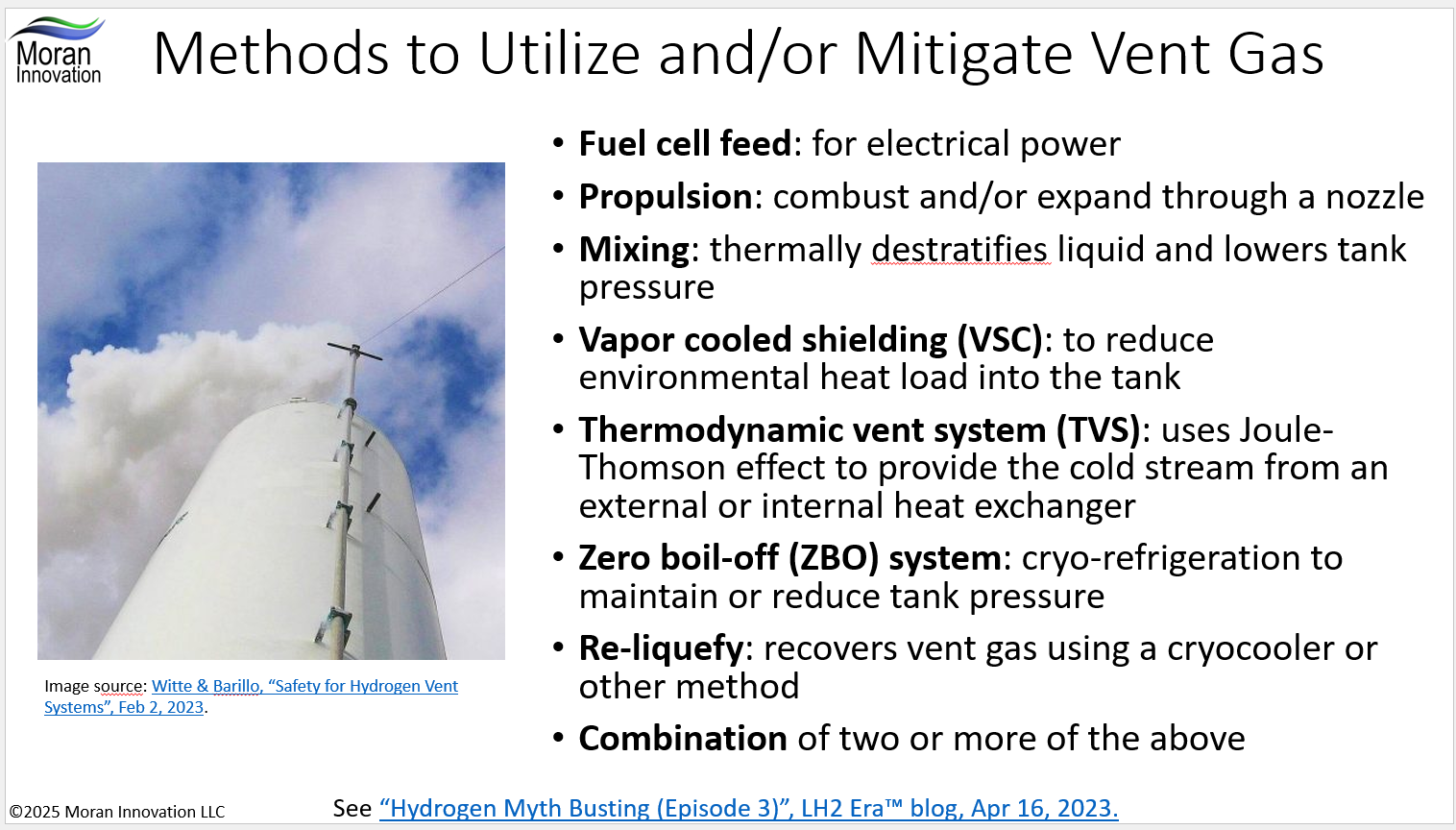
Existing mature cryogenic engineering technologies also enable any LH2 storage and deliver system to have zero boil-off losses. Every LH2 storage system has a characteristic natural boil-off rate profile depending on the size, environment, operations, fill level, and other variables.^^ In all cases, boil-off gas losses can be driven to zero with a combination passive, hybrid, active, and operational techniques. Claims of unavoidable boil-off losses with LH2 systems are false. All boil-off losses are avoidable with proper system design [10].


Changes to aircraft operations, and required airport infrastructure, are also valid considerations [11]. Below is a notional example of how onboard LH2 storage is affected by the acceleration and thermal environments during key aircraft operations. In addition to onboard systems that properly manage LH2, ground support systems must also be in place to support fueling and other associated activities [12]. Various organizations and standards working groups are actively addressing these aspects in preparation for the decades of development required to fully build out the infrastructure [13].


Safety is a paramount consideration with any fuel or energetic system, and hydrogen is no exception. Many codes, standards, training, and certifications are already in place; and many more are under development to address specific use cases and industries. Below is a comparison of key safety relevant properties for hydrogen and natural gas (methane). A few implications that may not be obvious on initial inspection:
  • A given volume of methane has more stored energy for detonation than hydrogen under identical conditions; and its lower bound detonation limit in air is less than one-third that of hydrogen
  • While both gases are lighter than air at ambient temperatures, hydrogen rises much faster (20 m/s or 45 mph) and diffuses much more rapidly in air
  • The lower flammability limit in air (which any safe system is designed to stay well below) and the autoignition temperatures for the gases are not much different
  • However, hydrogen has a much lower ignition energy, much higher upper flammability limit in air, and much higher flame speed

So which fuel is safer? It depends on the situation.# The same can be said for comparing legacy aviation fuels with hydrogen, because each fuel behaves very differently. In a mid-air collision or an emergency landing where the fuel storage is breached, hydrogen (in liquid or gas phase) would be vaporized, gone/diffused, ignited upward, or some combination thereof. And with none of the toxic fumes, smoke/soot, persistent burning pools of spreading liquid, or extended exposure to high temperatures that jet fuel produces.

On the other hand, an undetected fuel leak and potential ignition event is a generally lower risk for jet fuel than it is for hydrogen. However, hydrogen is nontoxic and can be safely breathed as long as its concentration is below asphyxiation levels. Definitely not the case for any legacy aviation fuels. Bottom line: every potential hazard and operational situation requires careful consideration while keeping in mind the unique properties and behaviors of the specific fuel in question.


The Path Forward


Every new energy paradigm shift in history (and every other major technological disruption) has occurred due to market adoption within a supportive policy environment by innovating individuals and teams developing systems and products in the real world. Not on social media. Not in general media opinion pieces or news coverage. And not in peer reviewed articles that ignore information that doesn't fit the predetermined narrative of the authors.

If we had relied on the talkers during previous energy paradigm shifts, we would still be huddled around wood and brush fires. Afterall, a technoeconomic analysis before the industrial revolution could have easily showed that the complexities and costs of extracting fossil fuels and transitioning to their use made no sense compared to burning cheap available wood. And if we rely on today's talkers and delay addressing the existential threats of rising GHGs, public health impacts, and pollution, we will end up dealing with much larger fires and many more calamities at a scale unprecedented in human history.


Footnotes


* For example: ignoring flight demonstrations and testing, alternative aircraft concepts, hydrogen systems state-of-the-art, cryogenic systems integration, propulsion dynamics, regulatory and certification pathways, infrastructure assessments, energy density trades, thermal management, cost projections, etc.

** Note: the so-called 'indirect greenhouse gas' effect of hydrogen is an unproven hypothesis based on unverified assumptions and no atmospheric data at scale. And initial studies into the contrails produced by hydrogen aircraft indicate they dissipate quicker than legacy aviation fuel contrails.

^ The website that documented this information appears to have been taken down by the current administration (https://www.faa.gov/sustainability).

^^ There is no standard value or accurate rule of thumb for estimating natural LH2 boil-off rates despite many sources that attempt to claim otherwise (which is a clear sign of someone lacking experience in this domain).

# Paradoxically, the most infamous historical hydrogen incident would have been much worse with any other fuel under similar conditions: store the fuel in an enormous fabric container with a highly flammable coating; suspend 97 people from it 200 feet (60 m) above the ground; have more people underneath it; allow a lightning strike to ignite the flammable coating; record it with a 1930s era black & white motion camera (that won't record hydrogen flames in daylight, and all the hydrogen is out of the frame within 2 seconds anyway). In the case of hydrogen, it did not detonate nor apparently even ignite any significant amount since there were no water droplets. And 62 of the 97 people onboard survived, with one casualty on the ground. What would be the outcome of repeating that scenario with any other fuel? Or with batteries?

References


[1] "Myth Busting (Episode 4): Hydrogen Haters", LH2era.com, Oct 26, 2023.
[2] "Hydrogen Aviation" Google Scholar search.
[3] Misinformation Hydrogen Zombies, LinkedIn post, Jun 27, 2025.
[4] "Realistic roles for hydrogen in the future energy transition", Johnson, et al., Nat. Rev. Clean Technol. 1, 351–371 (2025).
[6]  "Why All Hydrogen Cost Projections Are Wrong", LH2era.com, Aug 5, 2023.
[7] "List of large aircraft", Wikipedia
[8] "Lifting body", Wikipedia
[9] "Why Liquefy Hydrogen?", LH2era.com, Jun 4, 2025.
[10] "Hydrogen Myth Busting (Episode 3)", LH2era.com, Apr 16, 2023.
[11] "Decarbonizing Mobility with Liquid Hydrogen", SAE Research Report, 2024.
[12] "H2-powered aviation – Optimized aircraft and green LH2 supply in air transport networks", Hoelzen, et al., Applied Energy, Vol. 380, 2025.
[13] "Hydrogen Fueling Stations for Airports, in Both Gaseous and Liquid Form", SAE International, issued Nov 11, 2024.

All graphics are from: Liquid Hydrogen Systems Course, Moran Innovation LLC, 2025.

Author Bio

Matt Moran is the Managing Member at Moran Innovation LLC, and previous Managing Partner at Isotherm Energy. He's been developing power and propulsion systems for more than 40 years; and first-of-a-kind gas, slush, and liquid hydrogen systems since the mid-1980s. Matt was also the Sector Manager for Energy & Materials in his final position at NASA where he worked for 31 years. He's been a cofounder in seven technology-based startups; and provided R&D, engineering, and innovation consulting to several hundred organizations. Matt has three patents and more than 50 publications including his online Cryogenic Fluid Management guide and Decarbonizing Mobility with Liquid Hydrogen SAE report. He has created and taught liquid hydrogen courses, webinars, and workshops to global audiences.


Thursday, October 26, 2023

Myth Busting (Episode 4): Hydrogen Haters

Image created using Bing AI

This episode of hydrogen myth busting is dedicated to the source of a great deal of misinformation on the topic: hydrogen haters. And with the recent announcement of the US hydrogen hub awards, they are in full blast mode in the news, social media, and many other available venues that provide a soapbox.

It's a curiosity of human behavior that we are willing to accept the assertions of people who have no expertise in some areas, but openly challenge them in others. If our friend who has never set foot in a kitchen (except to eat) started giving us a lecture about cooking a gourmet meal, we would laugh at them. Many of us would have a similar reaction if someone who doesn't know a wrench from a hammer started giving us advice on car repair.

In contrast, it seems that anyone with a mouth or keyboard can make absurd and unsubstantiated pronouncements about hydrogen that get blindly accepted as true by some. This misinformation often gets re-posted and amplified by a bandwagon of equally unqualified sources until suddenly it becomes the assumed 'conventional wisdom'.

Types of Haters


In my experience, hydrogen haters can be categorized into five main types (or combinations thereof) depending on their viewpoint. You might be a hydrogen hater if:

1. It threatens your business or expertise. This may seem obvious, but it's surprising how many people don't take this into account when they listen to someone's opinion on the subject. Clearly, if the use of hydrogen represents a threat to your business model, or a better alternative to your product, you are highly incentivized to trash talk it. Some cynical types might call this marketing 101. Similarly, if it has the potential to make the expertise you've developed over a career less relevant, you might be looking for any opportunity to derail its implementation.

2. It competes with your preferred solution. Closely related to the previous type, this category often includes proponents of other solutions to decarbonization. Sadly, this is analogous to picking a fight with someone on your own team, and can sometimes take on the heated tenor usually reserved for brawls (e.g., batteries vs hydrogen). We need a portfolio of solutions to the problem... attacking other legitimate options causes confusion and is counter-productive to the overall goal.

3. You think it's an oil and gas industry conspiracy. I admit to being taken off guard by this one having spent nearly four decades developing hydrogen systems, none of them associated with the oil & gas industry. The fact that this industry has recently begun investing in hydrogen projects as a path to transition away from legacy fossil fuels seems like a positive trend to me. Of course, any of these efforts must be assessed in terms of their lifecycle environmental and public health impacts to be certain we are heading in the right direction and not supporting 'greenwashing' projects. That said, the workforce skill sets in the oil & gas industry overlap very closely with those needed for large scale hydrogen infrastructure. Let's not throw out the baby with the dirty bathwater.

4. It makes you feel relevant. A tried and true method of getting attention when your actual achievements can't draw the limelight you crave is to attack a highly visible target. If you make your remarks inflammatory and play to a mob of people equally ignorant on the topic, all the better. In fact, you can even create a business model (or political career) using this tactic while disguising your lack of competence.

5. You are a victim of misinformation. The previous categories are largely responsible for creating this type of hydrogen hater. A primary challenge for this category is separating the signal from the noise on the topic, and then being open to changing one's mind based on facts, data, and evidence. The remainder of this post will address this challenge with some guidance on how to assess the misinformation overload when it comes to hydrogen.


Red Flags and Filters


There are a few red flags to watch for when you're reading or hearing opinions about hydrogen:

  • "I ran some calculations...". Some people seem to think if they start with a preconceived (and often self-serving) conclusion, pull together some unverified assumptions that support it, and then reverse engineer simplistic equations full of errors and omissions, they can 'prove' their case. If it hasn't been published, or at least vetted by an independent third party, be very skeptical of anything claimed by these hand wavers.
  • When someone challenges another's hydrogen claims with data and evidence, the best response is to engage in an objective discussion with the willingness to adjust both of your perspectives based on what you each learn. Compare this to bad behavior responses such as egotistical rants, personal attacks, trolling, empty sarcasm, ghosting, or continuing to repeat the same claims ad nauseum after being proven wrong. Be extremely skeptical of any information from individuals exhibiting these bad behaviors
  • Claims that any given solution is always right or always wrong. This is an easy flag. Anyone who is forever beating the same dead horse at every opportunity and refuses to acknowledge that their preferred solution isn't universally the best in all applications - or that their hated solution will never work - can safely be ignored.
    
Once you've checked for the red flags, here's a quick set of questions you can ask to assess the source of the information:

How long has this individual worked with the relevant hydrogen systems being discussed? (points: 3-decades, 2-years, 1-studied it, 0-none)

What data and evidence is being provided to support the claims made? (points: 3-operational or test data, 2-technical publication, 1-validated model, 0-personal opinions)

Is the individual's income, status, business, ego, or religio-political beliefs threatened by increased use of hydrogen? (points: 3-definitely not, 2-maybe, 1-probably, 0-oh hell yes)

Now add up the points. Scoring:
    6 or higher: Information from this source is worth consideration
    3 to 5: Take information from this source with a grain of salt
    Below 3: Why are you reading/listening to this person?


Matt Moran is the Managing Member at Moran Innovation LLC, and previous Managing Partner at Isotherm Energy. He's been developing power and propulsion systems for more than 40 years; and break-through liquid, slush, and gaseous hydrogen systems since the mid-1980s. Matt was also the Sector Manager for Energy & Materials in his last position at NASA where he worked for 31 years. He's been a co-founder in seven technology startups; and provided R&D and engineering support to many organizations. Matt has three patents and more than 50 publications including the Cryogenic Fluid Management series. He also teaches courses, workshops, and webinars on liquid hydrogen systems.

Friday, May 26, 2023

ThinkTech Hawaii Interview: Hydrogen Myths vs Facts


Moving Beyond Hydrogen Fairytales and Zombie Myths


On the topic of hydrogen, there is a great deal of misinformation being circulated. Liquid hydrogen systems in particular are sometimes characterized as being a far-off vision that will require many years to deploy. The truth is there are no true technology gaps preventing the widespread application of hydrogen systems. The answer to many questions about hydrogen can be summed up as "it has already been done".

Unfortunately, inaccuracies have even made their way into key reports from authoritative government and international sources. These publications frequently contain errors and omissions, especially on the topic of liquid hydrogen. It is critically important to resolve this issue since public policy, regulations, funding priorities, and private sector investments are heavily influenced by these types of publications.

In this interview, common myths about hydrogen are dispelled with facts on the topics of safety, readiness level, leaks, materials, green hydrogen, energy storage, and system losses. And the 20-20 Vision for the Countdown to Hydrogen™ mnemonic will help with remembering some key hydrogen facts.


Matt Moran is the Managing Member at Moran Innovation LLC, and previous Managing Partner at Isotherm Energy. He's been developing power and propulsion systems for more than 40 years; and break-through liquid, slush, and gaseous hydrogen systems since the mid-1980s. Matt was also the Sector Manager for Energy & Materials in his last position at NASA where he worked for 31 years. He's been a co-founder in seven technology startups; and provided R&D and engineering support to many organizations. Matt has three patents and more than 50 publications including the Cryogenic Fluid Management series. He also leads the monthly LH2 Era™ Webinar.

Sunday, April 16, 2023

Hydrogen Myth Busting (Episode 3)


It's been about a year since my last hydrogen myth busting episode posts [1, 2]. This episode is about the hydrogen zombie myths that not only won't die but have actually made their way into reports from authoritative sources.

The focus will be on liquid hydrogen where many inaccuracies and outdated information are still being published. It's critically important to resolve this issue since public policy, regulations, funding priorities, and private sector investments are heavily influenced by these publications.

Two contemporary reports from the International Energy Agency (IEA) and the U.S. Department of Energy (DOE) will be used as examples [3, 4]. They are both excellent documents from an overall hydrogen survey standpoint, but unfortunately contain critical errors and omissions on the topic of liquid hydrogen.

Boil-Off Gas (BOG)


The potential for BOG generation is inherent in any cryogen storage vessel (liquid hydrogen, natural gas, oxygen, nitrogen, etc.). Environment heating - often termed "heat leak" in cryogenic engineering jargon - eventually leads to vaporization (aka "boil-off") of the liquid in a purely passive system if stored long enough.

There are several ways to address this, all of which have been operationally demonstrated over many years and have the highest technology readiness level possible (TRL = 9). Furthermore, all the necessary components are commercially available from long established supply chains:
  • Vent the gas. To prevent a liquid hydrogen storage vessel from getting above its maximum design pressure, the BOG can be vented. Legacy systems have historically released this vent gas to ambient air or used a flare stack. The IEA and DOE reports (and most others) imply that this is the only method of handling the BOG issue. It is not. In fact, modern liquid hydrogen systems can and should be designed to completely avoid venting and associated BOG losses except in emergency off-nominal situations.
  • Passive thermal design. Optimized insulation systems, support structures, penetrations, and other well established cryogenic design techniques are the first line of defense against BOG generation. In some cases, this is sufficient to keep the storage vessel within its specified pressure range without venting depending on the concept of operations (e.g., if the feed rates to a fuel cell, engine, or fuel transfer are sufficient to offset vaporization).
  • Mix the liquid. Liquid hydrogen storage vessels become thermally stratified over time, with subcooled liquid settling toward the bottom in the absence of any external agitation. By periodically mixing the liquid, the tank pressure can be reduced as the fluid is brought toward equilibrium.
  • Vapor cooled shielding. The environmental heat load can be reduced by adding a vapor cooled shield (e.g., tubing coil) that the hydrogen vapor is fed through prior to consumption in a fuel cell or engine. This lowers the vaporization rate within the storage vessel and can eliminate the need to vent depending on the concept of operation.
  • Joule-Thomson cooling. When hydrogen near its liquid temperature is expanded in a valve, orifice, or similar device, there is a drop in temperature and a significant cooling effect. Using this effect with either internal or external heat exchangers can cool the stored hydrogen whenever vapor is fed to a fuel cell or engine and bring down the storage vessel pressure.
  • Cryo-refrigeration or cryocoolers. In any application, cryo-refrigeration integrated with a heat exchanger can not only completely eliminate BOG (i.e., "zero boil-off"), it can also liquefy, re-liquefy, and condition liquid hydrogen to lower temperatures including densified states. This optional capability is built into the largest operational liquid hydrogen dewar tank in the world at NASA Kennedy [5, 6].

It's also worth noting that housekeeping and auxiliary power demands can be supplemented by BOG fed to a fuel cell. So although zero boil-off is possible with any liquid hydrogen storage system, it may actually be more desirable to design for some amount of BOG to provide this function. Trade studies early in the system development cycle are important to optimize all the design parameters (including BOG) to address needs, goals, objectives, requirements, etc. 

Nevertheless, the DOE report states the following (p17): "Liquid hydrogen is not viable for long-term storage (>10 days)". This is a stunningly incorrect statement, particularly since liquid hydrogen is the only method of long-term (and large scale) hydrogen storage that has been in continuous use for more than 60 years and counting.

Key takeaway: Vent losses can be completely eliminated in any liquid hydrogen system with proper system design using proven methods (i.e., zero boil-off). Claims and assumptions based on "unavoidable boil-off" are wrong and result in erroneous conclusions.

Energy Losses


The IEA report indicates that 20% of the initial energy in hydrogen is lost during liquefaction "conversion" (p140). The DOE report states: "Hydrogen liquefaction uses >30% of the hydrogen energy content" (p17). This is obviously a significant discrepancy.

The calculation is fairly simple based on the Carnot cycle temperatures, system pressures, liquefaction COP, hydrogen heating value, and thermophysical state point properties. Unfortunately, none of these assumptions are provided in either report, so it's difficult to pinpoint why the values are so divergent.

In any case, they are both misleading. Much of the energy "lost" during liquefaction is recovered in the eventual operation of a well designed liquid hydrogen system. This is due to the significant cold sink that the stored liquid hydrogen provides and can be applied to re-liquefaction, cooling of various streams and components, thermodynamic power or refrigeration cycles, and other system functions.

Key takeaway: Energy analyses should always consider the broadest system scope, operations, and lifecycle. Calculations of efficiency or energy losses that focus on an isolated process, subsystem, or component will result in misleading figures of merit.

Distribution Losses


Our legacy fossil fuel paradigm is based on separate locations and operations for exploration, extraction, refining, storage, distribution, and fueling. Even the incumbent liquid hydrogen providers have historically followed a similar paradigm of separate production, liquefaction, and delivery to their customers.

However, for many (if not most) emerging applications, the production, liquefaction, storage, and fueling of liquid hydrogen is best implemented in one location. Renewable energy and water (or other local feedstocks) inputs; liquid hydrogen output; all at the same site.

In this new paradigm, the distribution and transportation losses are nonexistent. Nonetheless, neither report - nor most others like them - even mentions this option. Instead, transportation losses are baked into every assumption and conclusion in both reports.

Key takeaway: Liquid hydrogen will be produced, stored, and delivered all in the same place at the point of use for many modern applications. This is a game changing paradigm shift that impacts every assumption and analysis.

Footnotes and References

  1. Hydrogen Myth Busting (Episode 1), 2022-Apr-22
  2. Hydrogen Myth Busting (Episode 2), 2022-May-01
  3. Global Hydrogen Review 2022, IEA, 2022-Sep-22
  4. Pathways to Commercial Liftoff: Clean Hydrogen, DOE, 2023-Mar-21
  5. Liquid Hydrogen Droplets to Millions of Gallons: Lessons Learned from Decades of Space Exploration Systems Operation, Testing and Technology Development, 2020-Sep-10
  6. Densified Liquid Hydrogen and No-Loss (Zero Boil-off) Systems, 2021-Dec-02

  • Matt Moran is the Managing Member at Moran Innovation LLC, and previous Managing Partner at Isotherm Energy. He's been developing power and propulsion systems for more than 40 years; and break-through liquid, slush, and gaseous hydrogen systems since the mid-1980s. Matt was also the Sector Manager for Energy & Materials in his last position at NASA where he worked for 31 years. He's been a co-founder in seven technology startups; and provided R&D and engineering support to many organizations. Matt has three patents and more than 50 publications including the Cryogenic Fluid Management series. He also leads the monthly LH2 Era™ Webinar.

Sunday, May 1, 2022

Hydrogen Myth Busting (Episode 2)

Global temperature anomalies (Source: NASA GISS)


In my previous post, I started to address some common and recurring myths about hydrogen. This post will continue along the same theme, but with myths that have more nuances to unpack.

Myth #5: Making Hydrogen From Renewables Isn't Practical


There are multiple variations on this myth. Some of the most persistent of them include:
  • There aren't enough renewable resources to support all the carbon-free hydrogen production needed
  • Renewables should only be used to directly meet the electrical demand; producing hydrogen with them is wasteful
  • Conclusions regarding hydrogen production from renewables specific to a particular region are globally true everywhere

    Not enough renewables

Let's start with the first variation. A typical set up for this argument is that if all fossil fuel applications were immediately switched to hydrogen there wouldn't be enough renewable energy capacity to support its production. 

The fundamental flaw with this argument is that every energy transition occurs over decades; there has never been and will never be an immediate transition to any new energy paradigm. If this argument had carried the day prior to the industrial revolution, our energy and transportation systems would still be based on horses.

Hydrogen production using renewables is growing via the deployment of new solar, wind and other generating capacity. These renewable resources can be used during periods of over-generation (more on this below), or supplied from dedicated new microgrids.
 
    Renewables should only be used for electrical demands 

In a fantasy computer simulation, it may be possible to make the sun shine and the wind blow whenever needed to perfectly match the electrical demand at all times. Unfortunately, electrical demand never matches available renewable energy in the real world.

The historical solution to this problem has been to use base load generating sources such as coal-fired or nuclear power plants plus peaking capacity (e.g. natural gas or diesel) to balance power vs load. However, as more renewables come on line, this balancing act becomes untenable when renewables reach about 30% or more of the generating mix.

As fossil fuel generating capacity continues being replaced by cheaper renewables, energy storage will become increasingly necessary to maintain the balancing act. If the local geographical features support pumped hydro (water) storage, that may be the cheapest and simplest solution for that locale. If the scale is not too large, batteries may also provide a reasonable solution.

But for large grids, or microgrids that also incorporate fueling functions, hydrogen is the solution that can be implemented anywhere at any scale. And the lifecycle costs and supply chain risks are lower than batteries under these conditions for an equivalent storage capacity.

    The same hydrogen solution applies everywhere

Consider a densely populated small region in the upper northern hemisphere with limited solar irradiation and no real estate for wind power. Large scale production of hydrogen from renewables in this region may not make much sense.

Now consider a sparsely populated larger region near the equator or in the southern hemisphere where there is an abundance of solar and wind resources and vast real estate available at a low price. Hydrogen production from renewables in this region is not only feasible but may represent a lucrative export opportunity. It can be transported to that densely populated region similar to oil or liquified natural gas.

Between these two extremes are a plethora of regions with varying natural, economic, and geopolitical conditions that dictate what type of hydrogen infrastructure makes sense for that location. And yet it is not uncommon to see articles and policymakers who declare a recent study for a specific region to be "the answer" on how hydrogen should be implemented globally.


Myth #6: Hydrogen Isn't Green


As with the previous myth, there are variations on this one:
  • Since most hydrogen has historically been produced with steam methane reforming (SMR), it isn't a solution to climate change
  • Hydrogen may contribute to global warming

    Hydrogen production

Hydrogen and lithium ion batteries can be used to store energy. When that energy is used, no carbon byproducts are emitted. These are simple irrefutable facts based on the associated chemical processes.

If the feedstock for producing hydrogen is water that is electrolyzed using solar or wind, then it is a "green" method of production. If batteries are charged using the same renewables, then the charging process is green.

Neither hydrogen nor batteries are inherently green or not... it is the lifecycle ("cradle to grave") processes associated with them that determine the impact on the environment. In the case of hydrogen, the number and capacity of electrolyzer installations powered by renewable energy are growing rapidly and represent a truly green source of energy storage and fuel.

    Hydrogen leaks and global warming

This relatively new myth is based on a recent study that has been warped beyond recognition to produce tabloid worthy - and grossly inaccurate - headlines. The study in question poses the following (paraphrased) scenario:
If hydrogen were to be produced in the quantities required to replace fossil fuels; and large aggregate leaks of hydrogen were permitted to occur throughout this new global hydrogen infrastructure; and furthermore, these leaked quantities of hydrogen managed to reach the upper atmosphere without already combining with oxygen in the lower atmosphere or water; it may combine with hydroxides in the upper atmosphere to form water vapor.

 So what's the issue? Keep reading...

This process may inhibit the amount of upper atmosphere hydroxides available to react with the large amounts of leaked methane; thereby inhibiting the ability to mitigate the impact of methane sources and leaks.

While methane is a very potent and prevalent greenhouse gas, it's rather difficult to overlook the circular argument of this scenario. Namely, that transitioning to hydrogen might inhibit the upper atmosphere mechanism that helps to mitigate the greenhouse gas effects of one of the fossil fuels that hydrogen will replace.

The study goes on to recommend that implementation of global hydrogen infrastructures should address leakage to ensure very little reaches the upper atmosphere. The methods and technologies for minimizing hydrogen leaks are well known within the hydrogen community and are already used in any appropriately designed system.

This is a key takeaway and valid consideration as we transition to hydrogen. Unfortunately, that valuable nugget rarely seems to make its way into the subsequent articles that misrepresent the findings. Instead, a more sensationalized tale is spun about the effects of large scale hydrogen usage and greenhouse gases. While that may draw a lot of readers, click-throughs, and online traffic, it is clearly misleading.


Myth #7: Any Particular Technology is the Only Solution


Lithium-ion batteries have evolved to become a truly amazing energy storage technology. High round trip efficiencies during charge and discharge cycles. Portability ideal for very small scales up to automobile applications. Continuing improvements that extend useful life before replacement is necessary.

Li-ion batteries also have their weaknesses. Charging time and heating; temperature effects on performance; thermal runaway if punctured or crushed; strategic materials issues; recyclability; limited practical scalability; weighs the same fully charged as fully discharged.

Hydrogen has its own strengths and weaknesses. Its much higher energy density relative to batteries extends the range and capacity of land, air, and marine electric vehicles. And the vehicle becomes lighter as the hydrogen is consumed, unlike batteries. There are no strategic material nor recycling issues. The operational lifetime of hydrogen systems are measured in decades. Hydrogen systems are scalable to meet very large energy storage requirements, and any application that currently uses fossil fuels.

On the downside, hydrogen has lower round trip efficiency when used in a fuel cell compared to Li-ion batteries (although much higher than any combustion process). High compression as a gas or liquefaction at cryogenic temperatures is required to overcome its otherwise low volumetric density. And workforce training is needed to ensure the required skillsets are sufficiently available for properly designing, commissioning, and operating new hydrogen infrastructures.

Other solutions that reduce or eliminate greenhouse gas emissions have their own unique pros and cons. No single technology or solution is universally optimal for every application. The path to a more secure energy and environmental future requires careful consideration of all feasible options that get us closer to that goal. An important step forward is dispelling myths promulgated by vested interests or the misinformed.


    Matt Moran is the Managing Member at Moran Innovation LLC, and previous Managing Partner at Isotherm Energy. He's been developing power and propulsion systems for more than 40 years; and first-of-a-kind liquid, slush and gaseous hydrogen systems since the mid-1980s. Matt was also the Sector Manager for Energy & Materials in his last position at NASA where he worked for 31 years. He's been a cofounder in seven technology based start-ups; and provided R&D and engineering support to hundreds of organizations. Matt has three patents and more than 50 publications including the Cryogenic Fluid Management report series. More about him can be found here.

    Friday, April 22, 2022

    Hydrogen Myth Busting (Episode 1)

    Liquid hydrogen jet aircraft in 1955 and rocket upper stage in 1966 (Source: NASA)


    On the topic of hydrogen, there seems to be a great deal of misinformation being circulated. Liquid hydrogen systems in particular are sometimes characterized as being a far-off vision that will require years or decades to deploy. This is complete nonsense. There are no true technology gaps preventing the widespread application of hydrogen systems.

    The answer to most questions about hydrogen can be summed up as "it's already been done". Below are some of the hydrogen myths that seem to keep getting regurgitated. I'll discuss more in subsequent myth busting episodes, and do a deeper dive into many of them in later posts.

    Myth #1: Liquid Hydrogen Isn't Ready Yet

    Large scale liquid hydrogen systems have been in continuous use for nearly sixty years in the space sector for launching spacecraft and vehicles to orbit and beyond. All the required technology and equipment for ground based systems is available off-the-shelf from multiple sources. New applications require good systems engineering not fundamental research.

    Most people are very familiar with the large orange External Tank of the Space Shuttle that contained liquid hydrogen and oxygen for the main engines. The giant spherical storage tank at Kennedy Space Center is another familiar image that appears near the top of any liquid hydrogen internet search.

    Anyone who watched a launch of the Space Shuttle on television, or any launches of the Ariane V or rockets with a Centaur upper stage, have seen the results of liquid hydrogen systems in action. Production, delivery, storage, fueling, and consumption. Successfully in operation for decades and continuing into the foreseeable future with existing and new launch vehicles.

    But the legacy of hydrogen reaches back even further. Hydrogen was the first fuel used in the development of jet engine technology in the 1930s. A liquid hydrogen turbojet engine with afterburner was built and tested in the 1950s; and successful flights of a B-57 jet aircraft with liquid hydrogen were also performed in the 1950s. Myth busted.

    Myth #2: Hydrogen Leaks Through Everything

    This myth seems to come from people who found hydrogen on the periodic table, noticed that it's the first element and contains only one proton, and are now convinced that nothing can contain it. Variations on this theme include that it can "squeeze" between the molecules of any solid container.

    Materials suitable for hydrogen service (compressed gas and liquid) are well known and routinely used. Stainless steel (300 series) and aluminum alloys for tanks, piping, and other components. Various seal materials for valves, ports, and fittings depending on the application. Newer composite and polymer formulations are being developed that do need to be tested, but these materials are not required nor used in existing conventional hydrogen systems.

    As proof, compressed hydrogen containers at 700 bar (10,000 psi) have been in storage for over a decade with no measurable loss of pressure. And liquid hydrogen systems are intentionally designed to meet extremely low leakage requirements for safety reasons. Myth busted.

    Myth #3: Hydrogen is Too Dangerous

    This is a culturally ingrained myth partially based on an 85 year old film of a dirigible in flames. The fact that the outer skin was a highly flammable cotton canvas doped with cellulose acetate butyrate and aluminum powder rarely gets mentioned. A very bad material choice for an application where electrostatic discharges are possible (and even common).

    Also not mentioned is that hydrogen burning in daylight is invisible to the eye and conventional cameras. It also produces not smoke or soot. And hydrogen rises at a rate of 20 m/s at ambient temperatures in air. So there is literally no hydrogen in the picture beyond the first two seconds after the skin is breached.

    If the Hindenburg had used helium or hot air (or any other lifting gas instead of hydrogen) the result would have been unchanged. The same footage would exist of a dirigible crashing to the ground with visible flames and smoke from the burning skin. It's also interesting to note that there was no detonation or explosion even though the entire containment fabric became engulfed by the advancing flame front characteristic of solid combustion.

    The unfortunate use of the term "hydrogen bomb" tied to the frightening images of mushroom clouds caused by thermonuclear weapons detonation is another factor. Nevermind that it's a nuclear fusion process at extremely high temperatures and pressures that has nothing to do with the flammability of hydrogen or its use as a fuel or for energy storage.

    In contrast, we seem to have cultural amnesia regarding the millions of accidents and videos involving hydrocarbon explosions, fires, noxious smoke, toxic spills, and so on. Natural gas detonations leveling buildings and city blocks; jet fuel accidents on runways and after in-flight collisions; oil and diesel tanker fires and spills; gasoline fires in vehicles of all types; etc.

    I sometimes ask a seemingly simple question when talking with someone who insists hydrogen is too dangerous. Would you rather stand next to a hydrogen storage tank, or one filled with a liquid or gaseous fuel of your choice, while both are being riddled with bullets?

    In fairness this is a trick question; the military already tested the hydrogen scenario (sans the bystander) with live rounds and nothing happened. The hydrogen escaped into the atmosphere with no ignition and no environmental impact. Not so lucky if you choose a tank with jet fuel, diesel, kerosene, gasoline, natural gas, or propane.

    Of course, there are legitimate safety issues associated with the wide flammability range of hydrogen in air and its low ignition energy. These hazards are addressed with properly designed systems based on well known standards and guidelines that have been developed over many decades.

    The biggest safety risks are posed by systems developed by organizations without the appropriate experience that don't follow the proper standards and guidelines. This is a reasonable concern that must be guarded against. So except for unqualified practitioners, myth busted.

    Myth #4: Hydrogen Produced from Water is Too Inefficient

    The proponents of this myth have moved slightly beyond the periodic table and black and white movies. After pulling out their high school or undergrad introduction to chemistry textbook, they wax eloquently about the binding energy of water and other hand waving arguments.

    If you start to inquire about their knowledge of how electrolyzers work, the conversation begins to wane. Alkaline vs proton exchange membrane electrolysis; electrode material options; electrolyte formulations; high pressure and high temperature operations. These topics aren't in their chemistry primer.

    Modern electrolyzers have efficiencies in excess of 70% (defined as the higher heating value of the hydrogen produced divided by the electrical energy consumed). These are large scale units that have been commercially available for many years. And they can be operated in-situ at the point of use.

    Compare this to the “well-to-wheel” energy efficiency of exploring, discovering, drilling/mining, extracting, refining, and distributing current fossil fuels to their point of use. Myth busted.


    Matt Moran is the Managing Member at Moran Innovation LLC, and previous Managing Partner at Isotherm Energy. He's been developing power and propulsion systems for more than 40 years; and first-of-a-kind liquid, slush and gaseous hydrogen systems since the mid-1980s. Matt was also the Sector Manager for Energy & Materials in his last position at NASA where he worked for 31 years. He's been a cofounder in seven technology based start-ups; and provided R&D and engineering support to hundreds of organizations. Matt has three patents and more than 50 publications including the Cryogenic Fluid Management report series. More about him can be found here.