Translate

Showing posts with label zero boil-off. Show all posts

Sunday, October 31, 2021

Densified Liquid Hydrogen and No-Loss (Zero Boil-off) Systems


Conference: Center for Hydrogen Safety (CHS) Asia-Pacific Conference, Nov 30 - Dec 2, 2021 AEST (Nov 29 - Dec 1 PST)

Abstract: Liquid hydrogen (LH2) can be thermodynamically conditioned to increase storage density compared to normal boiling point conditions in a process known as densification. A variety of methods to produce densified hydrogen have been successfully demonstrated using vacuum pumping or cryo-refrigeration. Additional system advantages beyond increased storage capacity include: increased cooling capacity for longer storage times or heat sink functions; greater vehicle payloads and/or range; higher mass flow rates; smaller hydrogen delivery components; and the potential for more efficient oxidizer-fuel ratios for some applications. No-loss LH2 systems have been demonstrated using cryo-refrigeration which enables zero boil-off storage and transfer operations. Gaseous hydrogen can also be liquified or re-liquefied in either continuous or batch processes. Additionally, high pressure and temperature LH2 can be thermodynamically conditioned to colder and lower pressure conditions without venting using cryo-refrigeration. The resulting system can operate for years without any boil-off losses. In the case of all these densified and zero boil-off LH2 systems, a key safety risk is the potential for subatmospheric conditions within the storage vessel and other fluid system components. The associated potential for air in-leakage and structural buckling failures can result in a catastrophic event. Proven mitigation methods are presented to manage this risk.


Video: 


Matt Moran is the Managing Member at Moran Innovation LLC, and previous Managing Partner at Isotherm Energy. He's been developing power and propulsion systems for more than 40 years; and first-of-a-kind liquid, slush and gaseous hydrogen systems since the mid-1980s. Matt was also the Sector Manager for Energy & Materials in his last position at NASA where he worked for 31 years. He's been a cofounder in seven technology based start-ups; and provided R&D and engineering support to many industrial, government and research organizations. Matt has three patents and more than 50 publications including the Cryogenic Fluid Management report series. More about him can be found here.

Saturday, October 9, 2021

Hydrogen Systems Development: Past, Present and Future


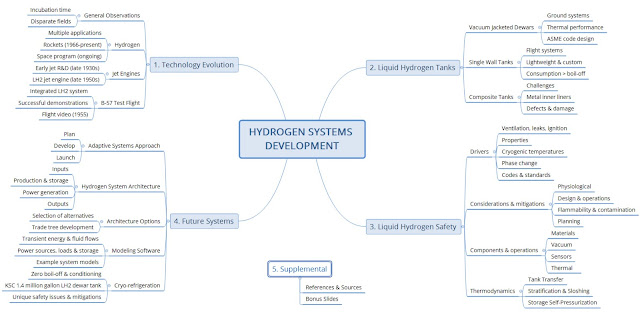
Technological evolution often requires decades of incubation and advancement in a variety of fields before large scale commercial adoption is achieved. Hydrogen has followed these trends since its discovery in the late 1700’s and subsequent application for wide ranging industrial uses. Liquid hydrogen (LH2) has been in routine and continuous use in the space program since the early 1960’s. However, many are not aware that its roots in aerospace trace much further back in aviation to the initial jet engine research and development in the late 1930’s; and later with successful flight demonstrations of a liquid hydrogen fueled jet engine in the mid-1950’s.

Modern LH2 systems make use of vacuum jacketed dewars for long term storage on the ground. Flight vehicles have used single wall tanks with foam insulation which significantly reduces mass but is only viable if the consumption rate in flight is greater than the boil-off venting required to meet tank pressure constraints. Composite LH2 tanks of various types (with or without metal inner liners) have been attempted over the years with mixed success and are still under development.

Safety with LH2 is a paramount priority. Key drivers are related to hydrogen’s properties, LH2 cryogenic temperatures, and liquid-vapor phase change within the system. Many legacy standards, codes and guidelines exist for LH2, and many more are in active formulation or revision. The three primary mantras to remember when designing and operating hydrogen systems is: 1) provide ventilation, 2) prevent leaks, and 3) eliminate ignition sources. Understanding the thermodynamic behavior of LH2 systems during various operations is also critical.

The development of future hydrogen systems can be optimized using an adaptive systems approach that treats hydrogen as a critical enabler in an overall system architecture rather than simply a commodity fuel. Selecting architecture options permit trade studies of candidate system concepts that can be assessed on the basis of technical, economic, environmental impact, and other key performance metrics. The end result is the ability to optimize systems for a multitude of hydrogen applications that can then be modeled, simulated, developed, assembled, and put into operation. Further, the proven ability to eliminate boil-off losses in LH2 systems - and provide better performing and sustainable propulsion and power relative to legacy fossil fuel systems - will play a key role in the global transition to hydrogen


Matt Moran is the Managing Member at Moran Innovation LLC, and previous Managing Partner at Isotherm Energy. He's been developing power and propulsion systems for more than 40 years; and first-of-a-kind liquid, slush and gaseous hydrogen systems since the mid-1980s. Matt was also the Sector Manager for Energy & Materials in his last position at NASA where he worked for 31 years. He's been a cofounder in seven technology based start-ups; and provided R&D and engineering support to many industrial, government and research organizations. Matt has three patents and more than 50 publications including the Cryogenic Fluid Management report series. More about him can be found here.

Saturday, May 12, 2018

No-Loss Liquid Hydrogen and LNG Systems (Zero Boil-Off)

Last December, we completed the analysis and design of an integrated cryogenic refrigeration system for the new 1.25 million gallon liquid hydrogen dewar at NASA Kennedy Space Center. The system enables zero boil-off long term storage for an electrical cost that is a fraction of the expense of replenishing hydrogen normally lost to venting. It also provides liquefaction and subcooling in support offloading, conditioning, transfer, and other critical operations.


Liquid Hydrogen Dewar at NASA Kennedy Space Center (source: NASA); and Isotherm Energy design process


The capability to economically eliminate boil-off gas at such a large scale is a game changer for many liquefied natural gas (LNG), liquid hydrogen and other cryogen applications.  Benefits include elimination of storage losses, improved system performance, increased safety, and mitigation of unwanted emissions. However,  a systematic approach is required to insure an optimal solution. This post provides an overview of the process we use at Isotherm Energy.

Needs, Goals and Objectives

The first step is establishing the why (needs), the what (goals), and the how (objectives) for the system. There's a common tendency to overlook this step and dive into a point design based on past projects or preconceived configurations. The result generally ranges from suboptimal at best, to infeasible at worst.


Questions to ask at this point include:
  1. Why is this system or capability needed? What is the overarching problem being solved?
  2. What addresses the identified needs? Performance, cost, efficiency, compliance, or other goals?
  3. How do we achieve the stated goals? Specific system objectives to be meet?

It's imperative that the documented answers to these questions are formally agreed upon by the key stakeholders. There must be a clear understanding of the needs,  goals and objectives at the start of the project. They form the compass that keeps the development process pointed in the right direction. A simple example to illustrate from the NASA hydrogen dewar project:
  • Need: Mitigation of hydrogen losses in a new 1.25 million gallon dewar
  • Goal: Long term storage with zero boil-off operation for 30 years or more
  • Objective: No-loss integrated refrigeration and storage system design


Top Level Requirements and Concept of Operation

With the needs, goals and objectives identified, top level system requirements can be defined. These top level requirements will provide the basis for lower level requirements, and must be verifiable (e.g. by analysis, test, inspection, or some other method). They must also be upwardly traceable to the objectives, and flow down to lower level requirements. Requirement definition and analysis is generally an iterative process, but the top level requirements should document the primary system drivers that often come from the key stakeholders as "non-negotiable". Without this step in the process, there is no definitive measure to assess whether the system solution is acceptable.


An equally important step is drafting a system concept of operation. What are the nominal operations for the system? What are the key duty cycles and time frames over which the operations occur? What off-nominal operations are anticipated for maintenance, repair, etc.? By thinking through the specifics of these and other operational questions, the range of feasible solutions begins to come into focus. Bypassing this important step can lead to over-designed or under-designed solutions that become more costly to correct later in the development cycle.


A simple example of one top level requirement and a brief concept of operations summary:

  • Requirement: The system shall be capable of removing 3000 W of thermal energy from the dewar continuously at 20 K. Rationale: Cooling capacity must be sufficient to overcome environmental heat leak and thermodynamic conditioning heat loads. Verification: by analysis and test.
  • Concept of Operation: During nominal operations, the refrigeration system maintains tank pressure without venting. For tanker off-loads, roadable tankers fill the large stationary dewar while the refrigeration system conditions the hydrogen to maintain tank pressure without venting. When rapid depressurization is needed, the refrigeration system cooling flow is reversed to provide maximum cooling in the ullage for liquefaction. During fueling operations, the refrigeration system is in bypass mode. After fueling (post launch), the refrigeration system may be used to re-liquefy hydrogen vapor and depressurize the dewar.


System Trades and Analysis

The next step is to identify system design options that are within the feasible trade space, and then analyze critical performance and economic parameters. There are many possible trades to consider, but the primary ones from a thermal performance standpoint can be broadly grouped as passive, hybrid, active, or some combination thereof. Note that many options may fit into more than one of these categories depending on the implementation.


Passive techniques minimizing heat treat transfer into the system through structures, insulation, and penetrations are always important to explore first. These methods rely on good cryogenic design and material selection, and do not need any power input. Depending on the requirements and concept of operation timelines, an optimized passive thermal design may be sufficient to develop a no-loss system within the operational parameters of the application.


The hybrid category often relies on driving pressure differentials or power input for pumps, mixers and valves to provide cooling. The Joule-Thomson effect can be used in single stream cooling lines, or augmented with a heat exchanger and pump for cryogen flow on the warm side. Thermal de-stratification with any method that induces circulation of the liquid cryogen can prolong storage times by bringing the tank to equilibrium conditions (and avoiding venting). Manipulation of the boundary temperature can significantly reduce the effective environmental heat leak. This can be accomplished using a thermodynamic vent system during cryogen use, or by storing or flowing a complementary higher temperature cryogen in a jacket around the tank.


Finally, active cooling techniques require significant input power to make use of cryogenic refrigeration or cryocoolers to intercept or extract heat from the system. These refrigerators must interface with some form of heat exchanger, and perform in an integrated dynamic fashion for all required operations. These systems can also be used to subcool (densify) the cryogen for increased storage density and thermal capacity. The result is much longer storage times since significant environmental heat leak is absorbed before the cryogen reaches saturation conditions.


Design and Development


Based on the system trades and analysis performed in the previous step, each feasible design trade is ranked based upon key quantitative and qualitative criteria. Ranking methods and criteria selection should be established by consensus with the stakeholders prior to comparing design trades. This helps avoid the temptation to tweak the process in real time which can result in selection bias.

The highest ranked trade that meets all the requirements can then be selected for detailed system analysis and design. It's important during this step to document key assumptions, system interfaces, boundaries conditions, analysis approach, parametrics, optimizations, detailed results, etc. This step may require more than one iteration, or selection of the next highest ranked design trade, if the initially selected trade doesn't result in an acceptable solution.

When the design is deemed satisfactory, verification and testing is performed to validate that all the requirements are are met by the system. The project scope dictates the details of the verification and validation effort (e.g. verification of all analysis results; component and subsystem testing; and integrated system testing). The subsequent final design and system specification provides the information required to build, install and operate the system.

Optimal No-Loss Liquid Hydrogen and LNG Systems

Of course, this brief overview doesn't address all of the detailed considerations and customization needed for a specific liquid hydrogen or LNG application. However, following the overall approach helps to insure that the needs, goals and objectives are addressed in a systematic way that meets the requirements and is consistent with the concept of operation.

Furthermore, exploring the feasible trade space - and selecting the best design within it - also mitigates the risk of a sub-optimal design. Such an approach is key to economically minimizing or eliminating boil-off losses for  cryogenic systems.


Matt Moran is the Managing Member at Moran Innovation, and previous Managing Partner at Isotherm Energy. He's been developing power and propulsion systems since 1982. Matt was also the Sector Manager for Energy & Materials in his last position at NASA where he worked for 31 years. He's been involved in seven technology based start-ups; and provided R&D and engineering support to many industrial, government and research organizations.  More about Matt here…

Saturday, July 15, 2017

Largest Liquid Hydrogen Dewar Tank (Ever)


NASA Kennedy Space Center Liquid Hydrogen Dewar Tank (credits: NASA/Kim Shiflett)

Isotherm Energy has been awarded a subcontract to provide support for development of the largest hydrogen dewar tank in history at the NASA Kennedy Space Center (KSC). As previously reported by NASA, the new dewar will hold well over one million gallons of liquid hydrogen and is 50% larger than the current record holder that supported space shuttle launches for 30 years (see above).

A primary focus of Isotherm Energy’s support is the analysis, design and integration of a new technology that eliminates hydrogen loss during storage. Shawn Quinn, assistant program manager of NASA KSC Ground Systems Development and Operations (GSDO), explained how the dewar and its unique capabilities will support the new Space Launch System 
[1], “…GSDO will fill the rocket's core stage and interim cryogenic upper stage with hundreds of thousands of gallons of liquid hydrogen. An important feature of the new zero boil-off technology is the potential to reduce long-term energy costs and liquid hydrogen commodity costs."

This key capability will build upon previous research demonstrations done by NASA to investigate an integrated system that can provide liquefaction, propellant densification, and zero boil-off. “The goal would be to integrate the unit's heat exchange system into the new tank, saving GSDO money by eliminating the loss of hydrogen”, according to Bill Notardonato, principal investigator for the 33,000 gallon demonstration unit (shown below) [2]. “By accomplishing zero boil-off of liquid hydrogen, we could save one dollar in hydrogen for every 20 cents spent on electricity to keep it cooled.”

(Photo credit: NASA/Cory Huston)

The successful design and operation of a liquid hydrogen storage system at this scale with zero boil-off, liquefaction and densification capabilities has far reaching implications even beyond the space program. For example, Isotherm Energy has developed a hydrogen energy storage architecture and associated system development software for renewable power sources (among other applications). The demonstrated ability to economically eliminate hydrogen losses for such a system – not to mention liquefy gaseous hydrogen and subcool the resulting liquid – would be a significant game changer.

[1] “Ultra-Cold Storage – Liquid Hydrogen May Be Fuel of the Future”, Amanda Griffin and Linda Herridge, NASA KSC, Dec 14, 2016.

[2] Ibid.

Matt Moran is the Managing Member at Moran Innovation, and previous Managing Partner at Isotherm Energy. He's been developing power and propulsion systems since 1982. Matt was also the Sector Manager for Energy & Materials in his last position at NASA where he worked for 31 years. He's been involved in seven technology based start-ups; and provided R&D and engineering support to many industrial, government and research organizations.  More about Matt here…