Densified Propellant Testing: Moran Innovation was awarded a subcontract to provide subject matter expertise for densified propellant capabilities development at White Sands Test Facility.
Short course, invited panelist, and presentation: Matt Moran taught a short course and was a panelist and presenter on the topic of cryogenic systems at NASA's 2022 Thermal and Fluids Analysis Workshop.
NASA Cryogenic Systems Modeling: Moran Innovation is supporting additional new contract work for NASA related to validation of high fidelity modeling tools with experimental tests of liquid hydrogen, methane, oxygen, and other cryogens.
Heavy-Lift Aircraft: Moran Innovation completed support of a design cycle for the liquid hydrogen propulsion and power system of a private sector heavy-lift cargo aircraft.
NASA Support Contract Extensions: Moran Innovation has been awarded two contract extensions of 6 months and 18 months, respectively, related to the NASA Human Landing System program.
- Other news. See the Moran Innovation website and blog at LH2era.com for more in depth information and news on hydrogen, propulsion, and power systems.
Translate
Showing posts with label propulsion. Show all posts
Sunday, January 1, 2023
Moran Innovation 2022 Highlights
Matt Moran is the Managing Member at Moran Innovation LLC, and previous Managing Partner at Isotherm Energy. He's been developing power and propulsion systems for more than 40 years; and first-of-a-kind liquid, slush and gaseous hydrogen systems since the mid-1980s. Matt was also the Sector Manager for Energy & Materials in his last position at NASA where he worked for 31 years. He's been a cofounder in seven technology based start-ups; and provided R&D and engineering support to hundreds of organizations. Matt has three patents and more than 50 publications including the Cryogenic Fluid Management report series. He also leads the LH2 Era™ Webinar Series. More about Matt can be found on his LinkedIn page.
Monday, December 20, 2021
Moran Innovation 2021 Highlights
![]() |
| NASA KSC LC39B New Liquid Hydrogen Dewar Tank (left: under construction in 2020, right: near completion in 2021) |
- Hydrogen Systems Development: Past, Present and Future. Seminar presentation to LTA Research on the evolution of hydrogen systems in aerospace along with present day state-of-the-art technologies and future hydrogen systems. A publicly available abstract and version of the presentation package can be found here.
- Densified and No-Loss (Zero Boil-off) Liquid Hydrogen Systems. An overview of these systems along with safety considerations and proven mitigations presented at the Center for Hydrogen Safety Asia-Pacific Conference 2021. The abstract, video and presentations slides can be found here.
- Liquid Hydrogen Drones and Microgrids. US Air Force funded project to demonstrate extended duration drones and integrated hydrogen energy storage for base operations under subcontract to NEOEx Systems. A $10 million earmark from the 2022 US federal defense appropriation budget will support further development of liquid hydrogen refueling systems.
- Lunar Human Landing System (HLS). Support to NASA under subcontract to HX5 as a subject matter expert in cryogenic fluid management for the SpaceX HLS development of the first commercial human lander that will safely carry astronauts to the lunar surface.
- Long Term Liquid Hydrogen Storage. Support to NASA under subcontract to HX5 for the Lockheed Martin Tipping Point testing of more than a dozen cryogenic fluid management technologies, positioning them for infusion into future space systems.
- Orbital Cryogenic Propellant Transfer. Support to NASA under subcontract to HX5 for the SpaceX Tipping Point large-scale flight demonstration to transfer cryogenic propellant, specifically liquid oxygen, between tanks on a Starship vehicle.
- New design tools and training courses. Several new software tools for liquid hydrogen systems and cryogenic fluid management were created in 2021. Training courses on these topic areas are also under development and planned for rollout in 2022.
- Lunar ice mining concept. "Down Under Excavation and Transport (DUET) Lunar Mining System (LuMiS)", Free J., Cannard S., Sciortino J., Rhatigan J., Haberbusch M., Moran M. Submitted to the NASA Break the Ice Challenge and presented at the 2021 Lunar Surface Science Workshop.
- Other news. See the Moran Innovation website and blog at LH2era.com for more in depth information and news on hydrogen, propulsion, and power systems.
Matt Moran is the Managing Member at Moran Innovation LLC, and previous Managing Partner at Isotherm Energy. He's been developing power and propulsion systems for more than 40 years; and first-of-a-kind liquid, slush and gaseous hydrogen systems since the mid-1980s. Matt was also the Sector Manager for Energy & Materials in his last position at NASA where he worked for 31 years. He's been a cofounder in seven technology based start-ups; and provided R&D and engineering support to many industrial, government and research organizations. Matt has three patents and more than 50 publications including the Cryogenic Fluid Management report series. More about him can be found here.
Saturday, October 9, 2021
Hydrogen Systems Development: Past, Present and Future
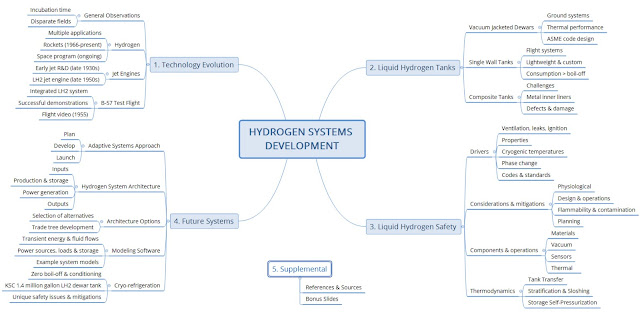
Technological evolution often requires decades of incubation and advancement in a variety of fields before large scale commercial adoption is achieved. Hydrogen has followed these trends since its discovery in the late 1700’s and subsequent application for wide ranging industrial uses. Liquid hydrogen (LH2) has been in routine and continuous use in the space program since the early 1960’s. However, many are not aware that its roots in aerospace trace much further back in aviation to the initial jet engine research and development in the late 1930’s; and later with successful flight demonstrations of a liquid hydrogen fueled jet engine in the mid-1950’s.
Modern LH2 systems make use of vacuum jacketed dewars for long term storage on the ground. Flight vehicles have used single wall tanks with foam insulation which significantly reduces mass but is only viable if the consumption rate in flight is greater than the boil-off venting required to meet tank pressure constraints. Composite LH2 tanks of various types (with or without metal inner liners) have been attempted over the years with mixed success and are still under development.
Safety with LH2 is a paramount priority. Key drivers are related to hydrogen’s properties, LH2 cryogenic temperatures, and liquid-vapor phase change within the system. Many legacy standards, codes and guidelines exist for LH2, and many more are in active formulation or revision. The three primary mantras to remember when designing and operating hydrogen systems is: 1) provide ventilation, 2) prevent leaks, and 3) eliminate ignition sources. Understanding the thermodynamic behavior of LH2 systems during various operations is also critical.
The development of future hydrogen systems can be optimized using an adaptive systems approach that treats hydrogen as a critical enabler in an overall system architecture rather than simply a commodity fuel. Selecting architecture options permit trade studies of candidate system concepts that can be assessed on the basis of technical, economic, environmental impact, and other key performance metrics. The end result is the ability to optimize systems for a multitude of hydrogen applications that can then be modeled, simulated, developed, assembled, and put into operation. Further, the proven ability to eliminate boil-off losses in LH2 systems - and provide better performing and sustainable propulsion and power relative to legacy fossil fuel systems - will play a key role in the global transition to hydrogen
See slide package here: https://drive.google.com/file/d/13CYhHxrRy8CcnwLKUjnatyY4ZiamiNst/view
Matt Moran is the Managing Member at Moran Innovation LLC, and previous Managing Partner at Isotherm Energy. He's been developing power and propulsion systems for more than 40 years; and first-of-a-kind liquid, slush and gaseous hydrogen systems since the mid-1980s. Matt was also the Sector Manager for Energy & Materials in his last position at NASA where he worked for 31 years. He's been a cofounder in seven technology based start-ups; and provided R&D and engineering support to many industrial, government and research organizations. Matt has three patents and more than 50 publications including the Cryogenic Fluid Management report series. More about him can be found here.
Sunday, August 30, 2020
AIAA Propulsion and Energy Forum
On August 24th I was on a Forum 360 panel about "Sustaining Mission Possibilities Through Enabling Technologies" at the virtual AIAA Propulsion and Energy conference. Above is a video clip of my opening remarks.
Matt Moran is the Managing Member at Moran Innovation, and previous Managing Partner at Isotherm Energy. He's been developing power and propulsion systems since 1982. Matt was also the Sector Manager for Energy & Materials in his last position at NASA where he worked for 31 years. He's been involved in seven technology based start-ups; and provided R&D and engineering support to many industrial, government and research organizations. More about Matt here…
Saturday, October 13, 2018
Space Sector Growing
Isotherm Energy recently completed aerospace consulting contracts for several customers. The projects involved systems engineering and design review support related to spacecraft fluid and propulsion systems.
The global space economy is currently valued at about $350 billion USD, and has been growing at 6-8% CAGR for the past decade. Projected annual growth rate is expected to continue at about the same clip (7%). [1]
While government and communications have predominantly driven past growth, new markets such as commercial human spaceflight are expected to play an expanded role going forward. Demand for experienced engineering support will also grow as a result.
![]() |
| NASA Lunar Gateway spacecaft concept (source: NASA) |
The global space economy is currently valued at about $350 billion USD, and has been growing at 6-8% CAGR for the past decade. Projected annual growth rate is expected to continue at about the same clip (7%). [1]
While government and communications have predominantly driven past growth, new markets such as commercial human spaceflight are expected to play an expanded role going forward. Demand for experienced engineering support will also grow as a result.
[1] Source: SpaceNews, 2018
Matt Moran is the Managing Member at Moran Innovation, and previous Managing Partner at Isotherm Energy. He's been developing power and propulsion systems since 1982. Matt was also the Sector Manager for Energy & Materials in his last position at NASA where he worked for 31 years. He's been involved in seven technology based start-ups; and provided R&D and engineering support to many industrial, government and research organizations. More about Matt here…
Tuesday, April 26, 2016
Power and Water the NASA Way
We’re sometimes met with a puzzled look at Isotherm Energy when we describe our hydrogen energy system architecture and its ability to store energy, generate power, recover heat, and produce potable water. It seems the combination of functions – particularly energy and water together - is unfamiliar to many. After three decades of working at NASA where these types of systems have been routine since the mid-1960s, I hadn’t considered that it might sound odd to those outside the aerospace industry.
A recent article about the famously jinxed Apollo 13 mission describes an early example:
The Space Shuttle also used fuel cells in a similar manner:
As another more personal example, I was asked in 1991 by NASA Headquarters to conduct a study on launching water to low earth orbit for processing into hydrogen and oxygen propellants to support missions to the moon and Mars. The published system concept I designed used an electrolyzer to produce the propellants, and then liquefy them for storage until a spacecraft docked for refueling (see schematic below). We would revisit aspects of this configuration later at NASA when I worked on designs to provide power, propulsion, water and environmental control for lunar surface systems.
So the integration of proven aerospace technologies into a combined energy-water-heat recovery architecture was a natural extension of my personal experiences and background. And I’m convinced it will serve us well as we begin to view our energy, water and food systems here on earth from a more integrated sustainable perspective.
A recent article about the famously jinxed Apollo 13 mission describes an early example:
“Apollo 13 lost its electricity, light, and water supply… The loss of an oxygen tank was crippling to an Apollo spacecraft because the oxygen tanks powered the fuel cells that powered the spacecraft… The electrochemical reaction of combining cryogenic hydrogen and oxygen produced electricity, heat, and potable water as byproducts.” [Popular Science, Apr 15, 2016]
![]() |
| Part of an unflown Apollo fuel cell [National Air and Space Museum] |
The Space Shuttle also used fuel cells in a similar manner:
“Fuel cells are used in the space shuttle as one component of the electrical power system. Three fuel cell power plants, through a chemical reaction, generate all of the electrical power for the vehicle from launch through landing rollout… are individually coupled to the reactant (hydrogen and oxygen) distribution subsystem, the heat rejection subsystem, the potable water storage subsystem, and the electrical power distribution and control subsystem. The fuel cell power plants generate heat and water as by-products of electrical power generation.” [NASA]
| One of the three fuel cells that provides electrical power to the space shuttle orbiter [NASA] |
As another more personal example, I was asked in 1991 by NASA Headquarters to conduct a study on launching water to low earth orbit for processing into hydrogen and oxygen propellants to support missions to the moon and Mars. The published system concept I designed used an electrolyzer to produce the propellants, and then liquefy them for storage until a spacecraft docked for refueling (see schematic below). We would revisit aspects of this configuration later at NASA when I worked on designs to provide power, propulsion, water and environmental control for lunar surface systems.
|
|
| Source: “Conceptual Study of on Orbit Production of Cryogenic Propellants by Water Electrolysis”, Moran, 1991. |
So the integration of proven aerospace technologies into a combined energy-water-heat recovery architecture was a natural extension of my personal experiences and background. And I’m convinced it will serve us well as we begin to view our energy, water and food systems here on earth from a more integrated sustainable perspective.
Matt Moran is the Managing Member at Moran Innovation, and previous Managing Partner at Isotherm Energy. He's been developing power and propulsion systems since 1982. Matt was also the Sector Manager for Energy & Materials in his last position at NASA where he worked for 31 years. He's been involved in seven technology based start-ups; and provided R&D and engineering support to many industrial, government and research organizations. More about Matt here…
Subscribe to:
Posts (Atom)


