Translate

Showing posts with label liquefaction. Show all posts

Wednesday, June 4, 2025

Why Liquefy Hydrogen?

Source: "Liquid Hydrogen Systems Course", Moran, 2025.


No Free Lunch (But Keeping it Chill Has Some Benefits)

It takes energy to store hydrogen whether it's liquefied, compressed, converted to/from another carrier fluid, or absorbed/adsorbed in a solid state material. So when does liquefaction make sense as the storage method of choice?

The answer lies in a properly executed systems engineering analysis and design trade study for the application being developed. There are a few key features and capabilities of liquid hydrogen (LH2) systems that come into play when comparing options: 
  • Higher volumetric density
  • Lower pressure storage
  • Higher storage mass fraction
  • Cooling capacity
  • Pressurization capability

The first three have been discussed in previous posts, and are the reason why so many mobility applications are using or contemplating LH2.  These characteristics also increase in importance for large scale applications such as maritime, rail, long-distance trucking, offtake and fueling infrastructure, delivery and export, etc.

However, the last two capabilities are often underappreciated or ignored by those not experienced with cryogenic systems. The cooling capacity and self-pressurization benefits of LH2 are used in a variety of ways in a properly designed system.

Both of these capabilities can effectively recover some of the energy expended during liquefaction, a fact that many reports and studies tend to ignore. State-of-the-art liquefaction plants require about 10 KWh of input energy per kg of liquefied hydrogen, and conceptual plant designs are expected to bring this down by more than 50% (see below). But part of that energy is still accessible in the stored LH2 for those who know how to use it.

A Cool Thing to Have Around (And Who Needs a Compressor)

The cooling capacity of LH2 can be used in heat exchangers to reject heat from other subsystems; maintain structures below their maximum temperature limits when subjected to high heat loads; or keep superconducting components at the required cryogenic temperature. This can all be done as part of the warming process of a hydrogen stream being fed to a fuel cell or engine.

Cooling is also available through the Joule-Thomson effect which can be produced using a pressure drop device with LH2 or GH2 below 200 K (e.g., orifice, valve, etc.). Another cooling mechanism unique to hydrogen is the endothermic reaction of the para-to-ortho conversion that can be catalyzed in a vaporized hydrogen stream.

And when it's time to pressurize a hydrogen system, the LH2 will do the job with no input power needed. Metering a small amount of LH2 into an isolated volume and allowing it to vaporize and warm results in any pressure required if done properly. This "pressure-building" method has been widely and routinely used for decades in LH2 systems of all sizes and types. No compressor or compressed gas needed.

It all comes down to knowing how to make cryogenics work in your favor. And the first law of thermodynamics is where to start (see below). Applying good systems engineering can uncover a great deal of overall efficiency improvements keeping this fundamental equation in mind.

Author Bio

Matt Moran is the Managing Member at Moran Innovation LLC, and previous Managing Partner at Isotherm Energy. He's been developing power and propulsion systems for more than 40 years; and first-of-a-kind gas, slush, and liquid hydrogen systems since the mid-1980s. Matt was also the Sector Manager for Energy & Materials in his final position at NASA where he worked for 31 years. He's been a cofounder in seven technology-based startups; and provided R&D, engineering, and innovation consulting to several hundred organizations. Matt has three patents and more than 50 publications including his online Cryogenic Fluid Management guide and Decarbonizing Mobility with Liquid Hydrogen SAE report. He has created and taught liquid hydrogen courses, webinars, and workshops to global audiences.


Saturday, June 25, 2022

Entering the Cryo Zone with Hydrogen


Saturation temperature vs pressure for hydrogen, oxygen, and methane [1]


At ambient temperature and pressure (i.e., 298 K and 1.01 bar), hydrogen is a gas with approximately 7% the density of air. This results in an advantageous rise rate of nearly 20 m/s (or six times faster than natural gas) enabling rapid dispersion of any leaks. However, this low density is a challenge for storage.

The two most commonly used methods of increasing hydrogen density in order to store significant quantities are compression and liquefaction. Compressed storage up to 700 bar is commercially available and increases the density of hydrogen by a factor of 477 times greater than ambient pressure; whereas, liquefaction increases it by 866 times compared to ambient conditions (i.e., nearly double the density of compressed hydrogen at 700 bar).

Liquefying Hydrogen


In order to liquefy hydrogen it must be cooled to a very low temperature (e.g., 20 K at 1.01 bar). This is accomplished with a cryogenic liquefier or cryocooler. Various thermodynamic cycles and equipment are available for this purpose.

All liquefaction processes are limited by the ideal Carnot efficiency which is calculated as the ratio of the cold refrigeration temperature divided by the difference in cold refrigeration and warm rejection temperatures. The actual performance of hydrogen liquefiers are a fraction of the ideal efficiency, ranging from about 30-40% of Carnot for state-of-the-art systems.

Two-stage hydrogen liquefiers generally bring the hydrogen gas down to the 80-100 K range in the first stage (i.e., sensible cooling); and then cool and liquefy it in the 20 K range in the second stage (i.e. sensible and latent cooling). Efficiencies are much higher for the first stage due to the higher refrigeration temperature.

Hydrogen liquefaction must also address the conversion of ortho-to-para hydrogen that occurs at cryogenic temperature. This change in equilibrium electron spin state is an exothermic process that is generally accelerated with a catalyst during liquefaction.

Liquid Hydrogen Storage Behavior


Insight into the behavior of hydrogen and other fluids at cryogenic temperatures can be gleaned by examining their saturation temperature at the vapor pressure of interest (see above plot). In a container of liquid hydrogen, the interface between the liquid and vapor is always at the saturation temperature corresponding to the container vapor pressure.

However, the temperatures in the hydrogen vapor space of the container - also known as the ullage - are at or above the saturation temperature (i.e., superheated). For a stationary tank, the ullage thermally stratifies with the coolest temperature near the interface and warmest temperatures near the top of the container.

Conversely, the liquid hydrogen in such a container is at or below the saturation temperature (subcooled). A stationary container with subcooled liquid will also thermally stratify with the coldest temperatures near the bottom of the tank. If the subcooled liquid is circulated toward the interface by a mixer, or from momentum forces in a mobile application, the tank pressure will drop to a new saturation condition.

Over time, the liquid hydrogen in a container will warm toward the saturation temperature (but not above it) due to heat transfer from the environment. When all of the liquid reaches saturation temperature, it will begin to boil off and raise the tank pressure. This additional vapor must either be vented when the tank pressure reaches the maximum design limit; or reliquefied to maintain "zero boil-off" storage.

Cryogenic Material Properties


Most materials behave very differently at cryogenic temperatures compared to ambient conditions. These differences must be well understood by engineers, designers, and operators of cryogenic systems.

Thermal properties of materials such as conductivity and specific heat are highly nonlinear functions of temperature in the cryogenic range. As a result, heat transfer and energy balance calculations often require integrating the property of interest over the temperature range. Simply using an average value between the upper and lower temperature can result in significant calculation errors.

Mechanical properties that can vary significantly at low temperature include:
  • Yield and ultimate strength: generally increases at lower temperatures for most solids
  • Ductility: some materials remain ductile (e.g. aluminum alloys, austenitic stainless steel with > 7% nickel, most face-centered cubic metals); while some materials become brittle (carbon steel, most plastics, most body-centered cubic metals)
  • Elastic modulus: varies
  • Fatigue strength: varies

All of the above has implications for the selection of materials in liquid hydrogen system design. Storage tanks of 300 series stainless steel are common. Aluminum alloys are also used in some applications, and titanium alloys are suitable but rarely used outside of the aerospace industry.

Seals for fittings, gaskets, and valves must be comprised of compatible elastomers for cryogenic hydrogen service. Likewise, instrumentation and sensors designed for cryogenic temperatures are required for liquid hydrogen system monitoring and process control.

In the next post I'll touch on tank design options, insulation systems, and filling/draining operations.


References


Matt Moran is the Managing Member at Moran Innovation LLC, and previous Managing Partner at Isotherm Energy. He's been developing power and propulsion systems for more than 40 years; and first-of-a-kind liquid, slush and gaseous hydrogen systems since the mid-1980s. Matt was also the Sector Manager for Energy & Materials in his last position at NASA where he worked for 31 years. He's been a cofounder in seven technology based start-ups; and provided R&D and engineering support to hundreds of organizations. Matt has three patents and more than 50 publications including the Cryogenic Fluid Management report series. More about him can be found here.

Saturday, October 9, 2021

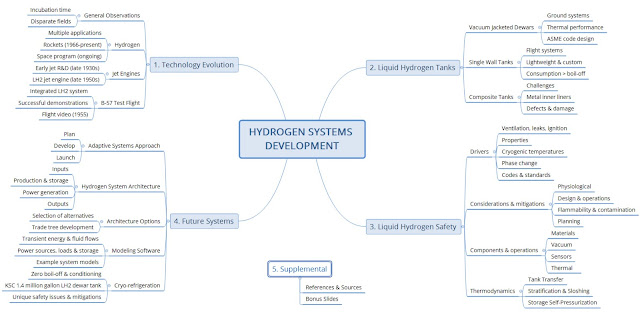
Hydrogen Systems Development: Past, Present and Future


Technological evolution often requires decades of incubation and advancement in a variety of fields before large scale commercial adoption is achieved. Hydrogen has followed these trends since its discovery in the late 1700’s and subsequent application for wide ranging industrial uses. Liquid hydrogen (LH2) has been in routine and continuous use in the space program since the early 1960’s. However, many are not aware that its roots in aerospace trace much further back in aviation to the initial jet engine research and development in the late 1930’s; and later with successful flight demonstrations of a liquid hydrogen fueled jet engine in the mid-1950’s.

Modern LH2 systems make use of vacuum jacketed dewars for long term storage on the ground. Flight vehicles have used single wall tanks with foam insulation which significantly reduces mass but is only viable if the consumption rate in flight is greater than the boil-off venting required to meet tank pressure constraints. Composite LH2 tanks of various types (with or without metal inner liners) have been attempted over the years with mixed success and are still under development.

Safety with LH2 is a paramount priority. Key drivers are related to hydrogen’s properties, LH2 cryogenic temperatures, and liquid-vapor phase change within the system. Many legacy standards, codes and guidelines exist for LH2, and many more are in active formulation or revision. The three primary mantras to remember when designing and operating hydrogen systems is: 1) provide ventilation, 2) prevent leaks, and 3) eliminate ignition sources. Understanding the thermodynamic behavior of LH2 systems during various operations is also critical.

The development of future hydrogen systems can be optimized using an adaptive systems approach that treats hydrogen as a critical enabler in an overall system architecture rather than simply a commodity fuel. Selecting architecture options permit trade studies of candidate system concepts that can be assessed on the basis of technical, economic, environmental impact, and other key performance metrics. The end result is the ability to optimize systems for a multitude of hydrogen applications that can then be modeled, simulated, developed, assembled, and put into operation. Further, the proven ability to eliminate boil-off losses in LH2 systems - and provide better performing and sustainable propulsion and power relative to legacy fossil fuel systems - will play a key role in the global transition to hydrogen


Matt Moran is the Managing Member at Moran Innovation LLC, and previous Managing Partner at Isotherm Energy. He's been developing power and propulsion systems for more than 40 years; and first-of-a-kind liquid, slush and gaseous hydrogen systems since the mid-1980s. Matt was also the Sector Manager for Energy & Materials in his last position at NASA where he worked for 31 years. He's been a cofounder in seven technology based start-ups; and provided R&D and engineering support to many industrial, government and research organizations. Matt has three patents and more than 50 publications including the Cryogenic Fluid Management report series. More about him can be found here.

Saturday, July 15, 2017

Largest Liquid Hydrogen Dewar Tank (Ever)


NASA Kennedy Space Center Liquid Hydrogen Dewar Tank (credits: NASA/Kim Shiflett)

Isotherm Energy has been awarded a subcontract to provide support for development of the largest hydrogen dewar tank in history at the NASA Kennedy Space Center (KSC). As previously reported by NASA, the new dewar will hold well over one million gallons of liquid hydrogen and is 50% larger than the current record holder that supported space shuttle launches for 30 years (see above).

A primary focus of Isotherm Energy’s support is the analysis, design and integration of a new technology that eliminates hydrogen loss during storage. Shawn Quinn, assistant program manager of NASA KSC Ground Systems Development and Operations (GSDO), explained how the dewar and its unique capabilities will support the new Space Launch System 
[1], “…GSDO will fill the rocket's core stage and interim cryogenic upper stage with hundreds of thousands of gallons of liquid hydrogen. An important feature of the new zero boil-off technology is the potential to reduce long-term energy costs and liquid hydrogen commodity costs."

This key capability will build upon previous research demonstrations done by NASA to investigate an integrated system that can provide liquefaction, propellant densification, and zero boil-off. “The goal would be to integrate the unit's heat exchange system into the new tank, saving GSDO money by eliminating the loss of hydrogen”, according to Bill Notardonato, principal investigator for the 33,000 gallon demonstration unit (shown below) [2]. “By accomplishing zero boil-off of liquid hydrogen, we could save one dollar in hydrogen for every 20 cents spent on electricity to keep it cooled.”

(Photo credit: NASA/Cory Huston)

The successful design and operation of a liquid hydrogen storage system at this scale with zero boil-off, liquefaction and densification capabilities has far reaching implications even beyond the space program. For example, Isotherm Energy has developed a hydrogen energy storage architecture and associated system development software for renewable power sources (among other applications). The demonstrated ability to economically eliminate hydrogen losses for such a system – not to mention liquefy gaseous hydrogen and subcool the resulting liquid – would be a significant game changer.

[1] “Ultra-Cold Storage – Liquid Hydrogen May Be Fuel of the Future”, Amanda Griffin and Linda Herridge, NASA KSC, Dec 14, 2016.

[2] Ibid.

Matt Moran is the Managing Member at Moran Innovation, and previous Managing Partner at Isotherm Energy. He's been developing power and propulsion systems since 1982. Matt was also the Sector Manager for Energy & Materials in his last position at NASA where he worked for 31 years. He's been involved in seven technology based start-ups; and provided R&D and engineering support to many industrial, government and research organizations.  More about Matt here…