Translate

Showing posts with label renewables. Show all posts

Saturday, August 5, 2023

Why All Hydrogen Cost Projections Are Wrong


Nobody Knows


At a recent conference I attended, a representative from a company based in the Netherlands gave an impressive presentation on the many components and subsystems they manufacture for large scale liquid hydrogen service. When he concluded his talk and opened up for questions, an audience member quickly stepped to the microphone and asked "When will hydrogen cost two dollars per kilogram?"

The speaker said he didn't know the answer, pointed out that his talk wasn't about cost projections for hydrogen, and suggested that perhaps one of the upcoming talks by the US DOE or others would address it. The questioner smugly grinned and nodded his head dismissively as if he had proven some unspoken point.

I've seen similar versions of this type of interrogation in a variety of forums over the past year or two. It generally comes across as a rather banal attempt to challenge the feasibility of transitioning to hydrogen because it hasn't yet reached some nebulous cost target that the questioner has deemed necessary.

My somewhat flippant reaction to such questions is that the cost will drop much faster than most people think, but not as quickly as some hydrogen startups trying to get their next round of venture funding might claim. A more serious answer is nobody really knows. And more importantly, it's the wrong question to begin with. Let's address the nobody really knows part first...

New vs Legacy Improvements


An analogous historical comparison that can provide some insight is renewable energy, specifically wind and solar. The plot above shows the global levelized cost of electricity from various sources for the 13 years prior to June, 2022. Note that the cost of legacy generating sources - coal and natural gas - have been stagnant over this period (and for many years prior as well). Although legacy nuclear is not shown on the plot, it has actually increased in cost.

Now take a look at onshore wind and solar (i.e., photovoltaics; "PV"). These costs have dropped dramatically to the point where they are the cheapest options available. And yet less than a decade ago renewables were derided as too expensive to ever be competitive. Fast forward a few years, and now coal, gas, and nuclear power plants are clamoring to get permission to pass along their higher operating costs to users because they cannot compete with solar and wind power generation.

There are at least three reasons why this has occurred:
  1. New technologies have the potential for large performance and cost improvements as they scale and more competitors enter the fray; Whereas, legacy technologies have already wrung out all but incremental performance and cost improvements over a very long time (often a century or more) in entrenched industries.
  2. Public policy and regulations generally favor legacy technologies, including subsidies that start as incentives and become perennial handouts (usually funded by taxpayers) as the legacy companies plow part of their outsized profits into political donations, lobbying, etc. Sometimes, however, a new technology begins to get traction and public policy starts to take its thumb off the legacy side of the scale. Geopolitical interests are also a powerful driver of policy changes.
  3. And the final reason is always in play regardless of the industry sector: follow the money. Once private and public investments start flowing toward the new technology, the momentum builds and also feeds into the other two reasons above. The overall effect is an acceleration in performance improvement, cost reduction, and market penetration that often becomes unstoppable.
As a result of these factors and others, projections about renewable energy from even a few years prior to the timeframe shown in the above plot grossly underestimated the magnitude and speed of the drop in cost. Simply put, the timing and interaction of all these factors cannot be predicted a priori with any meaningful accuracy. And it will be the same for hydrogen.

The Right Question to Ask


Of course, it's good to have hydrogen cost targets to help focus resources and priorities on the reductions necessary for widespread commercialization and adoption. But targets are goals, not predictions.

What the cost targets include, and how they compare to existing and competing technologies, is also a key consideration. Lifecycle and externality costs, for example, are often not addressed when comparisons are made. This inappropriately tilts the scale again toward legacy technologies.

But let's put aside the debate about what to include in costs for now. An arguably more important issue is what question should we be asking if the future cost of hydrogen can be made into target goals but cannot be accurately predicted? I suggest the right question to ask is: How can the cost of hydrogen be reduced as quickly as possible?

Focusing on "how" instead of "what" or "when" catalyzes the innovations and investments needed to transition away from fossil fuels and the damage they are doing to our health and environment. Those who insist on making strawman arguments based on the inherently unknowable timing and magnitude of hydrogen cost reductions will be relegated to the sidelines. Meanwhile, organizations and individuals who focus on how to accelerate the reduction in hydrogen cost will ultimately own the market and the new energy paradigm.

  • Matt Moran is the Managing Member at Moran Innovation LLC, and previous Managing Partner at Isotherm Energy. He's been developing power and propulsion systems for more than 40 years; and break-through liquid, slush, and gaseous hydrogen systems since the mid-1980s. Matt was also the Sector Manager for Energy & Materials in his last position at NASA where he worked for 31 years. He's been a co-founder in seven technology startups; and provided R&D and engineering support to many organizations. Matt has three patents and more than 50 publications including the Cryogenic Fluid Management series. He also leads the monthly LH2 Era™ Webinar.

Saturday, October 9, 2021

Hydrogen Systems Development: Past, Present and Future


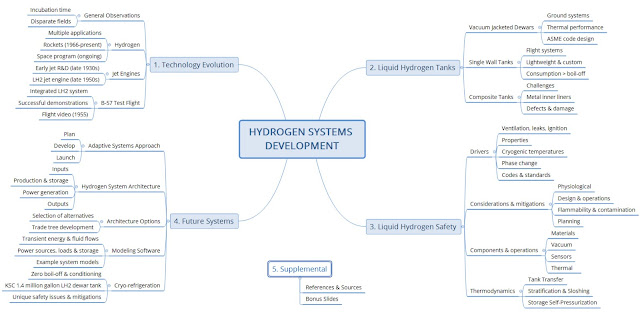
Technological evolution often requires decades of incubation and advancement in a variety of fields before large scale commercial adoption is achieved. Hydrogen has followed these trends since its discovery in the late 1700’s and subsequent application for wide ranging industrial uses. Liquid hydrogen (LH2) has been in routine and continuous use in the space program since the early 1960’s. However, many are not aware that its roots in aerospace trace much further back in aviation to the initial jet engine research and development in the late 1930’s; and later with successful flight demonstrations of a liquid hydrogen fueled jet engine in the mid-1950’s.

Modern LH2 systems make use of vacuum jacketed dewars for long term storage on the ground. Flight vehicles have used single wall tanks with foam insulation which significantly reduces mass but is only viable if the consumption rate in flight is greater than the boil-off venting required to meet tank pressure constraints. Composite LH2 tanks of various types (with or without metal inner liners) have been attempted over the years with mixed success and are still under development.

Safety with LH2 is a paramount priority. Key drivers are related to hydrogen’s properties, LH2 cryogenic temperatures, and liquid-vapor phase change within the system. Many legacy standards, codes and guidelines exist for LH2, and many more are in active formulation or revision. The three primary mantras to remember when designing and operating hydrogen systems is: 1) provide ventilation, 2) prevent leaks, and 3) eliminate ignition sources. Understanding the thermodynamic behavior of LH2 systems during various operations is also critical.

The development of future hydrogen systems can be optimized using an adaptive systems approach that treats hydrogen as a critical enabler in an overall system architecture rather than simply a commodity fuel. Selecting architecture options permit trade studies of candidate system concepts that can be assessed on the basis of technical, economic, environmental impact, and other key performance metrics. The end result is the ability to optimize systems for a multitude of hydrogen applications that can then be modeled, simulated, developed, assembled, and put into operation. Further, the proven ability to eliminate boil-off losses in LH2 systems - and provide better performing and sustainable propulsion and power relative to legacy fossil fuel systems - will play a key role in the global transition to hydrogen


Matt Moran is the Managing Member at Moran Innovation LLC, and previous Managing Partner at Isotherm Energy. He's been developing power and propulsion systems for more than 40 years; and first-of-a-kind liquid, slush and gaseous hydrogen systems since the mid-1980s. Matt was also the Sector Manager for Energy & Materials in his last position at NASA where he worked for 31 years. He's been a cofounder in seven technology based start-ups; and provided R&D and engineering support to many industrial, government and research organizations. Matt has three patents and more than 50 publications including the Cryogenic Fluid Management report series. More about him can be found here.

Sunday, August 30, 2020

AIAA Propulsion and Energy Forum


On August 24th I was on a Forum 360 panel about "Sustaining Mission Possibilities Through Enabling Technologies" at the virtual AIAA Propulsion and Energy conference. Above is a video clip of my opening remarks.


Matt Moran is the Managing Member at Moran Innovation, and previous Managing Partner at Isotherm Energy. He's been developing power and propulsion systems since 1982. Matt was also the Sector Manager for Energy & Materials in his last position at NASA where he worked for 31 years. He's been involved in seven technology based start-ups; and provided R&D and engineering support to many industrial, government and research organizations.  More about Matt here…

Tuesday, August 30, 2016

Hydrogen System Architecture and Software Demo

The variability of wind and solar energy sources presents a challenge for meeting electrical load requirements. Isotherm Energy has developed a system architecture for addressing this challenge that provides energy storage, potable water, and hydrogen fuel production. The architecture enables tailoring of system parameters to meet specific application requirements using current and emerging technologies.


Click here to view a demonstration of the software

Isotherm Energy is developing a suite of software tools to simulate, analyze and design systems based on our hydrogen storage system architecture. The software allows selection of various input energy sources, water sources, biomass and other inputs. Subsequent screens allow the selection of options for hydrogen production, storage, byproducts, power generation, heat recovery, power output, excess hydrogen, and water management.

Once the architecture options are selected, the software generates a system model that incorporates all the chosen parameters. The system model calculates all energy and mass flows between subsystems along with heat available for recovery and improved overall system performance. Note that all system flows are driven by the load following function of the power management and distribution (PMAD) subsystem and calculated accordingly.


The system model has an optional time stamp capability for the conditions being simulated. When the “Save Conditions” button is clicked, all of the parameters associated with the time stamped simulation are stored for subsequent transient analysis. In this manner, a sequence of simulated hours, days, weeks or a full year can be automatically generated and investigated. Every parameter of the system can then be adjusted using built-in optimization tools to meet the performance goals over any timeframe of interest.

The software also provides complete flexibility in the selection of system variables such as electrical load and energy inputs. These can be a constant number at a given timestamp, a historical profile, a statistical distribution over a time averaged period, a stochastic probabilistic algorithm (e.g. Monte Carlo), or some other user defined method.

New capabilities under development include:
  • Detailed subsystem and component models
  • Drop-in capability for existing and emerging technologies
  • Comparison to other storage options (e.g. batteries, compressed air, pumped hydro, etc.)
  • Capital/operating expenditures, payback period, levelized cost of energy and other financial


Matt Moran is the Managing Member at Moran Innovation, and previous Managing Partner at Isotherm Energy. He's been developing power and propulsion systems since 1982. Matt was also the Sector Manager for Energy & Materials in his last position at NASA where he worked for 31 years. He's been involved in seven technology based start-ups; and provided R&D and engineering support to many industrial, government and research organizations.  More about Matt here…

Wednesday, May 18, 2016

The Path to Greenhouse Gas Emission Reduction (Part 1)


Last week I participated in a business roundtable discussion in Toronto hosted by Canada’s Ontario Centres of Excellence (OCE).  The focus of the meeting was to bring together industry emitters and solution providers for a collective discussion about how to meet the province’s greenhouse gas emission reduction target of 37% below 1990 levels by the year 2030.

These types of conversations are occurring around the world in various forms as each nation participating in the 2015 United Nations Climate Change Conference in Paris formulate policies to meet the emission goals agreed upon.  Although the implementation details will undoubtedly vary within the global community, many of the key challenges and opportunities are common to all.

In preparation for the meeting, the OCE requested feedback from the invited participants regarding the appropriate path forward, the roles each of us can play, and the barriers to success.  I believe these questions form a useful framework for many governments that are grappling with the same issues.

Clean the Smokestack?


OCE welcomes industry stakeholder feedback on the following questions: Looking forward to 2030 and Ontario’s GHG emissions target of 37% below 1990 levels, what do you view as the path forward for the Province to meet this emission reduction target?

Isotherm Energy: There are two general approaches to lowering emissions:
  1. Reduction of emissions between the combustion source and the smokestack. This is a near term solution that reduces atmospheric emissions, but must still address the captured carbon. Enable greater adoption of renewable sources to accelerate transition away from fossil fuels. This is a mid-term solution that addresses the problem at the source by reducing carbon based fuels. A balance of these two approaches is ideal.
  2. The “clean the smokestack” approach is by far the historically favored solution to reducing airborne emissions of all kinds.  My experience with this approach started with my first engineering job in 1982 at a 2200 MW coal-fired power plant.  The plant was finishing a nearly half-billion dollar installation of precipitators to remove particulates from the smokestacks to meet regulations.  At the time, the industry was denying any connection between the sulfur contained in the coal being burned and acid rain miles away in the direction of the prevailing winds aloft.  Many years later, the same plant finally made a capital investment of nearly two billion dollars to install flue gas scrubbers that remove most of the sulfur dioxide and nitrous oxide emissions, again to meet regulatory requirements.  No doubt, they are now looking at an even larger price tag for reducing carbon emissions.


Of course, this smokestack approach is not unique to the stationary power generation industry.  In 1985, I was recruited by NASA to develop space experiments for the space shuttle to study the effects of low gravity on combustion phenomena.  During our early development testing in drop towers on earth that provide a few seconds of weightlessness, we filmed the formation of soot emanating from liquid hydrocarbon fuel droplets that had never been previously observed nor predicted.


Hydrocarbon droplet combustion soot formed during a drop tower test at NASA


In a subsequent discussion about soot formation with one of our principal investigators, he commented that soot is a big health problem, and used diesel fuel as an example.  He explained that there is an upper limit on size above which the lungs can expel an inhaled particle, and a lower limit below which a particle is absorbed into the body via the alveoli in the lungs.  But for sizes between those upper and lower limits, the lungs can neither expel nor absorb a particle.  And diesel soot particles are in that size range that can become permanently entrapped in the lungs.  That’s why diesel trucks have their tail pipe exit so high above the ground, he concluded.


Observing this smokestack approach to airborne emissions reveals some inherent recurring patterns.  These include very long cycles of:
  • Growing evidence regarding the detrimental impacts of a particular emission
  • Public denials of the data by entrenched interests
  • Eventual policies and regulations to address the issue
  • Costly implementation of commercially available systems targeting the emission
These cycles often take decades to culminate in the reduction of the target emission, while it’s detrimental health and environmental impacts continue to grow in the interim.  And in the end, another symptom of the core problem is addressed without addressing the root cause: the combustion of hydrocarbon fuels.


In my next post, I’ll touch on the second part of the answer we gave the OCE for the path forward.  Accelerating the adoption of renewable energy sources requires systems integration, application optimization, and sustainable energy storage.


Matt Moran is the Managing Member at Moran Innovation, and previous Managing Partner at Isotherm Energy. He's been developing power and propulsion systems since 1982. Matt was also the Sector Manager for Energy & Materials in his last position at NASA where he worked for 31 years. He's been involved in seven technology based start-ups; and provided R&D and engineering support to many industrial, government and research organizations.  More about Matt here…