Translate

Showing posts with label aerospace. Show all posts

Saturday, February 7, 2026

Armchair Rocketeers and Their Hydrogen Misconceptions

Artemis II mission SLS rocket "wet dress rehearsal" testing (photo credit: NASA/Sam Lott)


Liquid hydrogen (LH2) related news this week saw heavy coverage on the Artemis II mission fueling tests that NASA performed on the Space Launch System (SLS) rocket. Called a wet dress rehearsal, these tests involve loading the SLS with LH2 and liquid oxygen (LOx) on the launch pad to check out various systems and operations before clearing the rocket for launch.

NASA reported some hydrogen leaks that they are troubleshooting, which of course is one of the key reasons for a wet dress rehearsal. This has resulted in a rescheduled launch target in March. It's worth noting that SLS has only flown one other time and these types of fixable issues are extremely common in new launch vehicles.

Nonetheless, armchair rocketeers in traditional and social media have predictably jumped into the fray. The authors often have some combination of lack of any relevant competence; vested interests threatened by hydrogen; and/or are drawn to the siren call of easy clickbait. Below are a few facts to help filter out the noise from unqualified critics.


Workhorse Fuels for Heavy Launch Vehicles


There are many parameters to consider in the propulsion trade studies performed for any given rocket stage. Program and mission architectures, economic and technical assumptions and constraints, system requirements, concept of operations, flight heritage, supply chains, and a host of other considerations all come into play.

Two workhorse fuels that have been widely and successfully used for heavy launch vehicles are kerosene and LH2. These fuels are generally coupled with LOx as the oxidizer resulting in "kerolox" or "hydrolox" rocket propulsion systems. Other solid, liquid, and hybrid fuels are used for boosters and various stages, but none are more ubiquitous than kerosene and hydrogen. 

Some examples of rocket stages using hydrogen that have successfully launched large payloads and astronauts on over 500 missions over the past six decades include:
  • NASA Apollo Saturn rocket (second and third stages)
  • Centaur upper stage (atop Atlas, Titan, and Vulcan* first stages)
  • NASA Space Shuttle (external tank)
  • ESA Ariane 5 and now 6 rockets (both core stages)
  • ULA Delta IV M+/Heavy (both core stages)
  • NASA SLS rocket (both core stages)
  • China Long March rockets (various configurations and stages)
  • JAXA H3 rocket (both core stages)
  • Blue Origin New Glenn* rocket (upper stage)
  • ISRO LVM 3 and next generation rockets (upper stages)

The reason LH2 has been used (and continues to be used) for so long on so many rockets from so many countries is quite simple. It delivers the highest specific impulse among practical rocket fuel options and has provided decades of reliable and safe operations**.


Liquid Methane (LCH4) is Not Inherently Better


Methalox (LCH4 and LOx) heavy launch vehicle stages are still relatively new despite many years of testing at NASA going back to the 1960s. So far, there have been only three successful orbital launches with rockets fueled by liquid methane: Landspace ZQ-2 in 2023 (Chinese), SpaceX Starship in 2024 (US), and Blue Origin New Glenn first stage in 2025 (US)*. While the ongoing development and demonstration of these vehicles is impressive, it's a very limited number of launches so far compared to other rocket fuels.

In regards to safety, methane and hydrogen have many similar risks and associated mitigations. Hydrogen has never been the root cause of a NASA launch failure. And the use of methane instead of hydrogen would not have prevented any of the failures that did occur. But methane has been the root cause of several failures of launch vehicles under development, including some caused by leaks.

It's also worth noting that methane is a 25 times more powerful greenhouse gas over one hundred years than carbon dioxide (CO2), and much worse in shorter timeframes. As a result, while methalox propulsion may be lower capex and opex for a clean sheet vehicle design with a high launch cadence, the extrinsic cost to the global community of any methane releases to the air are high and very long lasting.

Finally, if a mission architecture requires in-situ resource utilization (ISRU) to produce more fuel on the moon or Mars, hydrogen can be generated by melting ice deposits followed by electrolysis. In contrast, methane requires all of that since hydrogen is a necessary feedstock, plus processing the hydrogen with a source of carbon to produce methane (e.g., Sabatier process with CO2 and H2). In the case of the moon, that requires bringing the carbon along or collecting a great deal of astronaut respiration over a long time.

Despite all of the above - and the significantly lower specific impulse of methalox vs hydrolox propulsion - there are a gaggle of armchair rocketeers who start writing about the demise of hydrogen and how it should be replaced by methane every time there is a hiccup with a hydrolox rocket stage. This is nonsense.


The Problem with Umbilicals


The only association most people have with umbilicals is the biological kind that allows vital fluids to pass between a mother and her fetus. At birth, the mammalian umbilical is severed and the remaining stump dries up and falls off leaving a sealed useless belly button to wash (and perhaps get a piercing in).

Launch vehicle fluid umbilicals are another matter. They must be easily mated, flexible, tightly seal, allow very large flowrates, de-mate on command, and retract away from the vehicle for launch. And do all of that repeatably, reliably, and automated at very low allowable leakage rates. No other cryogenic fluid interface outside of the aerospace and defense sector has to deal with these kinds requirements.

As a result, rocket umbilicals can (and sometimes do) leak regardless of the fluid being used. The question is how much is too much, and how to stay below that threshold via design and operational procedures. And when you're dealing with a human rated vehicle, the stakes are too high to take any chances when sensors indicate you might be at or over the allowable leakage limit during testing. Failing fast and iterating is not an acceptable option when lives are at stake.


Hydrogen Will Take Us to the Moon Again


Minimizing loss of life risks must take precedence over launch schedules, external pressure, or the "optics" of poor media coverage. NASA has learned and relearned this painful lesson three times in its history: Apollo I (1967), Challenger (1986), and Columbia (2003). We must never forget the ultimate sacrifice of those astronauts. 

Artemis II will launch when it's ready. And all the noise from this week's news and social media coverage will be immediately forgotten as we send humans around the moon again for the first time since the Apollo program.


Tuesday, July 1, 2025

Hydrogen in Aviation (Myth Busting, Episode 5)

Hydrogen aircraft concept (Airbus); engine testing (Rolls-Royce); and flight tests (multiple)


There is a small cadre of very vocal hydrogen critics with an outsized presence on social media, and media coverage in general. I've written about some of the most common archetypes in a previous hydrogen myth busting post [1]. Yet in a Google Scholar search on "hydrogen aviation", these self-proclaimed experts are nowhere to be found in the ranking of published sources on the topic [2].

Unfortunately, peer-reviewed articles are also not a guarantee of unbiased accurate information as addressed in my recent LinkedIn post on the topic [3]. A contemporary example is an article co-authored by techno-economic and energy analysis experts, but without any apparent input from experts with relevant hydrogen systems experience [4]. As a result, it contains some errors, omissions, and assumptions untethered to real world data.*

In the real world, the increased use of hydrogen in new aircraft development and demonstrations requires a paradigm shift in conventional aviation systems engineering and integration. Unlike sustainable aviation fuel (SAF) options, hydrogen is not a drop-in replacement for legacy aircraft. However, hydrogen is an important long-term solution in terms of performance, environmental impact, many safety aspects, and full lifecycle cost.

This leads to a few key questions. Why is hydrogen being used for aviation? What are the fundamental design drivers for successful implementation? How can lessons already learned from the aerospace sector be incorporated? This blog post is a short introduction to these topics in the hopes of dispelling some of the persistent misinformation that continues to be posted and published on the subject.


Options for Decarbonizing Aviation


The table below summarizes key characteristics of the primary atmospheric greenhouse gases (GHGs), with carbon dioxide (CO2) being the most prevalent in terms of concentration and with an atmospheric lifetime of thousands of years. The global warming potential of these GHGs in the last column has been normalized to CO2. Each of these characteristics are important to keep in mind when assessing the impact of any systems or processes that use or emit one of these GHGs.**


Aviation accounts for roughly 2.5% of all global CO2 emissions and 4% of the global warming to date [5], with CO2 emissions expected to double in 25 to 30 years based on current legacy technologies and predicted growth in air travel according to the FAA.^ These may seem like small percentages in the big picture, but aviation is a difficult industry to decarbonize directly with renewables-based electrification along with other large transportation and maritime applications. There are a few methods for potentially reducing GHGs that are applicable to aviation: SAF, batteries, hydrogen, methane, and nuclear.

SAFs provide a near-term solution for reducing CO2 emissions in existing aircraft as a drop-in fuel. However, the impact on overall CO2 emissions depends on the degree of uptake and these emissions continue to grow over time for most scenarios.^ So, SAFs can help blunt the environmental effects of legacy fuels, but they can't fully decarbonize aviation. In addition, SAFs have some challenges at scale related to sustainable feedstocks, supply chains, and infrastructure build out. Incidentally, some of the most promising formulations use hydrogen as a feedstock.

Batteries are feasible for some electric aviation applications where the impacts to range, payload, and operations due to their low specific energy relative to chemical fuels and their charging requirements are acceptable. Most of these applications are short haul small aircraft flying at low to moderate altitudes using electric motor driven propellers or fans. A fundamental drawback is that batteries weigh the same whether fully charged or fully discharged, so there is no reduction in aircraft mass in flight (or propulsion requirements) common with chemical fuels. And landing is one of the highest energy consumption flight phases, resulting in a hot discharged battery that must be conditioned and recharged before the next flight. This impacts operational turn around time and infrastructure requirements. 

Hybrid electric aircraft concepts can potentially extend the suitable aviation applications using various fuels (including hydrogen) integrated with batteries. Depending on the fuel choice, there are tradeoffs related to technology development required, degree of decarbonization, and other parameters. Advanced hybrid electric propulsion systems are under development by NASA and other organizations that may be promising to commercialize as they reach sufficiently mature technology readiness levels.

Methane, which is the primary constituent of natural gas, and liquefied natural gas (LNG) have been considered and tested for aircraft. But neither are drop-in fuels. In the case of LNG, cryogenic systems similar to liquid hydrogen (LH2) must be developed, albeit at a somewhat higher operating temperature as shown below. Similar to SAF, combustion of methane still produces CO2 emissions, although at a lower rate than legacy fuels. More concerning is un-combusted methane that has 25 times the 100-year global warming potential of CO2. So any leaks, venting, dumping, or other releases of methane anywhere in its journey from extraction or production to consumption represents a powerful GHG gas being added to the atmosphere.


Nuclear aircraft were investigated by NACA and during the early days of NASA. And demonstrations of nuclear powered drones have been reported in recent years by multiple sources. In theory, the performance of these aircraft greatly exceeds any chemically fueled or battery powered vehicle. In practice, use in a non-military application would run afoul of national security, regulatory, and public safety concerns. This is also the reason why nuclear powered naval ships and submarines have been successfully operating since the 1950s, but there is only one currently operating nuclear powered merchant ship.

That leaves hydrogen as the final practical option, which can be used for an unlimited range of aircraft types and flight requirements. A multitude of hydrogen propulsion systems testing and flight tests have been successfully performed by combusting it in jet engines or feeding it to fuels cells for electric motor driven propulsion. Hydrogen is suitable for fixed wing or vertical-take-off-and-landing (VTOL) aircraft of any size currently used, at any currently feasible altitude and range, and with no carbon emissions during operation.


Hydrogen Use in Aerospace


There are two primary reasons to use hydrogen for any aerospace application: superior performance and decarbonization.

Performance is the reason liquid hydrogen has been used for various launch vehicles and rocket stages continuously at large scale and full lifecycle for six decades. Historic examples include: Apollo's Saturn rocket upper stages, Centaur upper stage, and the Space Shuttle. Currently operational examples include: NASA's SLS (see design below); upper stages of the Atlas V, Delta IV, ULA Vulcan, and New Glenn; EU's Ariane 5 and 6; Japan's H-IIA; variants of China's Long March rockets; and India's LVM-3 upper stage.


The specific energy (energy per unit mass) of hydrogen is three times greater than legacy fuels, and along with other energetic properties and characteristics enables its superior performance. This is offset by the low volumetric energy density which requires larger storage volumes compared to legacy fuels. However, fuel cell applications significantly reduce this requirement with more than double the efficiency of conventional combustion engines. Below is a plot illustrating some of these hydrogen properties.


For aircraft, decarbonization is the primary reason for using hydrogen, although performance gains are possible as designs evolve to optimize its usage. The first LH2 aircraft flight testing was done in the 1950s by NACA/NASA, and a dozen more hydrogen powered aircraft have flown as of 2024.

Fuel cell power and propulsion systems only emit water vapor during operation and are currently limited to altitudes where propellers can be used. However, internal combustion engines (ICE) can cover the entire aircraft size range (small piston to jet engines) and can operate at any altitude currently feasible with legacy aircraft. In fact, hydrogen ramjets and scramjets can operate well above legacy aircraft altitudes.

It's important to note that all combustion engines produce nitrous oxides (NOx) due to the disassociation of air at high temperatures. However, the wide oxygen-fuel (O/F) ratio possible with hydrogen permits very lean mixtures that can decrease NOx much more than legacy fuels or SAF.

There is much too be learned in implementing hydrogen aviation from the aerospace-adjacent space industry. Systems, integration, infrastructure, safety, components, supporting technologies, supply chains, and a host of other challenges have long ago been solved in the space industry. Adapting all of it to new industry sectors requires good systems engineering, sound business models, capital investments, infrastructure build out, scaling for cost reductions, and supportive policy and regulatory environments. All the enabling technology is already available.

When all lifecycle costs are included, hydrogen is an economically competitive investment in our future. As it scales, further cost reductions will occur as they do with any new technology shift. This has occurred with solar and wind renewables, just as it did with the shift to natural gas, and the shift from coal to oil before that, and the shift from wood to coal before that. It is the natural economic evolution of new energy paradigms [6].

Valid comparisons to legacy fuels must include their costs associated with: exploration of underground sources (including "dry well" and other abandoned costs); extraction; storage; delivery to refinery; refining; distribution; fueling depots and stations; legacy subsidies; and casualty losses and public health impacts from exposure to toxic fuels, fumes, smoke/soot, polluted air and water, accidents, and all the aggregated effects of GHG emissions. Along with the outlays over the past 100+ years (private and public) associated with putting all the existing infrastructure in place for fossil fuels.


Hydrogen Systems Considerations


For aviation and most other industry sectors transitioning to hydrogen, there are a few key initial design drivers to consider, particularly for LH2: volumetric density, systems integration, cryogenic engineering, operations, and safety.

The comparatively low volumetric density of hydrogen is resolved in the systems engineering and integration of the aircraft. For legacy aircraft, innovative designs and packaging of hydrogen tanks is required. This can result in less volume available for payloads or passengers, longer and/or wider fuselages, storage outside of the fuselage, or other methods to accommodate the volume required.

Larger tanks that can result in increased drag for legacy aircraft designs are a relevant consideration, although many aircraft have successfully flown with enormous outer mold line volumes in order to achieve overall vehicle and mission performance criteria [7]. New VTOL and fixed wing aircraft designs optimized around hydrogen can actually improve aerodynamic performance. Lifting bodies and flying wing configurations are examples where the volume requirements become much more easily integrated within the fuselage [8].

Therefore, the combination of higher specific energy but lower volumetric density of hydrogen relative to legacy fuels are primary parameters to optimize in aircraft design. Lower fuel mass requires less lift which can be traded against greater payload and/or longer range. Larger fuel storage volumes require holistic integration within the aircraft to minimize the impact on drag and maximize aircraft performance and capabilities.

Systems engineering and integration combined with cryogenic engineering best practices also plays an important role. A portion of the energy expended to liquefy hydrogen can be recovered for better overall system efficiency [9]. Examples include: pressure building systems for zero-power pressurization; heat rejection from other subsystems; thermal protection of structures exposed to high temperatures; cooling of superconducting components; Joule-Thomson cooling; vapor-cooled shields for reducing heat loads; para-to-ortho conversion cooling; and other methods.


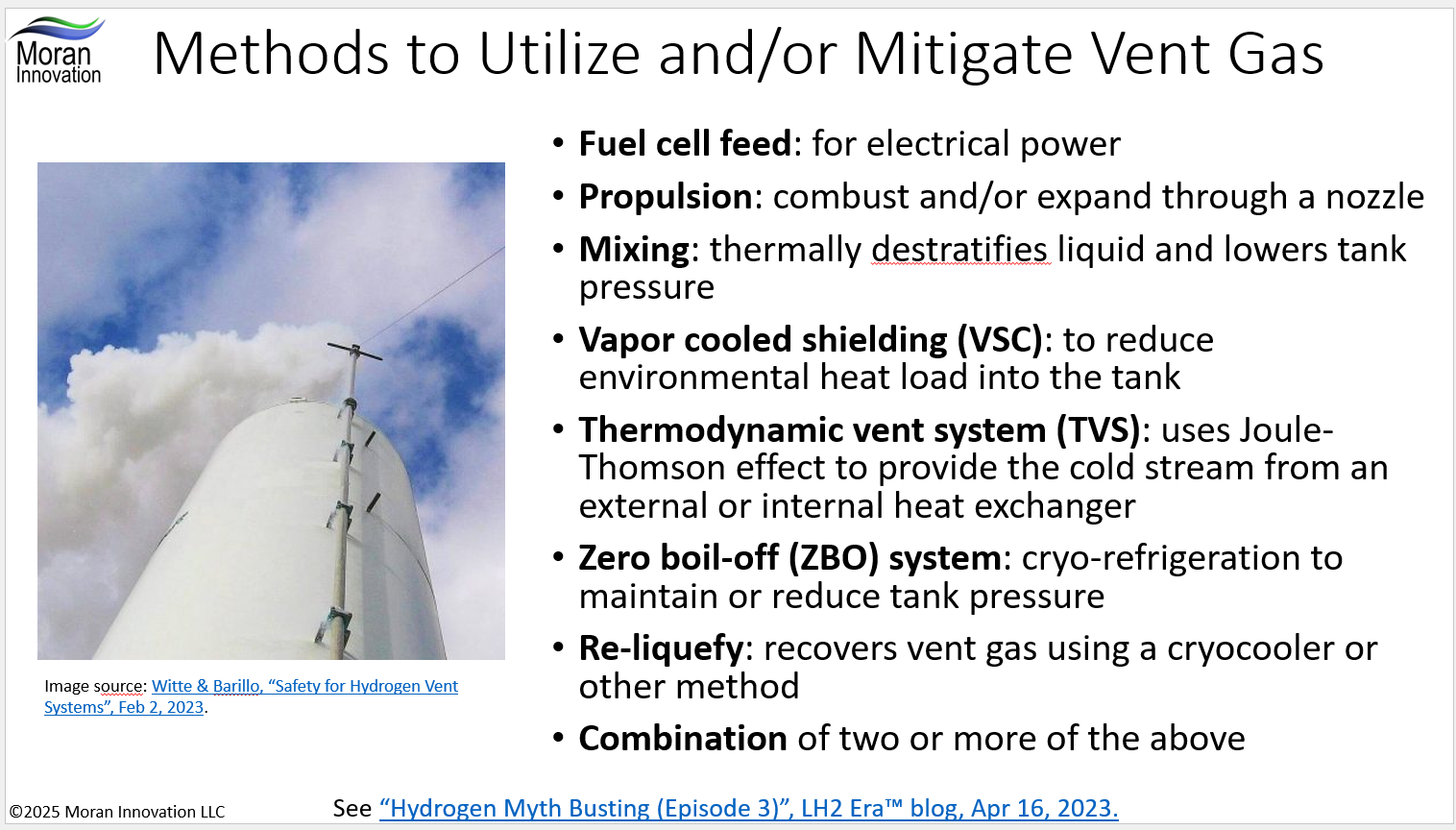
Existing mature cryogenic engineering technologies also enable any LH2 storage and deliver system to have zero boil-off losses. Every LH2 storage system has a characteristic natural boil-off rate profile depending on the size, environment, operations, fill level, and other variables.^^ In all cases, boil-off gas losses can be driven to zero with a combination passive, hybrid, active, and operational techniques. Claims of unavoidable boil-off losses with LH2 systems are false. All boil-off losses are avoidable with proper system design [10].


Changes to aircraft operations, and required airport infrastructure, are also valid considerations [11]. Below is a notional example of how onboard LH2 storage is affected by the acceleration and thermal environments during key aircraft operations. In addition to onboard systems that properly manage LH2, ground support systems must also be in place to support fueling and other associated activities [12]. Various organizations and standards working groups are actively addressing these aspects in preparation for the decades of development required to fully build out the infrastructure [13].


Safety is a paramount consideration with any fuel or energetic system, and hydrogen is no exception. Many codes, standards, training, and certifications are already in place; and many more are under development to address specific use cases and industries. Below is a comparison of key safety relevant properties for hydrogen and natural gas (methane). A few implications that may not be obvious on initial inspection:
  • A given volume of methane has more stored energy for detonation than hydrogen under identical conditions; and its lower bound detonation limit in air is less than one-third that of hydrogen
  • While both gases are lighter than air at ambient temperatures, hydrogen rises much faster (20 m/s or 45 mph) and diffuses much more rapidly in air
  • The lower flammability limit in air (which any safe system is designed to stay well below) and the autoignition temperatures for the gases are not much different
  • However, hydrogen has a much lower ignition energy, much higher upper flammability limit in air, and much higher flame speed

So which fuel is safer? It depends on the situation.# The same can be said for comparing legacy aviation fuels with hydrogen, because each fuel behaves very differently. In a mid-air collision or an emergency landing where the fuel storage is breached, hydrogen (in liquid or gas phase) would be vaporized, gone/diffused, ignited upward, or some combination thereof. And with none of the toxic fumes, smoke/soot, persistent burning pools of spreading liquid, or extended exposure to high temperatures that jet fuel produces.

On the other hand, an undetected fuel leak and potential ignition event is a generally lower risk for jet fuel than it is for hydrogen. However, hydrogen is nontoxic and can be safely breathed as long as its concentration is below asphyxiation levels. Definitely not the case for any legacy aviation fuels. Bottom line: every potential hazard and operational situation requires careful consideration while keeping in mind the unique properties and behaviors of the specific fuel in question.


The Path Forward


Every new energy paradigm shift in history (and every other major technological disruption) has occurred due to market adoption within a supportive policy environment by innovating individuals and teams developing systems and products in the real world. Not on social media. Not in general media opinion pieces or news coverage. And not in peer reviewed articles that ignore information that doesn't fit the predetermined narrative of the authors.

If we had relied on the talkers during previous energy paradigm shifts, we would still be huddled around wood and brush fires. Afterall, a technoeconomic analysis before the industrial revolution could have easily showed that the complexities and costs of extracting fossil fuels and transitioning to their use made no sense compared to burning cheap available wood. And if we rely on today's talkers and delay addressing the existential threats of rising GHGs, public health impacts, and pollution, we will end up dealing with much larger fires and many more calamities at a scale unprecedented in human history.


Footnotes


* For example: ignoring flight demonstrations and testing, alternative aircraft concepts, hydrogen systems state-of-the-art, cryogenic systems integration, propulsion dynamics, regulatory and certification pathways, infrastructure assessments, energy density trades, thermal management, cost projections, etc.

** Note: the so-called 'indirect greenhouse gas' effect of hydrogen is an unproven hypothesis based on unverified assumptions and no atmospheric data at scale. And initial studies into the contrails produced by hydrogen aircraft indicate they dissipate quicker than legacy aviation fuel contrails.

^ The website that documented this information appears to have been taken down by the current administration (https://www.faa.gov/sustainability).

^^ There is no standard value or accurate rule of thumb for estimating natural LH2 boil-off rates despite many sources that attempt to claim otherwise (which is a clear sign of someone lacking experience in this domain).

# Paradoxically, the most infamous historical hydrogen incident would have been much worse with any other fuel under similar conditions: store the fuel in an enormous fabric container with a highly flammable coating; suspend 97 people from it 200 feet (60 m) above the ground; have more people underneath it; allow a lightning strike to ignite the flammable coating; record it with a 1930s era black & white motion camera (that won't record hydrogen flames in daylight, and all the hydrogen is out of the frame within 2 seconds anyway). In the case of hydrogen, it did not detonate nor apparently even ignite any significant amount since there were no water droplets. And 62 of the 97 people onboard survived, with one casualty on the ground. What would be the outcome of repeating that scenario with any other fuel? Or with batteries?

References


[1] "Myth Busting (Episode 4): Hydrogen Haters", LH2era.com, Oct 26, 2023.
[2] "Hydrogen Aviation" Google Scholar search.
[3] Misinformation Hydrogen Zombies, LinkedIn post, Jun 27, 2025.
[4] "Realistic roles for hydrogen in the future energy transition", Johnson, et al., Nat. Rev. Clean Technol. 1, 351–371 (2025).
[6]  "Why All Hydrogen Cost Projections Are Wrong", LH2era.com, Aug 5, 2023.
[7] "List of large aircraft", Wikipedia
[8] "Lifting body", Wikipedia
[9] "Why Liquefy Hydrogen?", LH2era.com, Jun 4, 2025.
[10] "Hydrogen Myth Busting (Episode 3)", LH2era.com, Apr 16, 2023.
[11] "Decarbonizing Mobility with Liquid Hydrogen", SAE Research Report, 2024.
[12] "H2-powered aviation – Optimized aircraft and green LH2 supply in air transport networks", Hoelzen, et al., Applied Energy, Vol. 380, 2025.
[13] "Hydrogen Fueling Stations for Airports, in Both Gaseous and Liquid Form", SAE International, issued Nov 11, 2024.

All graphics are from: Liquid Hydrogen Systems Course, Moran Innovation LLC, 2025.

Author Bio

Matt Moran is the Managing Member at Moran Innovation LLC, and previous Managing Partner at Isotherm Energy. He's been developing power and propulsion systems for more than 40 years; and first-of-a-kind gas, slush, and liquid hydrogen systems since the mid-1980s. Matt was also the Sector Manager for Energy & Materials in his final position at NASA where he worked for 31 years. He's been a cofounder in seven technology-based startups; and provided R&D, engineering, and innovation consulting to several hundred organizations. Matt has three patents and more than 50 publications including his online Cryogenic Fluid Management guide and Decarbonizing Mobility with Liquid Hydrogen SAE report. He has created and taught liquid hydrogen courses, webinars, and workshops to global audiences.


Sunday, January 1, 2023

Moran Innovation 2022 Highlights


  • Cryogenic Fluid Management: Part 1 of this report series has been published and is available online. In-house training based on the material is also available (see Training).
  • Other news. See the Moran Innovation website and blog at LH2era.com for more in depth information and news on hydrogen, propulsion, and power systems.

Matt Moran is the Managing Member at Moran Innovation LLC, and previous Managing Partner at Isotherm Energy. He's been developing power and propulsion systems for more than 40 years; and first-of-a-kind liquid, slush and gaseous hydrogen systems since the mid-1980s. Matt was also the Sector Manager for Energy & Materials in his last position at NASA where he worked for 31 years. He's been a cofounder in seven technology based start-ups; and provided R&D and engineering support to hundreds of organizations. Matt has three patents and more than 50 publications including the Cryogenic Fluid Management report series. He also leads the LH2 Era™ Webinar SeriesMore about Matt can be found on his LinkedIn page.

Sunday, June 5, 2022

The Evolution of Hydrogen Systems: 1930 - 1960


Technological evolution often requires decades of incubation and advancement before large scale commercial adoption is achieved. First discovered as a discrete substance by Henry Cavendish in the late 1700s, hydrogen has followed a circuitous path of discovery and application in a variety of fields.

Its primary large scale commercial use was in the petroleum and chemical industry where it's still a critical element of fossil fuel upgrading processes. Various other industrial processes - including applications as wide ranging as food preparation and semiconductors - use hydrogen.

Although it's been demonstrated in nearly every type of internal combustion engine as a replacement for fossil fuels, it's primary use for power and propulsion (until recently) has been in the aerospace industry.

Liquid Hydrogen


Liquid hydrogen (LH2) has been in routine and continuous use in the space program since the early 1960’s. However, many are not aware that its roots in aerospace trace much further back in aviation to the initial jet engine research and development in the late 1930’s; and later with successful flight demonstrations of a liquid hydrogen fueled jet engine in the mid-1950’s [1].

Initial jet engine testing done by the German's in 1937 used hydrogen in part due to its ease of ignition and high flame speed. First used on a 250 pound thrust (lbf) jet engine operating at 10,000 rpm (and later on a 989 lbf jet engine), hydrogen proved to be an ideal fuel for this new propulsion technology.

About twenty years later, Pratt & Whitney Aircraft developed a jet engine with an afterburner that operated on liquid hydrogen. The project was started in 1956 and resulted in a 4700 lbf jet engine intended for a supersonic reconnaissance aircraft under development by Lockheed. The engine was a success, but the aircraft concept was cancelled in favor of the Blackbird SR-7 development.

Aircraft Flight Testing with LH2


Liquid hydrogen was eventually tested successfully in a series of B-57 flights at the NASA Lewis Research Center from 1956 through 1959. The aircraft was modified with an LH2 tank under one wing; a helium pressurant tank under the other wing; and a heat exchanger to vaporize and warm the hydrogen prior to engine injection.

No modifications were made to the Curtiss Wright J-65 turbojet engines that typically operated on JP-4 (kerosene) fuel. Multiple in-flight tests involved taking off with JP-4 and then switching to hydrogen in one of the two engines during flight to demonstrate various operational conditions.

Three successful flight test campaigns were completed with 38 transitions from JP-4 to hydrogen that thoroughly demonstrated the feasiblity of using LH2 for jet aircraft. In parallel with the flight tests, wind tunnel and fixed engine tests were also performed. The hydrogen jet engines were found to significantly outperform their JP-4 counterparts in terms of engine mass, thrust, stable operation, and fuel consumption.

Beyond Aircraft


Paradoxically, aviation did not become the primary use case for LH2 despite these early successes. However, it did set the stage for LH2 use in rockets and future space vehicles. More on that in the next post.

As a final thought, it is interesting to note that electric cars have followed a similar path. First introduced by Thomas Edison circa 1913, they were initially unable to compete with internal combustion engines. Now both technologies are aggressively competing to overtake fossil-fueled aircraft and vehicles in the marketplace.

References


Matt Moran is the Managing Member at Moran Innovation LLC, and previous Managing Partner at Isotherm Energy. He's been developing power and propulsion systems for more than 40 years; and first-of-a-kind liquid, slush and gaseous hydrogen systems since the mid-1980s. Matt was also the Sector Manager for Energy & Materials in his last position at NASA where he worked for 31 years. He's been a cofounder in seven technology based start-ups; and provided R&D and engineering support to hundreds of organizations. Matt has three patents and more than 50 publications including the Cryogenic Fluid Management report series. More about him can be found here.

Monday, December 20, 2021

Moran Innovation 2021 Highlights

NASA KSC LC39B New Liquid Hydrogen Dewar Tank (left: under construction in 2020, right: near completion in 2021)


  • Hydrogen Systems Development: Past, Present and Future. Seminar presentation to LTA Research on the evolution of hydrogen systems in aerospace along with present day state-of-the-art technologies and future hydrogen systems. A publicly available abstract and version of the presentation package can be found here.
  • Densified and No-Loss (Zero Boil-off) Liquid Hydrogen Systems. An overview of these systems along with safety considerations and proven mitigations presented at the Center for Hydrogen Safety Asia-Pacific Conference 2021. The abstract, video and presentations slides can be found here.
  • Liquid Hydrogen Drones and Microgrids. US Air Force funded project to demonstrate extended duration drones and integrated hydrogen energy storage for base operations under subcontract to NEOEx Systems. A $10 million earmark from the 2022 US federal defense appropriation budget will support further development of liquid hydrogen refueling systems.
  • Lunar Human Landing System (HLS). Support to NASA under subcontract to HX5 as a subject matter expert in cryogenic fluid management for the SpaceX HLS development of the first commercial human lander that will safely carry astronauts to the lunar surface.
  • Long Term Liquid Hydrogen Storage. Support to NASA under subcontract to HX5 for the Lockheed Martin Tipping Point testing of more than a dozen cryogenic fluid management technologies, positioning them for infusion into future space systems.
  • Orbital Cryogenic Propellant Transfer. Support to NASA under subcontract to HX5 for the SpaceX Tipping Point large-scale flight demonstration to transfer cryogenic propellant, specifically liquid oxygen, between tanks on a Starship vehicle.
  • New design tools and training courses. Several new software tools for liquid hydrogen systems and cryogenic fluid management were created in 2021. Training courses on these topic areas are also under development and planned for rollout in 2022.
  • Lunar ice mining concept. "Down Under Excavation and Transport (DUET) Lunar Mining System (LuMiS)", Free J., Cannard S., Sciortino J., Rhatigan J., Haberbusch M., Moran M. Submitted to the NASA Break the Ice Challenge and presented at the 2021 Lunar Surface Science Workshop.
  • Other news. See the Moran Innovation website and blog at LH2era.com for more in depth information and news on hydrogen, propulsion, and power systems.


Matt Moran is the Managing Member at Moran Innovation LLC, and previous Managing Partner at Isotherm Energy. He's been developing power and propulsion systems for more than 40 years; and first-of-a-kind liquid, slush and gaseous hydrogen systems since the mid-1980s. Matt was also the Sector Manager for Energy & Materials in his last position at NASA where he worked for 31 years. He's been a cofounder in seven technology based start-ups; and provided R&D and engineering support to many industrial, government and research organizations. Matt has three patents and more than 50 publications including the Cryogenic Fluid Management report series. More about him can be found here.

Saturday, October 9, 2021

Hydrogen Systems Development: Past, Present and Future


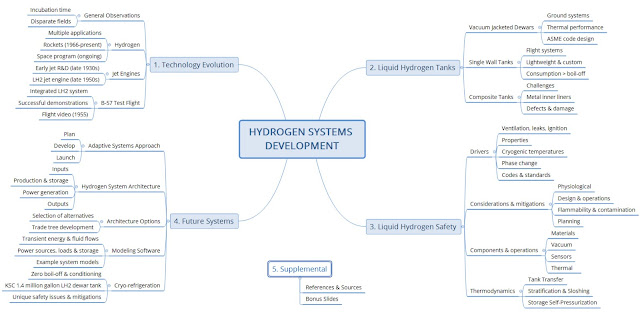
Technological evolution often requires decades of incubation and advancement in a variety of fields before large scale commercial adoption is achieved. Hydrogen has followed these trends since its discovery in the late 1700’s and subsequent application for wide ranging industrial uses. Liquid hydrogen (LH2) has been in routine and continuous use in the space program since the early 1960’s. However, many are not aware that its roots in aerospace trace much further back in aviation to the initial jet engine research and development in the late 1930’s; and later with successful flight demonstrations of a liquid hydrogen fueled jet engine in the mid-1950’s.

Modern LH2 systems make use of vacuum jacketed dewars for long term storage on the ground. Flight vehicles have used single wall tanks with foam insulation which significantly reduces mass but is only viable if the consumption rate in flight is greater than the boil-off venting required to meet tank pressure constraints. Composite LH2 tanks of various types (with or without metal inner liners) have been attempted over the years with mixed success and are still under development.

Safety with LH2 is a paramount priority. Key drivers are related to hydrogen’s properties, LH2 cryogenic temperatures, and liquid-vapor phase change within the system. Many legacy standards, codes and guidelines exist for LH2, and many more are in active formulation or revision. The three primary mantras to remember when designing and operating hydrogen systems is: 1) provide ventilation, 2) prevent leaks, and 3) eliminate ignition sources. Understanding the thermodynamic behavior of LH2 systems during various operations is also critical.

The development of future hydrogen systems can be optimized using an adaptive systems approach that treats hydrogen as a critical enabler in an overall system architecture rather than simply a commodity fuel. Selecting architecture options permit trade studies of candidate system concepts that can be assessed on the basis of technical, economic, environmental impact, and other key performance metrics. The end result is the ability to optimize systems for a multitude of hydrogen applications that can then be modeled, simulated, developed, assembled, and put into operation. Further, the proven ability to eliminate boil-off losses in LH2 systems - and provide better performing and sustainable propulsion and power relative to legacy fossil fuel systems - will play a key role in the global transition to hydrogen


Matt Moran is the Managing Member at Moran Innovation LLC, and previous Managing Partner at Isotherm Energy. He's been developing power and propulsion systems for more than 40 years; and first-of-a-kind liquid, slush and gaseous hydrogen systems since the mid-1980s. Matt was also the Sector Manager for Energy & Materials in his last position at NASA where he worked for 31 years. He's been a cofounder in seven technology based start-ups; and provided R&D and engineering support to many industrial, government and research organizations. Matt has three patents and more than 50 publications including the Cryogenic Fluid Management report series. More about him can be found here.