Translate

Showing posts with label webinar. Show all posts

Tuesday, May 30, 2023

Pre-Test Results for June 2023 LH2 Era™ Webinar Session 3: Zero Boil-Off Case Study


Question 1:

Some of the methods to eliminate venting losses due to boil-off gas (BOG) in liquid hydrogen systems are briefly mentioned here: https://blog.matthewemoran.com/search?q=myth+busting. This is also an example of the last option for me... needing to vent about the persistent myths regarding hydrogen.


Question 2:

Everyone agreed on the last option not being part of systems engineering. Unfortunately some version of that argument is often made when a new project starts. The cost and time impact of the decision often comes back to haunt the project for the remainder of its life. For an example approach to avoid this trap, see: https://blog.matthewemoran.com/2020/08/on-august-24th-i-was-on-forum-360-panel.html


Question 3:


Question 4:

When hydrogen gas is liquefied by bubbling it up through a container of liquid hydrogen, there is no system energy input associated with liquefaction for that isolated process. A lifecycle analysis is required to find the total liquefaction energy for the system based on its lifecycle operations. This would include the liquefaction input energy for the initial LH2 quantity plus any make-up LH2 added over the system lifetime.

The lifecycle analysis should also take into account any cold sink functions that the LH2 enables such as: cooling of various process streams; reduction of environmental heat leak; temperature difference driven power cycles; refrigeration cycles; etc. The resulting lifetime effective energy cost of liquefaction will be higher than zero but less than 20% for many systems.

This is why quoting "energy loss" due to liquefaction as a single value is a misleading figure of merit. In properly designed LH2 operational systems, a significant amount of this "lost" energy is utilized for other functions.


Question 5:

Everyone got this answer right! Unfortunately, most reports and studies still bake in the assumptions of distributed production, storage, and distribution when it comes to hydrogen. This is a remnant of the fossil fuel paradigm that doesn't apply to hydrogen systems that do all of those functions in one place. More on this topic here: https://blog.matthewemoran.com/2023/04/hydrogen-myth-busting-episode-3.html

The ability to produce prodigious quantities of potable water from hydrogen usage is also a significant and unique benefit that is often ignored. Same with the ability to have an isolated renewables microgrid operating anywhere on the globe using hydrogen storage. Additional comments about these aspects can be found here: https://blog.matthewemoran.com/2022/05/energy-shapeshifting-with-hydrogen.html


Question 6:

The answer to this question is 1 W/m^2. More details can be found in Section 3.2 of the Cryogenic Fluid Management report available online here: https://sites.google.com/view/matthewemoran/training#h.ir8xm9d8wn6h

This is a handy value to remember for doing quick assessments of heat load into an LH2 vacuum jacketed dewar (or an LH2 tank in space) with an inch of MLI applied. Equations for the surface area of common tank shapes can be found in Section 3.3 of the same report cited above.


Question 7:

There has been a great deal of inaccurate media coverage about hydrogen being a potential so-called "indirect" greenhouse gas (GHG). This reporting has grossly misrepresented the contents of some recent studies that are based on a series of unproven hypotheses that would require a good deal of research (and funding) to address.

Whether or not scientific investigation of this topic is a good use of research funds is debatable. The one known fact on this topic is that hydrogen is not a GHG. And there are no evidence-based facts to support that it will become an "indirect" GHG of any consequence. More of my thoughts on this can be found here: https://blog.matthewemoran.com/2022/05/hydrogen-myth-busting-episode-2.html


Matt Moran is the Managing Member at Moran Innovation LLC, and previous Managing Partner at Isotherm Energy. He's been developing power and propulsion systems for more than 40 years; and break-through liquid, slush, and gaseous hydrogen systems since the mid-1980s. Matt was also the Sector Manager for Energy & Materials in his last position at NASA where he worked for 31 years. He's been a co-founder in seven technology startups; and provided R&D and engineering support to many organizations. Matt has three patents and more than 50 publications including the Cryogenic Fluid Management series. He also leads the monthly LH2 Era™ Webinar.

Sunday, May 21, 2023

Upcoming LH2 Workshops, Courses, Interviews, and Webinars


There are a number of upcoming liquid hydrogen (LH2) events I'll be involved in over the next several months. Here is a rundown for those who may be interested in watching or participating.

ThinkTech Hawaii Interview: Hydrogen Myths vs Facts


Mitch Ewan, Hydrogen Program Manager at the Hawaii Natural Energy Institute (HNEI), will be interviewing me for this online broadcast. Common myths about hydrogen will be dispelled with facts on the topics of safety, readiness level, leaks, materials, green hydrogen, energy storage, and system losses. The livestream will be on May 25, 2023 at 4pm - 5pm HST at: https://thinktechhawaii.com/.

For those who aren't able to watch the broadcast live, the video is available here: https://youtu.be/vBWHhycEaIY. This is my second interview with Mitch and ThinkTech Hawaii. A recording of the first interview from 2019 can be found here: https://blog.matthewemoran.com/2019/06/thinktech-hawaii-interviews-matt-moran.html

Cryogenic Engineering Conference


This conference is being held July 9-13, 2023 in Honolulu, Hawaii, USA. I may be chairing a session, but mostly going to hear about the latest cryogenic advancements and connect with colleagues. Historically, some of the published papers from this annual conference become seminal references in the field. The conference website is here: https://www.cec-icmc.org/2023/

A description of the conference: "The Cryogenic Engineering Conference (CEC) focuses on the science and engineering required for cryogenic applications. Examples of topics in past conferences include liquefied gases for fuels, space applications of cryogenic liquids, cooling and performance of superconducting magnet systems in medical, transportation, power, and basic research applications, as well as the systems, machinery, control technology and thermodynamics required to produce low temperatures."

Energy & Mobility Conference & Expo


This conference is being held Sep 12-15, 2023 in Cleveland, Ohio, USA. I'm teaching a full day workshop on liquid hydrogen systems at this event with my colleague Wesley Johnson of NASA. Information and registration for the workshop can be found here: https://www.energyandmobility.org/schedule/workshops/liquid-hydrogen-lh2-systems/

A description of the conference: "...a multi-industry international conference focused on energy and modern mobility, with an emphasis on advanced technologies, the challenges of systems integration, autonomy, and related product value chains and business models. All are critical factors enabling the transition to a robust, decentralized and resilient energy sector, the security of our critical infrastructure, and the evolution of mobility via advanced controls and alternative fuels, including Hydrogen, towards energy-efficient, cost-effective and sustainable solutions."

Flying HY ("The World's Largest Hydrogen Aviation Event")


This event is being held October 10-11, 2023 in Grand Forks, North Dakota, USA. I'll be teaching a half day hydrogen aviation course along with Danielle McLean, Founder & CEO of HYSKY. More information can be found here: https://www.hysky.org/news-events

Danielle and I are also tentatively planning to teach a full day version of the course at the Transformative Vertical Flight meeting February 6–8, 2024 in Santa Clara, California, USA. More details will be coming later this year. The meeting website is: https://vtol.org/tvf2024


LH2 Era™ Monthly Webinar Series


This online global webinar series focused on liquid hydrogen systems (and broadcast on the first Thursday of every month) continues with a zero boil-off case study session on June 1, 2023. The following month's session on July 6, 2023 will address the topic of liquid hydrogen integrated into grid, microgrid, and other multi-function architectures and system of systems applications.

The guest speakers for these next two sessions will be Norbert Palenstijn of Leybold USA Inc; and Dr. Ngalula Sandrine Mubenga, Assistant Professor at the University of Toledo, and Founder & President of STEM DRC Initiative. More information and free registration for this webinar series can be found at: https://sites.google.com/view/matthewemoran/training


  • Matt Moran is the Managing Member at Moran Innovation LLC, and previous Managing Partner at Isotherm Energy. He's been developing power and propulsion systems for more than 40 years; and break-through liquid, slush, and gaseous hydrogen systems since the mid-1980s. Matt was also the Sector Manager for Energy & Materials in his last position at NASA where he worked for 31 years. He's been a co-founder in seven technology startups; and provided R&D and engineering support to many organizations. Matt has three patents and more than 50 publications including the Cryogenic Fluid Management series. He also leads the monthly LH2 Era™ Webinar.

Tuesday, May 2, 2023

Pre-Test Results for May 2023 LH2 Era™ Webinar Session 2: Hydrogen Evolution

Image credit: NASA


Question 1:


The primary goal of the LH2 Era™ monthly webinar series is to provide accurate and actionable information to ensure robust, high performance, and operationally safe liquid hydrogen systems: https://sites.google.com/view/matthewemoran/training#h.cse56tn4ffmk

Meeting that goal requires assessing your current awareness about hydrogen systems and then leveling up by participating in the webinar. Take this poll to see where you are in an adapted version of the Gartner hype cycle: 1. Initial Exposure, 2. Inflated Expectations, 3. Disillusionment or Misinformation, 4. Pragmatic Productivity


Not necessarily followed by all technologies (or even most), and not generally applicable to hydrogen since it's been around a very long time. Interesting to compare though...


Question 2: 


I can neither confirm nor deny the unicorn answer, but there seems to be a consensus on glitter and rainbows on the internet. And that's how the first three myths probably got started too...


Question 3: 


300 series stainless steel is the most common structural material used for all types of hydrogen service. However, note that 400 series stainless steel has a ductile to brittle transition temperature (DBTT) above liquid hydrogen temperature so is generally not suitable for cryogenic service in this range.

Aluminum alloys are historically the second most common structural material for hydrogen service. Some very recent research papers are suggesting there may be some hydrogen embrittlement possible at very high pressures. I've never witnessed nor heard of this issue in any operational system, but something to stay up to date on as more data becomes available.

Teflon can be used as a seal material or gasket for liquid hydrogen service since it still cold flows at these temperatures. Other seal material options are also appropriate depending on the application.

Cotton canvas infused with highly flammable chemicals was used for hydrogen containment in an infamous dirigible more than 85 years ago. This is an inappropriate material choice for any lifting gas (hydrogen, helium, hot air, etc.) since an electric discharge can set the entire structure aflame: https://blog.matthewemoran.com/2022/04/hydrogen-myth-busting-episode-1.html


Question 4: 


The answer to this one is over a decade as of the time I visited UT Austin several years ago. This of course speaks to the myth about hydrogen leaking though everything. Methods and materials to mitigate hydrogen leaks are very well established and have been operationally validated with liquid hydrogen systems in continuous use since the 1960s.

The first answer is not relevant but nonetheless also true. I did a bar (pub) crawl with my oldest son years ago when he lived there during the city's annual SXSW festival. We gave up before reaching the last stop but had a great time :)


Question 5: 


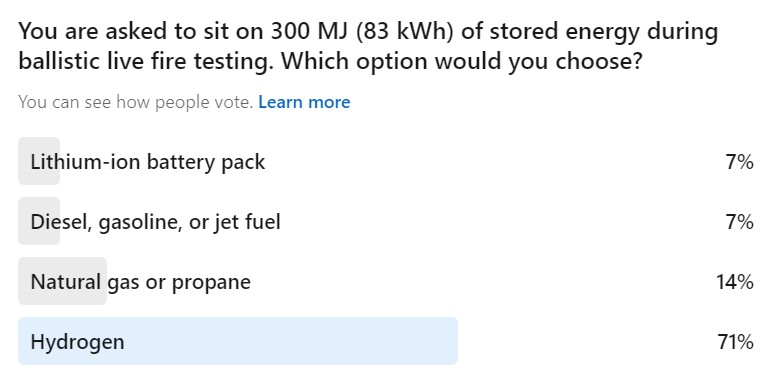
I've been driving my battery electric vehicle (BEV) for 18 months sitting on top of a lithium-ion battery pack with this quantity of energy storage. But if live rounds were being fired at it (or the battery compartment was damaged in a collision) I'd abandon it and get far away as quickly as possible. Li-ion batteries are subject to thermal runaway if any of the cells are crushed or penetrated, resulting in that energy being rapidly released and leaving behind a smoldering melted mass.

For the fossil fuel options, there are at least three serious hazards in this scenario: 1. ignition (conflagration or detonation); 2. inhalation of toxic fumes or smoke; 3. asphyxiation. The liquid fuels also spread quickly along the ground if the containment is breached, significantly increasing the physical area of risk exposure. Propane is heavier than air so it increases the physical volume of risk exposure. Natural gas is lighter than air so will eventually dissipate unless confined. Both gases pose a significant detonation hazard in this scenario.

In the case of compressed gaseous hydrogen, this scenario has already been tested on composite overwrap (COPV) pressure vessels (without the bystander). From the conclusion section of the test report: "When penetrated by AP [armor piercing] rounds, the cylinder will vent quickly without producing a flame. The cylinder will not catastrophically fail when pierced by a round, retaining its structural integrity and venting its contents safely."


Also note that hydrogen is not toxic, and is actually used as a breathing gas with oxygen (hydrox) for very deep diving. At ambient temperature in air, it rises at a rate of 20 m/s. And it produces no smoke nor soot when it burns.

Liquid hydrogen (LH2) was not tested in the cited report. LH2 in this scenario would vaporize very quickly if the containment vessel is breached and begin rising as it quickly warms up. Liquefied natural gas (LNG) would behave similarly, but would vaporize and rise much more slowly than LH2.


Question 6: 


Section 3.3 of the passive Cryogenic Fluid Management report provides a detailed comparison of these options. See: https://sites.google.com/view/matthewemoran/training#h.p_0kmGtNXJhZlO

The most common insulation historically for vacuum-jacketed dewar tanks is perlite powder. It has been used in many over-the-road truck trailer vessels and stationary vessels including the large LH2 spherical dewar tank built in the 1960s that supported the Apollo and space shuttle programs. It is comparatively inexpensive and has moderate thermal performance in a hard vacuum in comparison to the other options. However, perlite has a tendency to settle over time and uncover the upper portions of the vacuum space thereby increasing the heat load.

Glass microspheres have slightly better thermal performance than perlite and are not as prone to settling. They are also relatively inexpensive and were used on the new spherical LH2 dewar tank that is 50% larger than the previous tank used for space shuttle launches. 

Aerogel beads or blankets do not perform as well as perlite or glass microspheres in a hard vacuum jacket, but are better performing than those options at soft vacuum or atmospheric pressure. Aerogel insulation is more costly but may be a suitable choice for situations where thermal performance is needed in varying atmospheric and vacuum environments (e.g., a tank that is launched in normal atmosphere and then is in the vacuum of space for some period of time).

Multilayer insulation (MLI) is the best performing option in a hard vacuum jacket. It is comprised of reflective thermal shields separated by low conductivity high porosity spacer materials (e.g., double aluminized mylar with dacron net spacers). The thermal performance of MLI is affected by a number of parameters including appropriate installation and close-outs. It is the most expensive of the options shown, and is used in high performance vacuum-jacketed stationary storage tanks and various types of tanks in spacecraft applications.

Spray on foam (SOFI) provides moderate thermal performance in a normal atmosphere but has very poor performance in vacuum conditions. It is among the most inexpensive options and has been used on launch vehicle tanks and the space shuttle external tank. SOFI is not generally appropriate for stationary LH2 tanks but can be a suitable option for higher temperature cryogens depending on the use case (e.g., methane, oxygen, nitrogen, etc.).


  • Matt Moran is the Managing Member at Moran Innovation LLC, and previous Managing Partner at Isotherm Energy. He's been developing power and propulsion systems for more than 40 years; and break-through liquid, slush, and gaseous hydrogen systems since the mid-1980s. Matt was also the Sector Manager for Energy & Materials in his last position at NASA where he worked for 31 years. He's been a co-founder in seven technology startups; and provided R&D and engineering support to many organizations. Matt has three patents and more than 50 publications including the Cryogenic Fluid Management series. He also leads the monthly LH2 Era™ Webinar.

Sunday, April 23, 2023

Hydrogen Evolution: LH2 Era™ Webinar Series May 2023 Session


Our first webinar session last month (April 2023) was well attended. We had participants from 19 countries, 37 industry sectors, 71 organizations, and with 67 different job titles. Demographics from the April session can be viewed here:

Videos and slides from the April session can also be accessed at the above link up until the next session starts on May 4th. Sponsors have access at any time during their subscription to videos, slides, and Q&A recordings from all of the sessions.

The topic for next session is the evolution of liquid hydrogen technologies and systems. A summary of the subtopics is shown in the above graphic.

If you registered for the previous session you should have already received a calendar invite and link to connect for the May session (unless you cancelled your registration). New participants can register here for free:

Based on feedback from the previous session, making a few changes to improve the audience experience and engagement:
  • Captioning for the presentation and guest interview
  • Larger slide visuals and less "talking heads"
  • Chat enabled throughout the session
  • Option to raise hand and be unmuted for questions during Q&A

The anonymous Q&A option and cameras disabled feature will remain for those who prefer to stay in semi-stealth mode. Hope to see more people and more countries represented at the next webinar session!

  • Matt Moran is the Managing Member at Moran Innovation LLC, and previous Managing Partner at Isotherm Energy. He's been developing power and propulsion systems for more than 40 years; and break-through liquid, slush, and gaseous hydrogen systems since the mid-1980s. Matt was also the Sector Manager for Energy & Materials in his last position at NASA where he worked for 31 years. He's been a co-founder in seven technology startups; and provided R&D and engineering support to many organizations. Matt has three patents and more than 50 publications including the Cryogenic Fluid Management series. He also leads the monthly LH2 Era™ Webinar.

Sunday, March 19, 2023

Pre-Test Results for April 2023 LH2 Era™ Webinar Session 1: Introduction to Hydrogen


LinkedIn Poll Results and Correct Answers

Below are the pre-test questions for April's session along with the LinkedIn poll results and correct answers. Follow me on LinkedIn if you'd like to test your hydrogen knowledge and see how others vote in real time.


Questions 1 and 2:

Answer:

Gaseous hydrogen was the first fuel used for the pioneering work in jet engine research in the 1930's. The first successful liquid hydrogen fueled jet aircraft flights were done in the 1950's. A liquid hydrogen fueled jet engine with an afterburner was also successfully developed and ground tested in the 1950's. More details can be found here: https://blog.matthewemoran.com/2021/10/hydrogen-systems-development-past.html

In the 1960's, liquid hydrogen made it's operational rocket debut in the Centaur upper stage and subsequently became the workhorse propellant for many launch vehicles (including the space shuttle). Modern operational launch systems using liquid hydrogen besides Centaur and other upper stages include: NASA's new Space Launch System, the Ariane 5 (and soon 6), the JAXA H3, and several variants and stages of the Long March rocket family.

As a result, the space industry has evolved the requisite technology and operations required for large scale liquid hydrogen systems over the past six decades. Meanwhile, aviation is returning to its (sometimes forgotten) roots to decarbonize air travel and improve performance using hydrogen.


Questions 3:

Answer:

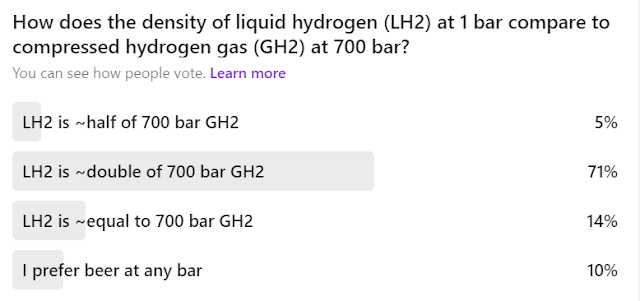
Liquid hydrogen (LH2) at 1 bar saturated conditions has a density of 71 kg/m^3. Compressed hydrogen gas (GH2) at 700 bar and ambient temperature (27 C) has density of 39 kg/m^3. So LH2 has nearly double the density of compressed GH2 at these conditions. More information can be found here: https://blog.matthewemoran.com/2016/03/storing-energy-in-form-of-hydrogen.html.

Extra credit for the beer at any bar votes...


Question 4:

Answer:

Only a couple of years ago the correct answer would have been the large spherical liquid hydrogen dewar tank used for the NASA shuttle launches for decades which is ~3200 cubic meters. And hopefully in the not distant future the answer will be the newly designed (but not yet operational) large shipping dewar tanks of ~20000 cubic meters.

But as of now, the correct answer is the recently commissioned dewar tank at NASA KSC supporting the Artemis program (~4700 cubic meters). This link has some information on it and the role I played in it's design: https://blog.matthewemoran.com/2018/05/no-loss-liquid-hydrogen-and-lng-systems.html

And thank you for the dad joke votes...

Question 5:

Answer:

Any answer is arguably correct on this question (see: https://blog.matthewemoran.com/2016/02/a-hydrogen-system-architecture-for.html). Generating hydrogen by water electrolysis produces oxygen as a "byproduct" which can be released to ambient air, used locally, or stored for later use or sale.

When hydrogen is used in a fuel cell or combusted, significant quantities of water are produced. With proper material selection and handling, the water can be used for drinking, agriculture, and many other purposes.

Waterworld was a post-apocalyptic 1995 movie premised on the melting of the polar regions due to global warming. This future (hopefully) fictional world is completely covered by oceans, and Kevin Costner's character has gills. Basically, Mad Max with boats instead of all-terrain vehicles....


Question 6:

Answer:

Any answer is correct on this question, but "all of the above" is the most correct (see: https://blog.matthewemoran.com/2016/03/previous-posts-introduced-isotherms.html). The wisdom of the crowd prevails this time.

Most people already know that electrolysis of water produces hydrogen. In addition to fresh water, it is feasible to use seawater, waste water, and even urine (animal or human) with the appropriate processing and design. Waste biomass from agriculture, livestock, and other sources can also be processed to extract hydrogen.

Likewise with methane (the primary constituent in natural gas), coal, and other hydrocarbons, although carbon capture is a key consideration. Cows and other ruminant animals are prodigious producers of methane (from both ends). As a soymilk drinking vegan most of the time, I say free all the cows but harvest their emissions! A win-win for both species.


Question 7:


Answer:

The correct answer to this question hinges on the interpretation of "at scale". It was intended to mean commercially available at a physical equipment scale that is competitive with legacy options, and has already been deployed in operational systems. Based on that meaning of at scale, both fuel cells and hydrogen turbines for power generation are correct.

A system architecture take on it can be found here: https://blog.matthewemoran.com/2016/03/power-generation-and-outputs-from.html

For those who interpreted at scale to mean fully adopted as the dominant solution, that hasn't occurred yet in most industry sectors. Accelerating that transition is paramount to addressing the existential threat of continued fossil fuel usage.

(According to the "Back to the Future" movies, Dr. Emmett Brown's flux capacitor runs on various fuels including garbage. Perhaps hydrogen will be in the mix too. Guess we will have to wait until the future arrives to find out...)


Question 8:

Answer:

My answer to this question is none. Below is the reason why, and more can be found here: https://blog.matthewemoran.com/2022/04/hydrogen-myth-busting-episode-1.html. It would be interesting to hear others' thoughts in the comments about which specific technology gaps they believe exist.

NASA, where I spent most of my career, defines a technology gap as the difference between a capability needed to *enable* a future mission and the current state-of-the-art. In contrast, an *enhancing* technology improves some aspect of a mission but is not required for it to be fulfilled. 

Based on that mental model, there are no existing technology gaps for the use of liquid hydrogen as a replacement for fossil fuels. That said, there are certainly a plethora of enhancing technologies that could improve the performance and economics (e.g., new materials, better cryocoolers, improved insulation, etc.).

However, all the technology necessary to implement liquid hydrogen systems to replace fossil fuels already exists. Capital investments, domain knowledge, and good engineering are what's needed. Favorable public policy and regulations also helps to accelerate the transition.


Homework and Upcoming Session


If you didn't get a chance to do the reading assignment, it can be accessed here: The Infinity Fuel for a Sustainable Future. And the viewing assignment is available here: Online Resources for the LH2 Era™ Webinar Series

To participate in next month's pre-test poll, follow my posts on LinkedIn. And to get details and register for the next LH2 Era™ webinar visit HERE.


Matt Moran is the Managing Member at Moran Innovation LLC, and previous Managing Partner at Isotherm Energy. He's been developing power and propulsion systems for more than 40 years; and first-of-a-kind liquid, slush and gaseous hydrogen systems since the mid-1980s. Matt was also the Sector Manager for Energy & Materials in his last position at NASA where he worked for 31 years. He's been a cofounder in seven technology based start-ups; and provided R&D and engineering support to hundreds of organizations. Matt has three patents and more than 50 publications including the Cryogenic Fluid Management report series. He also leads the LH2 Era™ Webinar SeriesMore about Matt can be found on his LinkedIn page.

Saturday, March 11, 2023

Online Resources for the LH2 Era™ Webinar Series


These two video clips provide a quick overview of the online resources available at www.moraninnovation.com that support this liquid hydrogen webinar series. Please ignore the cursor placement in the videos; there's a strange offset and lag time in the recordings for some reason. Sometimes building liquid hydrogen systems is easier than talking about them... :)


Matt Moran is the Managing Member at Moran Innovation LLC, and previous Managing Partner at Isotherm Energy. He's been developing power and propulsion systems for more than 40 years; and first-of-a-kind liquid, slush and gaseous hydrogen systems since the mid-1980s. Matt was also the Sector Manager for Energy & Materials in his last position at NASA where he worked for 31 years. He's been a cofounder in seven technology based start-ups; and provided R&D and engineering support to hundreds of organizations. Matt has three patents and more than 50 publications including the Cryogenic Fluid Management report series. He also leads the LH2 Era™ Webinar SeriesMore about Matt can be found on his LinkedIn page.

Wednesday, March 8, 2023

LH2 Era™ Monthly Webinar Series Invitation


Hello, my name is Matt Moran. I've been developing, designing, and building liquid hydrogen (LH2) systems since the mid-1980s. My company, Moran Innovation, sponsors the global LH2 Era™ Webinar series.

This monthly webinar addresses the critical need for actionable knowledge on liquid hydrogen as the world transitions away from fossil fuels. Each month we will focus on a different topic for an hour of presentations, guest interviews, and Q&A.

Webinar content will draw from decades of experience with liquid hydrogen, as well as picking the brains of our expert guest speakers. The goal is to provide actionable knowledge for developing robust, high performance, and operationally safe systems.

Let's build a better future together with hydrogen! For more details and to join in the global conversation for free, please visit www.moraninnovation.com. Thank you.


Matt Moran is the Managing Member at Moran Innovation LLC, and previous Managing Partner at Isotherm Energy. He's been developing power and propulsion systems for more than 40 years; and first-of-a-kind liquid, slush and gaseous hydrogen systems since the mid-1980s. Matt was also the Sector Manager for Energy & Materials in his last position at NASA where he worked for 31 years. He's been a cofounder in seven technology based start-ups; and provided R&D and engineering support to hundreds of organizations. Matt has three patents and more than 50 publications including the Cryogenic Fluid Management report series. He also leads the LH2 Era™ Webinar SeriesMore about Matt can be found on his LinkedIn page.

Thursday, March 2, 2023

Webinar Session 1: Introduction to Liquid Hydrogen

Click above image for more details and free registration


Matt Moran is the Managing Member at Moran Innovation LLC, and previous Managing Partner at Isotherm Energy. He's been developing power and propulsion systems for more than 40 years; and break-through liquid, slush, and gaseous hydrogen systems since the mid-1980s. Matt was also the Sector Manager for Energy & Materials in his last position at NASA where he worked for 31 years. He's been a co-founder in seven technology startups; and provided R&D and engineering support to many organizations. Matt has three patents and more than 50 publications including the Cryogenic Fluid Management series. He also leads the monthly LH2 Era™ Webinar.

Thursday, February 23, 2023

Liquid Hydrogen (LH2) Webinar Series


WHY

Liquid hydrogen (LH2) systems are being developed for a multitude of applications to decarbonize and to enable a secure and sustainable future. The demand for knowledge on this topic is high, but the supply of experienced practitioners is limited. There is a strong need for accurate and actionable information to ensure robust, high performance, and operationally safe LH2 systems.

WHAT

This webinar series will address key topics related to the design, development, and operation of integrated liquid hydrogen systems. Matt Moran will lead the discussion. He has been developing, building, and operating liquid hydrogen systems for spacecraft, rockets, aircraft, marine vessels, transportation, grid/microgrid, and large scale storage applications since the mid-1980s.

WHEN

The monthly series will be held on the first Thursday of every month at 2pm ET beginning on April 6, 2023.  Repeat sessions will be held on the second Thursday at 9am ET and third Thursday at 9pm ET of every month to accommodate global participants in different time zones. Each session will consist of approximately 30 minutes of presentation, a 15 minute guest speaker interview, and 15 minutes of questions and answers (Q&A) with the audience.

HOW

Liquid hydrogen topics to be covered in this webinar series include: Introduction, Evolution, Fundamentals, State-of-the-Art, Safety, Advancements, Applications, Systems, Strategy, Implementation, and other topics based on participant feedback. There is no charge to register and participate in this webinar series. Click here for more information and to register.


Matt Moran is the Managing Member at Moran Innovation LLC, and previous Managing Partner at Isotherm Energy. He's been developing power and propulsion systems for more than 40 years; and first-of-a-kind liquid, slush and gaseous hydrogen systems since the mid-1980s. Matt was also the Sector Manager for Energy & Materials in his last position at NASA where he worked for 31 years. He's been a cofounder in seven technology based start-ups; and provided R&D and engineering support to hundreds of organizations. Matt has three patents and more than 50 publications including the Cryogenic Fluid Management report series. He also leads the LH2 Era™ Webinar SeriesMore about Matt can be found on his LinkedIn page.